The public sector's ability to meet the investment challenge
1.3 There was a general view, accepted by the Government, that there had been decades of underinvestment in the Tube, adversely affecting train service reliability and passenger comfort. In 1997, the Department and London Underground estimated that the present value of the funding required, just to overcome the maintenance backlog, was between £1,000 million -£1,500 million.
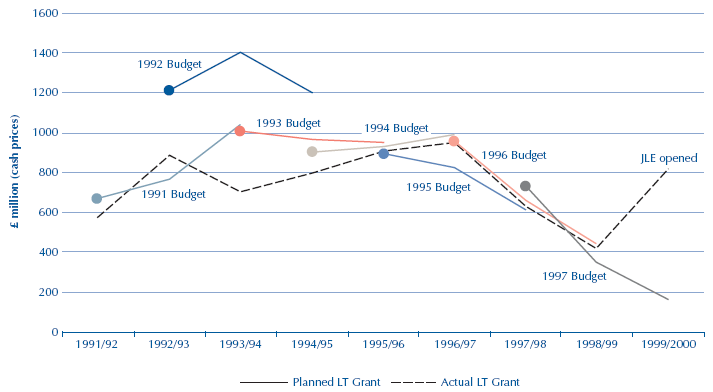
1.4 The investment that had taken place had suffered from budgetary uncertainty. As with all public sector bodies, every year London Underground submitted budget requests looking forward three years. The process resulted in a firm budget for the first year and provisional budgets for the following two years. In repeating the process in year 2, there was considerable uncertainty about whether the company's actual budget for that year would even be close to the provisional figure agreed in Year 1 (Figure 2). This annual funding uncertainty compromised planning and execution of infrastructure investment. When budgets were cut, projects were not only postponed but also curtailed. This often meant that synergies between planned expenditure could not be realised fully. When unused or excess funds were available projects that could be carried out quickly were rushed through.
1.5 The gestation of the PPP business structure occurred when public sector investment in the Tube was higher than average because of funding for the Jubilee Line Extension Project. This ambitious project, managed by London Underground, was running £100s of millions over budget, and two years late. Although this type of project was excluded from the PPP, more comparable was London Underground's attempt to upgrade the Central Line in the 1990s. This had failed to deliver, in full, the desired improvement in journey times. As a consequence, there was little Government confidence that the management of London Underground could be relied on to manage the infrastructure investment on the scale needed to modernise the Tube. Nor was London Underground management thought to be in a position to reduce the risks that it retained under conventional contracts sufficiently to cover the economic costs of failure, e.g. the consequences of late delivery and non-performance.
|
2 |
|
Uneven grant levels |
|
|
|
Stop-start funding levels made investment planning erratic and inefficient. |
|
|
|
|
|
|
|
NOTE All figures for total London Regional Transport grant, including Jubilee Line Extension, bus etc as well as 'core' London Underground. Source: Department for Transport. |