Affordability constraints
2.14 Over the period since 1999, London Underground's original engineers' estimates of £13,300 million for base costs had increased, once allowance had been made for risks, to a range of £15,000 million to £17,300 million. This increase was attributed to investigations that found that the state of some of the assets was worse than expected and required more remedial work. Although it did not disclose these cost findings to bidders, London Underground concluded that the increased base costs and contingency used in the BAFO bids, which also came in higher than expected, were mostly reasonable.
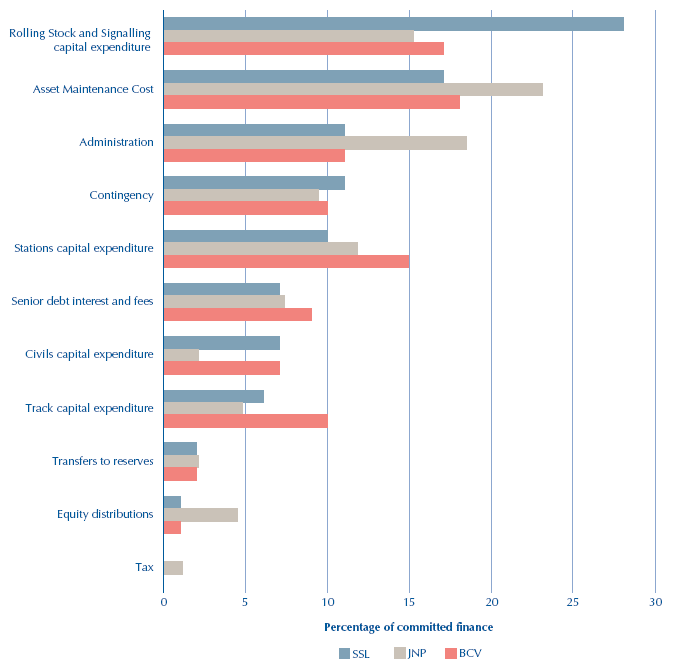
2.15 The two BAFO bids for Infraco JNP contained considerable increases in contingencies for risk over those included in earlier submissions following the invitation to tender, bringing the level in these bids more into line with Metronet's provisions on the other Infraco bids (see Figure 9). Metronet's later revised BAFO bid (para 2.17), however, had lower exposure to risk because it could seek a price revision if adverse conditions, unrelated to the risks transferred under the contract, reached £50 million, instead of the higher threshold of £200 million originally sought by London Underground, and retained for the first 7½ years in the Tube Lines bid.
|
9 |
|
Uses of Finance |
|
|
|
|
|
|
|
Source: Metronet and Tube Lines Information Memoranda (1/2003 and 5/2002) |
2.16 The magnitude of the infrastructure service charges included in these bids and the estimated ISC for Infraco SSL (before receipt of BAFO bids) increased the grant requirement. Another factor contributing to affordability concerns was a deteriorating view of London Underground's operating profit projections for the first 7½ years. This annual surplus of some £450 million (Appendix 3, Figure 3.3) reduced the amount of grant needed. The assumption that this would remain was to prove too optimistic, but was accepted by the Department following advice from Ernst & Young that London Underground's forecasting was generally robust. Continuation of a surplus depended on the favourable prevailing trend of operating costs growing less than revenues. In fact, the trend reversed so increasing the call on grant to meet the charges.
2.17 As a result, London Underground re-profiled the timing of investment for the PPP by delaying some key service improvements and asked bidders for the deep tube Infracos to revise their BAFO offers thereby delaying the procurement by five months. Affordability continued to be under review during the post BAFO negotiations. In February 2002, Metronet submitted its Committed Finance Offer (CFO) for the sub-surface line revealing a shortfall against planned funding levels, or affordability shortfall, of some £55 million a year. Based on cost- benefit appraisal by London Underground, the Department therefore decided that Metronet's proposal to upgrade the sub-surface line two years early be declined, reducing the affordability shortfall to some £40 million. This was offset by an overall increase in costs for the SSL over the 30 year period of £827 million (10 per cent), which included additions to train maintenance, and to signals and control maintenance costs on the SSL prior to the delayed first upgrade. Following a similar appraisal, the Department decided, however, that the upgrade on Metronet's deep tube Victoria Line bid should go ahead as proposed.
2.18 All in all, after some de-scoping of the BAFO requirements, the grant requirement for the Tube was estimated at some £900 million a year for the first 7½ years of the contract. The Department and London Underground throughout had been careful to avoid a disclosed ceiling becoming a bid target. Bidders became aware of an affordability constraint only when, at BAFO, their bids breached the Government's affordability threshold. At this stage London Underground issued guidance giving short term affordability constraints for the first 3 and 7½ years which deferred the rate of recovery from the maintenance backlog. (see Figure 7 on page 17) These targets reduced London Underground's forecast annual grant requirement by £80 million.