Some authorities have found their perception of value for money has changed since contract letting
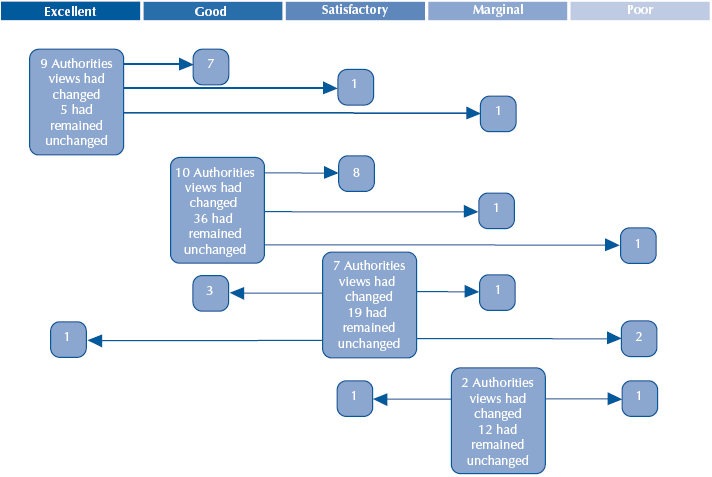
3.39 There has been a slight decline, however, in perceived value for money since contracts were let. Some 86 per cent of authorities considered that the value for money of their PFI projects at the time of contract letting was satisfactory or better, 14 per cent said it was marginal and none said it was poor. 23 authorities (23 per cent of authorities who gave us their current perception of value for money), considered that value for money was not as good as at contract letting although in two thirds of these cases the authority still considered value for money to be at least satisfactory (Figure 36). Authorities gave a variety of reasons for the change in perception. These included high charges for additional services, user dissatisfaction and expected benefits not being realised (Figure 37). 5 authorities (5 per cent of authorities which gave a perception) considered value for money had improved.
35 |
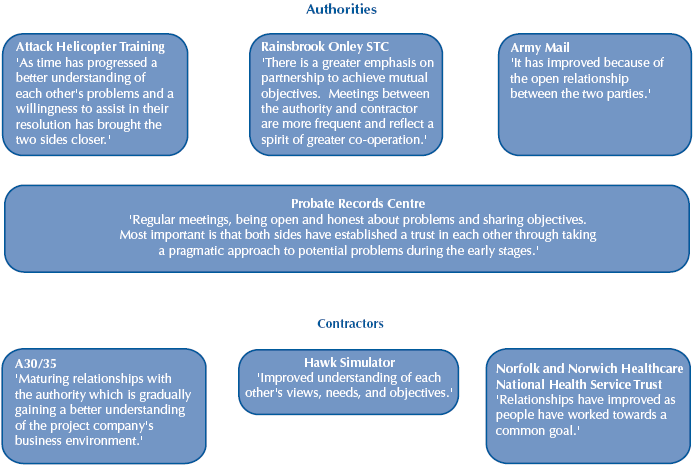
| Examples of how relationships have improved |
|
|
|
|
| Source: National Audit Office survey of authorities and contractors |
36 |
| Changes in authorities' perception of value for money to be gained from their projects |
|
|
|
|
| NOTES 1. In total the perception of value for money has changed since contract letting in 28 projects (28 per cent of the authorities who gave us their current perception). In 23 projects (23 per cent of the authorities who gave us a current perception) perceived value for money has decreased. In 5 projects (5 per cent of the authorities who gave us a current perception) it has increased. 2. In 16 (70 per cent) of the 23 cases where value for money was perceived to have decreased since contract letting, value for money was still considered to be satisfactory or better. Source: National Audit Office survey of authorities |
37 |
| Examples of why perceived value for money has decreased |
|
|
|
|
| ELGAR (IT) - Excellent to Good |
|
| 'On the standard infrastructure service, value for money is still 'excellent'. For new services, in a non-competitive situation, value for money is 'good' but allowances for profit, overheads and financing charges, together with contingency to cover risk, have increased the customer perspective that charges are 'too high' and more detailed scrutiny of overall value for money by the authority. Inevitably, this has brought a sharper focus on the 'bottom line' by the contractor'. |
|
| RAF Mail - Excellent to Marginal |
|
| 'The performance of the contract, in terms of user satisfaction and take-up is not a consideration of the contractor, and much work has been needed by the authority to provide a satisfactory level of service.' |
|
| TAFMIS - Good to Satisfactory |
|
| 'Delays in take up of the system, leading to delays in the pursuit of hard benefits'. |
|
| AFPAA - Good to Poor |
|
| 'The contract has failed to deliver to MOD the expected business benefits while also failing to provide the contractor with the expected financial return. This is currently being addressed by a reconstruction of the contract'. |
|
| Source: National Audit Office survey of authorities |
3.40 In a large population of projects, it is not surprising that some would not work out as well as expected. Nevertheless, in such cases, authorities and contractors should together determine the reasons for value for money being less than had been anticipated and what needs to be done to improve it. Such an assessment may lead to changes within contracts and perhaps the behaviour within the relationship for both parties. Departments may need to get involved in this process. There may be common issues which have lead to a deterioration of performance across a number of projects and lessons should be disseminated.
3.41 The fact that perceptions of value for money have changed in 28 per cent of the projects surveyed highlights the need for authorities to establish methodologies for regularly assessing the value for money of each PFI project in progress to ensure that value for money continues to be delivered. This assessment should consider information on performance and pricing available from the contract monitoring procedures. It should also take account of feedback from users as part of a consideration of how well the contract is meeting the authorities' current and expected requirements. This overview of value for money will assist authorities in determining action which may be necessary in their relationship with the contractors on the project being assessed and also relationships with contractors on other existing projects and those under procurement.