Operational performance of the deal
1.18 From April 2003, when the two Metronet contracts entered into force, Metronet achieved the main contractual benchmarks of operational performance: availability, capability and ambience. The 'availability' benchmark was set five per cent lower than previous performance, however, to facilitate the introduction of a structure with incentives to improve performance. Benchmark levels for 'capability' and 'ambience' were above previous performance. Metronet did not, however, meet higher targets it had set itself as part of its business strategy.
1.19 Metronet had problems in delivering its capital works programme to time and within the costs bid. These problems were partly due to Metronet's governance structures and tied supply chain arrangements, which meant suppliers had power over some of the scope of work and expected to be paid for it under their supply contracts. Suppliers also failed to give Metronet's management complete and timely information about costs against delivery.
3 | Metronet's tied supply chain |
Source: National Audit Office | |
NOTE Simplified representation of stakeholder relationships. | |
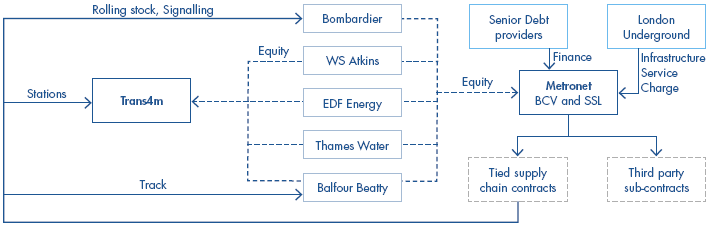
1.20 In particular, Metronet delivered its station refurbishment programme late and over budget. By March 2005 Metronet had not completed any of the eight stations due. Only 11 out of 35 stations were accepted as delivered by March 2006 and 28 out of 64 by March 2007. London Underground took steps to revise station programme procedures to improve progress. Metronet's five shareholders were initially unable to agree, however, on decisive action to resolve delivery and cost problems (see Appendix 5).
1.21 Metronet responded by investing more heavily on stations work from 2006 onwards. To this end, it agreed to borrow an extra £322 million between October 2006 and March 2007, engaging external contractors to deliver stations. Lenders agreed, and increased their scrutiny, although it meant Metronet would exceed the upper spending limit in its loan agreements.
1.22 Ambiguities in scope, poor programme management and delays led to significant increases in the cost per station. A number of early station refurbishments cost over three times the original bid. In July 2007 a regression analysis, on behalf of London Underground, quoted Metronet's own figures which projected that for a sample of 31 stations due for completion up to April 2008, Metronet's work would cost on average 2.2 times the budget.
1.23 Metronet also delivered its track investment programme late and over budget. By March 2006, Metronet had delivered only 44km of track renewals compared to 69km planned at bid. Since Metronet was spending money at the same rate anticipated in the bid, the unit costs for delivering track renewal increased significantly. The Arbiter found in 2006 that the subcontract for track had insufficient flexibility to adapt easily to changes, insufficient resources to deliver required volumes of work and poor delivery of maintenance and renewals3. He also challenged the high level of fixed cost in the track contract.
1.24 London Underground issued Corrective Action Notices to Metronet BCV and SSL for poor performance on track in 2004 and 2005, respectively. In 2006-07 Metronet increased its spending on track by 60 per cent (£59 million) improving the completion of track renewal compared to target from 81 per cent in 2005-06 to 93 per cent in 2006-07.
__________________________________________________________________________________________