B. London Underground's Project Management
London Underground's structure
12 London Underground had a senior owner for the PPP contract, the Chief Programmes Officer (CPO), as well as a Project Director for Metronet BCV, SSL and Tube Lines. Both Tube Lines and Metronet found that London Underground's horizontal organisation, with several overlapping authorities, led to a number of different approvals being required on the scope of stations' work. While London Underground's CPO was in principle responsible for scope issues, Metronet and Tube Lines found that other London Underground representatives also became involved in the process of station scope development. Metronet and Tube Lines explained that, once scope had been agreed with CPO, discussions on scope continued with the Engineering Directorate (ED), which was responsible for ensuring compliance with London Underground standards. Metronet and Tube Lines also had to reach agreement with Strategy & Service Development (S&SD) and Station Operators before getting site access (see Figure 25).
25 | Structure of London underground Limited |
Source: London Underground Limited | |
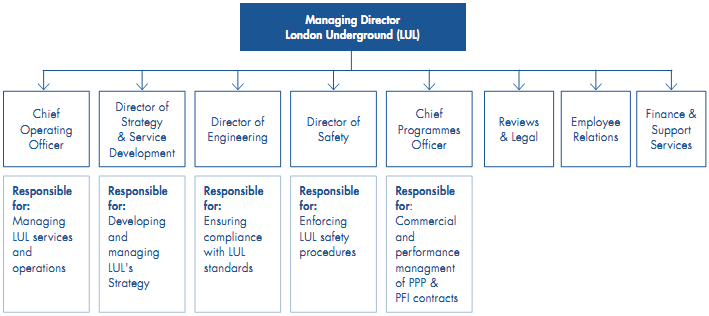
13 The high number of London Underground contact points meant that Metronet and Tube Lines struggled to get the scope of their work agreed. In total, Tube Lines identified 90 individuals within London Underground who held authority in the scope approval process - although Tube Lines and London Underground worked together and gradually reduced this number to 18 after work on the first set of stations was completed.
14 A letter from Metronet to London Underground in February 2004 showed that Metronet was keen to tackle this problem. It explained that the "process for agreeing scope is not well established and there appears to be no common understanding by all London Underground parties regarding which submission document should be provided for scope agreement. This problem is accentuated by the apparent uncertainty in London Underground as to who has responsibility for agreeing scope."
15 London Underground responded by developing and publishing a Project Stations Process in October 2004 jointly with Metronet and Tube Lines. Tube Lines successfully allowed sufficient extra time in its work timetables to tackle these difficulties. Metronet also allowed extra time, but failed to deliver within the extended period.
16 London Underground has disputed that the structure of its organisation increased the burdens on companies at the planning and scoping stage. It contends that any project with the complexity of the PPP contract station works would involve a number of contact points. It says London Underground engineers needed to have direct contact with engineers from the companies involved in addition to the formal contractual relations between Metronet contract managers and CPO.