The Department of Social Security and Post Office Counters Ltd signed a Private Finance contract with Pathway to provide a modern, secure method of benefit payment and to automate post offices
1.1 In May 1996 the Benefits Agency of the Department of Social Security and Post Office Counters Ltd (the purchasers), jointly awarded a contract to Pathway, a wholly-owned subsidiary of the ICL plc computer services group. The project 1 was intended to replace the existing paper-based methods of paying social security benefits with a magnetic stripe payment card and to automate the national network of post offices through which most benefits are paid. An extended chronology of the key events in the life of the project is at Appendix 3 and the three main players are described in Figure 1.
Figure 1 |
| ||
| The main players in the Benefits Payment Card Project | ||
| The Department of Social Security and the Department's Benefits Agency1 | Post Office Counters Ltd | ICL plc, through Pathway |
Area of Business | The Benefits Agency's purpose is to deliver benefits to the public through services that are active, customer focused, secure and accurate. They operate from a national network of several hundred local offices and from three central directorates. The Agency's Chief Executive is a member of the Management Board of the Department of Social Security and is accountable to ministers of that Department, and to Parliament as an Accounting Officer. | Operates a network of some 18,300 post offices, providing services such as postage, bill payment and financial services, to some 28 million customers each week. One of the three main businesses of the Post Office, a public corporation established under the Post Office Act 1969. Through the Department of Trade and Industry, Government appoints the Post Office's management board. | Owned by Fujitsu of Japan, the company implements systems for major projects and provides services to a range of industries including retail, finance, telecommunications and the education, local and central government sectors. ICL plc participated in this project through a wholly-owned subsidiary, Pathway, that it formed for this specific purpose. |
Financial and staffing | The Benefits Agency employs some 70,000 staff and pays over £80 billion each year through over 20 different social security benefits. Its operating costs were £2.4 billion in 1998/99. The other Agencies of the Department are the Child Support Agency and the War Pensions Agency, which, with Departmental Headquarters and various statutory bodies, constitute a group with over 80,000 staff including the Benefits Agency. | In 1999-2000 Post Office Counters Ltd reported turnover of £1.17 billion and profits of £46 million before taxation and exceptional items. It directly employs 12,000 staff and has contracts with nearly 17,000 sub-postmasters. | Operating in over 70 countries and employing over 20,000 people, ICL's revenues for the period ending March 1999 were £3.3 billion generating a pre-tax profit of £41 million before exceptional items. |
Note: 1. This description of the Department's structure describes the situation at the time of the project. Since July 1999 the Department have embarked on a programme of restructuring to focus on delivering the Government's welfare and modernisation agenda. This includes setting up a new joint agency for welfare to work services with the Employment Service, and a separate Pensions organisation. Internally, traditional policy and operational responsibilities are being aligned more closely. Source: National Audit Office | |||
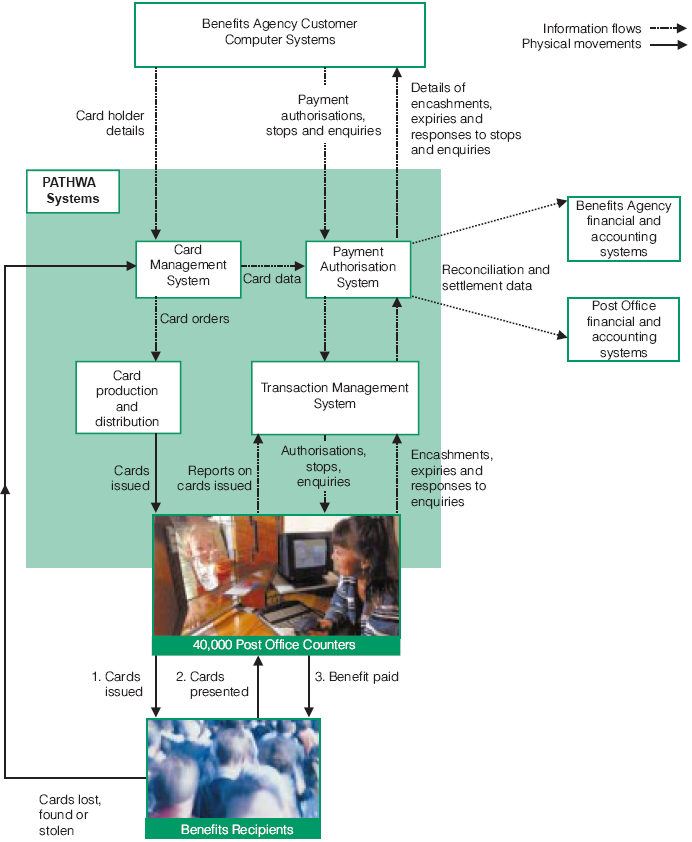
1.2 As Figure 2 and Figure 3 show, the project was vast in its investment, scale and complexity. One of the three shortlisted bidders told us that it was the most complex project their firm had ever bid for, rating 94 points out of a maximum 100 on their scale of complexity. It was also one of the first Information Technology contracts awarded under the Private Finance Initiative. The essence of such a deal is that the private sector supplier receives a contract to design, build, finance and operate an asset, and is paid for the provision of the service only as it is delivered to the public sector purchaser. In the context of information technology, government departments pay for the availability or use of the system to the standards laid down in the contract. In this way, many risks that would normally be borne by the public sector, such as higher than expected development or running costs, should be borne by the private sector.
Key Statistics of the Project | Figure 2 |
|
| |
|
| |||
| Estimated contract value, (Payments by Department and Post Office): | £1 billion, net present value over 7 years | ||
| Number of post offices to be equipped: | Up to 20,000, with 40,000 counter points in Great Britain and Northern Ireland | ||
| Number of post office staff to be trained in use of the system: | 67,000 staff, serving 28 million customers per week | ||
| Number of social security benefit recipients to be issued with Payment Cards: | 17 million, claiming some 24 different benefits. | ||
Source: National Audit Office | Number and value of benefit transactions: | In 1999/2000 some 760 million payments worth £56 billion were made through post offices | ||
Figure 3 |
|
| The Benefits Payment Card System - An overview |
The Benefits Payment Card system was a large, complex system, linking transactions at Post Offices with the systems of the Benefits Agency and Post Office Counters Limited. The supplier, Pathway, was responsible for the issue and distribution of payment cards and the processing of transactions and enquiries. | |
| |
Note: To ensure clarity, other functions particular to Post Office Counters Limited are not shown. Source: National Audit Office | |
_______________________________________________________________________
1 The names "Horizon", BA-POCL (Benefits Agency – Post Office Counters Ltd) and "Bringing Technology to Post Offices and Benefit Payments" have all been applied at different times to all or parts of this programme.