The timetable for delivery slipped continually, the benefits were deferred and in late 1997 Pathway requested improved terms
1.11 The Department, Post Office Counters Ltd and Pathway were successful in rolling out a limited early version (the "Initial Go-Live") of the Benefits Payment Card hardware and software to ten post offices in Stroud, Gloucestershire by October 1996, close to their contractual timetable. As was planned, this system had only partial functionality. For example, it:
■ supported the payment of only child benefit, and with only limited volumes of transactions. The system could technically process other benefits, but it had yet to include additional security features which would assure the Department that it could be entrusted with other higher risk benefits, and in higher volumes; and
■ did not allow payees to collect benefit from post offices other than their nominated one.
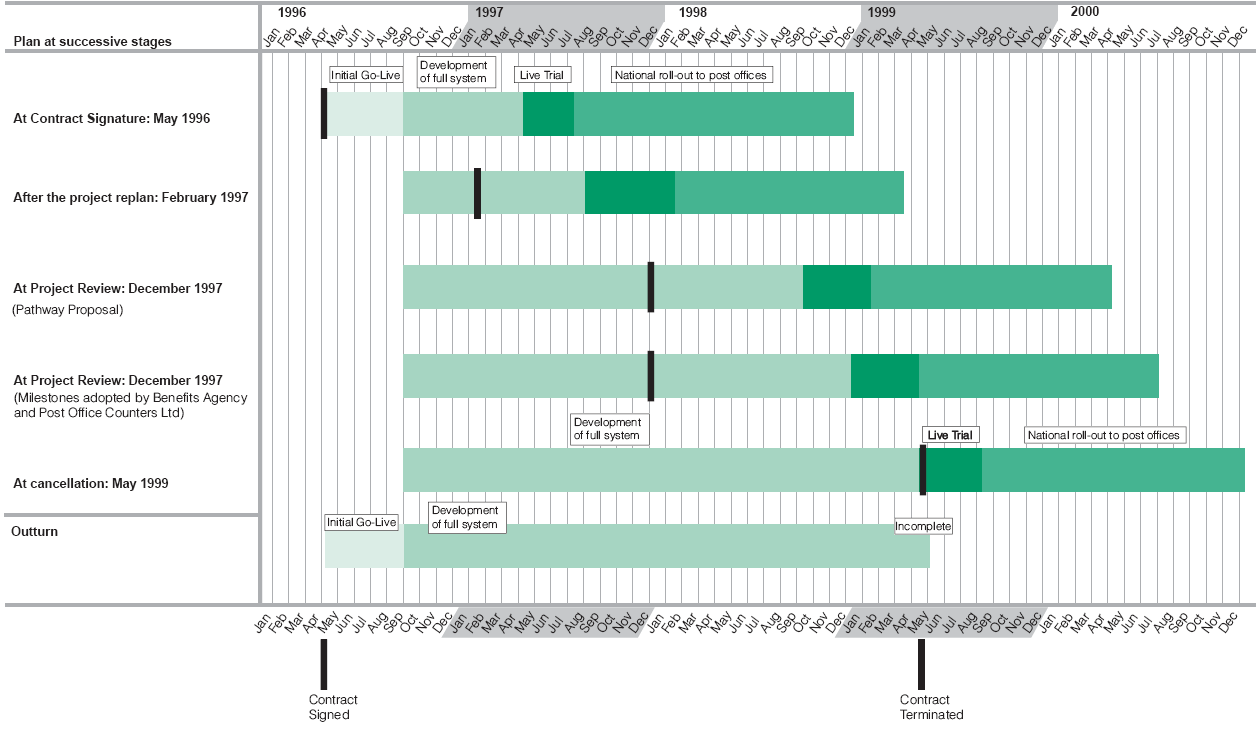
1.12 Though the parties successfully implemented the limited "Initial Go-Live" as planned, the process of designing and developing a fully functional system proved much more complex and took much longer than had been expected. The programme at the time the contract was signed assumed that it would take ten months to start a live trial of the full system. In fact, this stage had not been reached at the time the contract was terminated nearly three years later. The overall timetable for completing roll-out of the full system across the country slipped from 1999 to 2001 although development work continued and further functionality was added through successive software releases, which were used in 205 post offices. Figure 8 shows the extent of slippage in the project after the contract was let in May 1996. The main reasons for this slippage, how key risks to delivery were managed, and subsequent consequences, are described in Parts 2 to 3 of this report. We have found that there were severe delays in Pathway's development of Card software, though it is clear that Pathway encountered problems resolving with the purchasers agreements to agree and detailed requirements in order to finalise its software. The Department's delivery of data from its own systems should also be taken into account. The balance of responsibility at different times throughout the life of the project remains a matter of dispute between the parties.
1.13 During the second half of 1996 the Department, Post Office Counters Ltd and Pathway became increasingly aware of the difficulty they faced in implementing the full Benefits Payment Card system. The Department found that the complexity and resource requirements of their Customer Accounting and Payments System (CAPS) project, which was to feed data to Pathway's Card systems, had been greatly underestimated. At the same time, they were aware from their continuing liaison arrangements that Pathway had encountered similar difficulties in their own work. Pathway expressed concern about some aspects of the agreed high level specification regarding security, which were central to the Department's business case. Therefore discussions were opened that led in February 1997 to a "no-fault" replan involving all parties of both the projects. Under this agreement, all parties agreed to postpone the delivery dates, as shown in Figure 8, and to bear their own costs in doing so. The parties all committed to achieving the revised dates. The Department agreed to continue development of CAPS separately to Pathway's development of software for the Card, but ensure that the necessary technical interfaces were in place to meet Pathway's revised timetable. This was the first and last formal, contractual agreement to change delivery dates, though in 1998 and 1999 when dates slipped again the parties worked without prejudice using a later timetable in order to sustain progress.
Figure 8 |
|
| Slippage in the major milestones of the Benefit Payment Card project |
Though the clients and Pathway ensured the delivery of an initial system to time, design and development of the full system took far longer than expected. | |
Source: The National Audit Office | |
1.14 The risk that the project might have to be cancelled became serious during the second half of 1997. By 21st November 1997, a live trial which was intended to demonstrate sustained, satisfactory operation of child benefit payments and a range of post office functions in 300 post offices, had not been completed. The purchasers alleged that Pathway was in breach of contract. Pathway denied liability and in December 1997 wrote to the Benefits Agency suggesting three options to proceed:
■ to maintain the existing contract but with Pathway's prices raised by 30 per cent;
■ to extend the contract by five years and raise prices by five per cent; or
■ terminate the contract.