Some contracts do not have benchmarking/ market testing arrangements, mainly for valid reasons, but we found examples where contracts would have been suitable for these arrangements
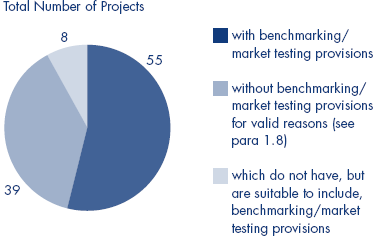
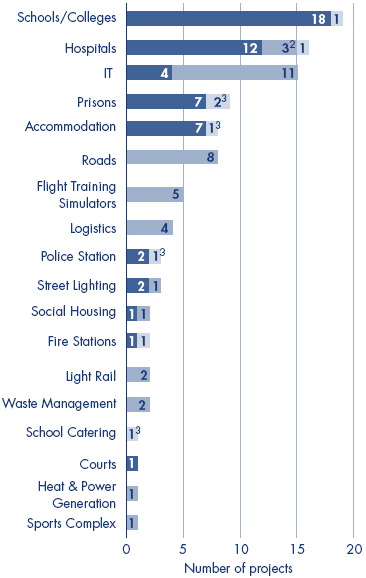
1.8 In addition to our review of the effectiveness of legal clauses for benchmarking and market testing, Partnerships UK (PUK) carried out separate research on PFI projects' value testing arrangements. In a sample of 102 PFI contracts now in operation, many of which were let before the standardisation of PFI contract terms were introduced, PUK found that in 47 cases (46 per cent of the sample) the contracts did not have benchmarking or market testing provisions but in 39 of these contracts there were valid reasons (Figure 9). For example:
9 | A sample of 102 PFI projects carried out by Partnerships UK to assess those with and without Benchmarking/Market Testing provisions |
| |
Type of project
Source: Partnerships UK | |
NOTES 1 The sample was drawn from operational PFI projects. Just over three-quarters of responses relate to projects that became operational between 1997 and 2000. 2 These three hospital projects reported that the contracts did not include soft FM. 3 These contracts were signed prior to the Treasury's introduction of standard contract terms in 1999. | |
■ some PFI projects do not have a soft FM service (e.g. waste and IT projects) so the need to value test such services does not arise;
■ some PFI projects may have chosen to specifically exclude soft FM from the scope of the contract – as indeed was the case for three out of the four hospital deals identified in Figure 9. In such cases, the alternatives are either an in-house option or to let separate short term contracts for the soft FM services.
1.9 The remaining eight contracts were the type of project where benchmarking and market testing would have been appropriate. It was not part of the PUK research, or this examination, however, to consider other aspects of the projects' contractual arrangements and it is possible that these contracts included other arrangements to seek to maintain value for money from the service provision, for example through price caps or profit sharing. In addition, projects might agree separate non- contractual arrangements with contractors. For example, one of the eight PFI projects without benchmarking/market testing clauses where the projects appeared suitable for the Authority to value test the soft FM provision, Victoria Dock Primary School, had an alternative arrangement for the Authority to benefit from reductions in the costs of its service providers. The Head Teacher together with the contractor (Atkins) had agreed to an informal, non-contractual profit sharing scheme. Money saved by the contractor by, for example, having lower than expected maintenance costs, was shared with the school through the provision of additional services, such as new playground areas. While proper contractual arrangements are preferable, this example demonstrates that good partnering arrangements can improve the outcome for authorities where contracts do not include mechanisms for sharing in cost savings.
1.10 Five of the contracts, which were the type of project where benchmarking and market testing clauses would have been appropriate, were signed before the Treasury's 2006 guidance had been issued. The Treasury notes that, if there is agreement between both parties, its 2006 guidance could be followed to allow value testing by these projects which did not include value testing arrangements in the contracts.