APPENDIX TWO Contract clause analysis
We identified a number of criteria to test the expected effectiveness of the benchmarking and market testing provisions within PFI contracts:
■ whether the contract clearly and unequivocally sets out the responsibilities of the public and private sector in relation to the operation of the benchmarking and market testing provisions;
■ whether the services that are subject to benchmarking and market testing are clearly defined;
■ whether the contract clearly provides guidance on how the process of benchmarking and market testing should be followed;
■ whether the contract contains appropriate timescales for the processes of benchmarking and market testing to be started and completed;
■ whether the contract clearly sets out the rights of the public sector to audit the data provided by the private sector to substantiate any benchmarking and market testing;
■ whether the contract has a clearly defined dispute resolution process should the parties not agree the outcome of the benchmarking and market testing exercises; and,
■ if there was the opportunity in the contract to bring services back in-house, whether the process of including an in-house bid in the market test was clearly defined.
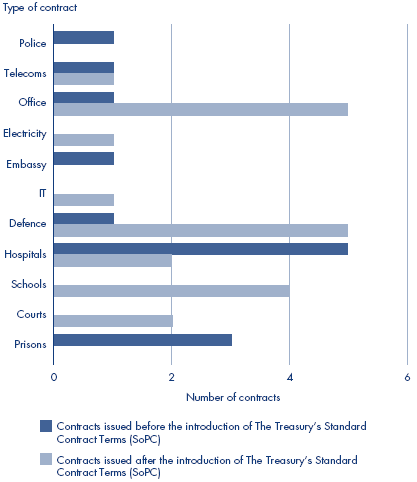
This piece of work examined a separate sample of 34 PFI contracts. This sample was then subdivided into 13 projects that had benchmarking/market testing provisions in their contracts before the introduction in 1999 of The Treasury's Standardisation of PFI Contract Terms (SoPC) and 21 thereafter. These projects were selected mainly
from the major users of PFI: Health, MOD, Transport and Education, although some were chosen from other government departments (see Figure 21 overleaf). The objective of this sampling was to illustrate whether there were any noticeable differences between the quality of the contract clauses in those projects for benchmarking and market testing signed before and after the introduction of standardisation. Information to assist in the selection of the contracts had been gathered from PUK, department Private Finance Units and previous work of the NAO. In addition a contract was examined containing the most recent Treasury standard contract terms (SoPC3) on benchmarking and market testing.
Nabarro assessed each PFI contract against these criteria. A clause was acknowledged as effective when it met the criteria clearly and unequivocally. Where a clause met the criteria but contained elements that could limit its effectiveness, then the clause was given 'qualified' status. Where a clause failed because it did not contain provisions relating to the criteria or the provisions did not meet the criteria, clearly and unequivocally, the clause was judged to be not effective.
The analysis represents Nabarro's legal opinion regarding the effectiveness of the benchmarking/market testing clauses and is based on a limited sample of PFI contracts. It does not necessarily indicate what the outcome will be using these terms since where Nabarro's review of the contract clauses suggested that they were to have limited effectiveness, it may nevertheless be possible for the parties to carry out effective value testing if they develop suitable processes which may not have been set out in the contract.
While the results in Figure 8 could be set out according to departmental groupings, the sample size is too small to make robust conclusions regarding the effectiveness of contract clauses by department.
21 | An analysis of the 34 contracts |
| |
Source: National Audit Office | |