SUMMARY
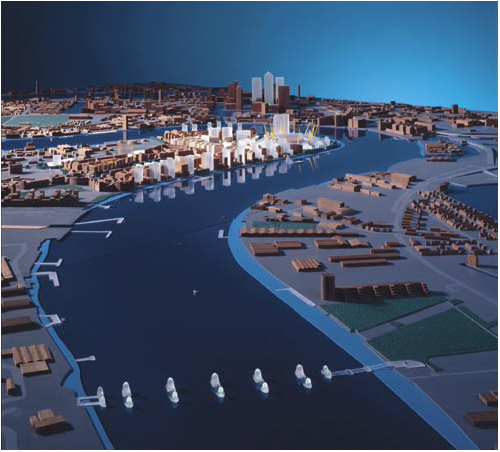
1 In 1997 the incoming Government decided that the Millennium Experience should provide a lasting legacy for the nation. In 1998, Ministers decided that the Dome would itself remain, as part of that legacy. English Partnerships - the national regeneration agencywhich owned the site (and which are now sponsored by the Office of the Deputy Prime Minister1) and were due to receive it back after the New Millennium Experience Company's occupation - were asked to find a sustainable long term use for the structure, recognisinits status as an iconic building. The Dome is located on a site of great strategic importance. The Greenwich Peninsula marks the western end of the Thames Gateway, one of the main growth areas proposed for economic regeneration and development in the South East of England. Public investment in remediation, servicing and landscaping works and in transport links has opened up the site for intensive and profitable redevelopment.
2 The initial unsuccessful competition for the Millennium Dome began in March 1999 but failed to find a buyer able to complete on acceptable terms. The first selected buyer, Dome Europe, had intended to continue operating the Dome as a visitor attraction but withdrew in September 2000 citing unacceptable commercial uncertainties over the assets and liabilities of the New Millennium Experience Company which operated the Dome. Ministers from several departments involved in the Millennium Dome project then selected a replacement bidder, Legacy plc, which proposed developing a high technology business park within the Dome. In February 2001 the Government withdrew Legacy's exclusive negotiating rights, mainly because their professional advisers and English Partnerships had grave doubts that Legacy had secured sufficient pre-lets and financial backing, and would give the taxpayer a good deal from shared profits over the lifetime of the project. In March 2001 the Government initiated a new sale process which led to a deal with Meridian Delta Ltd and the Anschutz Entertainment Group (Anschutz) for the redevelopment over 20 years of the whole northern Greenwich Peninsula, including reuse of the Dome.
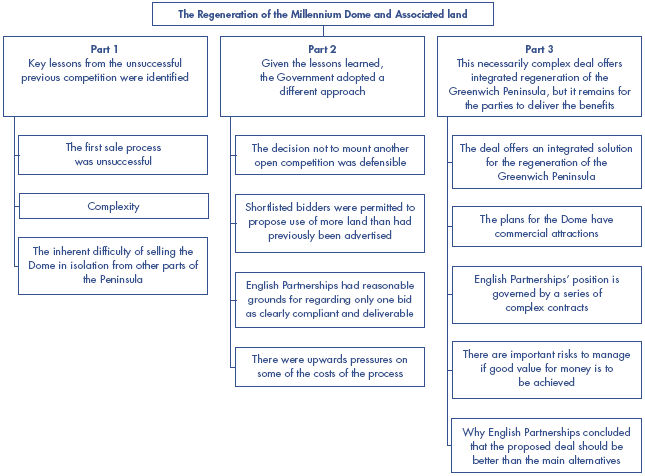
3 The key question which we sought to address through our examination was whether, having learned lessons from the previous unsuccessful competition, the Government now has a good deal. Our approach is detailed in Appendix 1. Our overall conclusion is that the second sale process avoided many of the problems of the earlier Competition, and has produced a deal which looks capable of meeting government's objectives as the Peninsula is developed over the next two decades. The following paragraphs summarise the main conclusions from our examination. Figure 1 overleaf shows how the issues are analysed in detail in the main body of the report.
4 There were two main reasons behind the lack of success of the original Dome sale competition. The objectives for, and process of, the first competition were complex. The difficulties were exacerbated for those bidders which depended on the business records and performance of the New Millennium Experience Company. Second, it was inherently difficult to sell the Dome separately from other parts of the Greenwich Peninsula site, and within this it was difficult for the Government to derive sufficient confidence about the deliverability of innovative proposals from bidders.
5 The Government learned lessons from the original competition and applied these to the subsequent sale process. The Government followed a different approach in adopting a limited competitive process, against a background of little market enthusiasm for a rerun of open competition, widespread cynicism about the risks and costs of participation, and little specific interest in the Dome. During the second sale process the scale of the final deal expanded to include over 100 acres more land than had been explicitly offered. English Partnerships' active promotion of the opportunity to potential bidders had been focussed on the 68 acres beneath the Dome and its immediate surroundings, in line with government priorities. Some bidders realised that more land could in fact be available. English Partnerships, the Department and their advisers believe that to have made a clear, open offer of more land would have diminished interest in the Dome itself and in any case the winning Consortium has such strengths that the final choice of partner would not have been different, even had further strong consortia been attracted. The National Audit Office takes the view that it is unclear whether such an offer would have produced additional strong bids.
|
1 |
The report Structure |
|
|
|
6 Based on a review of the legal documentation, the main assumptions underlying the projected future revenues, and the practical constraints and commercial factors that influence the decision on whether or not the Dome should be retained for at least the next 15 years, the deal that English Partnerships have reached with Meridian Delta Ltd and Anschutz ("the Consortium"), for the development inside the Dome and on the Greenwich Peninsula provides a platform for regenerating the Peninsula as the Government desires. However, as is the case in any joint venture, there are risks which English Partnerships will have to manage over the life of the deal to achieve maximum benefit for the taxpayer.
7 The deal is with a strong consortium. Lend Lease is a large development and construction company backed by a substantial balance sheet. Both it and Quintain are experienced property developers with track records of realising successful schemes, such as the Bluewater shopping centre in Kent, developed and managed by Lend Lease. The Anschutz Entertainment Group brings resources and relevant experience as a developer and operator to the Dome. Its need for a larger arena in London coincided with the availability of the Dome. It now remains for the parties to finalise key details arising from the contracts and to convert their assessment of the scheme's potential into a reality.
__________________________________________________________________________________
1 "The Department" See Appendix 2.