Summary
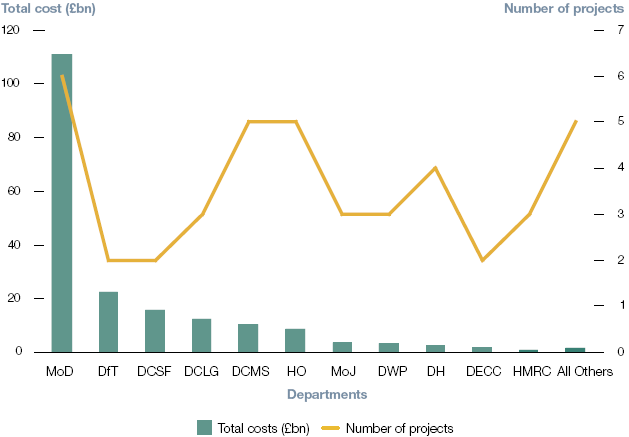
1 The value of the Government's Major Projects Portfolio (Figure 1) is approximately £200 billion. To achieve value for money the Government needs to ensure that these and other complex projects are being:
• delivered by project teams with the required commercial skills. We define commercial skills as the ability to interact on equal and professional terms with the private sector; and
• approved, led and governed by commercially aware senior civil servants and departmental boards.
2 The National Audit Office (NAO) and the Committee of Public Accounts (PAC) have consistently identified cases of problem government projects involving a lack of public sector commercial skills and experience. This has slowed the delivery and reduced the value for money of complex government projects. Appendix 2, which is published separately on our website www.nao.org.uk/commercialskills09_examples, provides examples from previous NAO and PAC reports.
3 Government has long been aware of the need to improve its commercial skills. In 1999 a report by Sir Peter Gershon, Review of civil procurement in Central Government,1 concluded that commercial skills levels needed to be raised significantly. In 2000, partly in response to the report, the government created the Office of Government Commerce (OGC). Since then, the demand for commercial skills has grown. This has been influenced by an increase in the number and complexity of the contracts that the government has entered into.
4 Many parts of Government contribute to the development of commercial skills for complex projects (Figure 2, page 15). Departments and the OGC play the most important roles. In particular:
• Departments have ultimate responsibility for ensuring their staff have the commercial skills appropriate for their projects; and
• the OGC has developed a significant programme of initiatives to support departments in improving commercial skills. These initiatives cover both the activities that lead to contract award, and subsequent contract management.
Figure 1
MoD = Ministry of Defence DfT = Department for Transport DCSF = Department for Children, Schools and Families DCLG = Department for Communities and Local Government DCMS = Department for Culture, Media and Sports HO = Home Office MoJ = Ministry of Justice DWP = Department for Work and Pensions DH = Department of Health DECC = Department of Engergy and Climate Change HMRC = HM Revenue & Customs Source: HM Treasury Major Projects Portfolio as at September 2009 NOTE Based on departments' total estimated programme costs or, where cost total has not yet been formally approved, the departments' best estimate of the total programme cost. |
5 This report is part of a series of reports examining the OGC's support to departments on procurement and contract management. It examines the current level of commercial skills and experience in Government, and considers whether the OGC and departments are being successful in improving them. A description of the methods used in the study is set out at Appendix 1. A glossary can be found at Appendix 4 on the NAO website at www.nao.org.uk/commercialskills09_glossary.
________________________________________________________________________________
1 Sir Peter Gershon, Review of civil procurement in Central Government (2009) http://archive.treasury.gov.uk/docs/1999/pgfinalr.html.