Government's approach to commercial skills
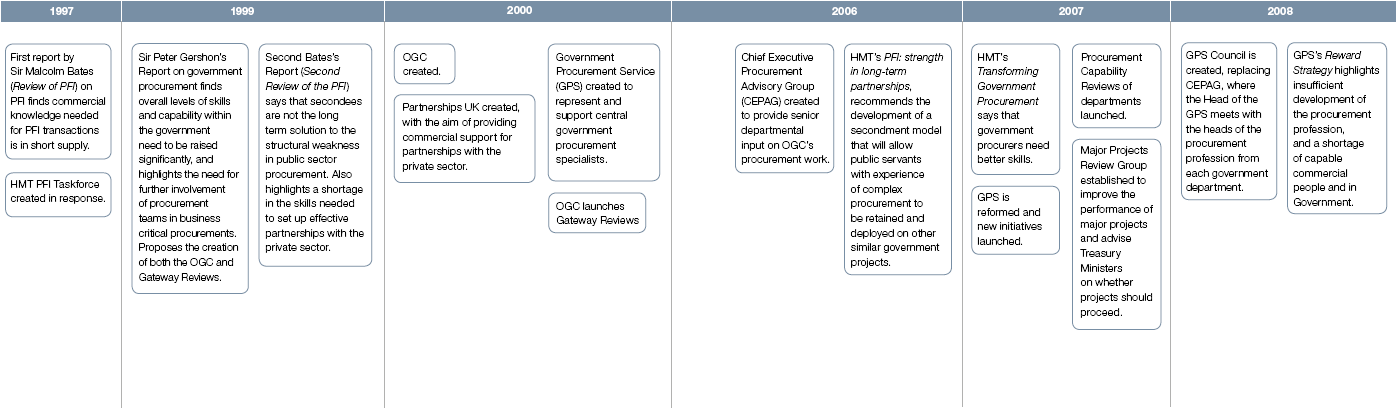
1.11 The importance of developing the commercial skills required to deliver complex projects has been recognised within government for over 10 years. In his 1999 report Review of civil procurement in Central Government,3 Sir Peter Gershon concluded that the level of commercial skills across the procurement profession needed to be raised significantly. The report triggered the creation of OGC in 2000, and soon after the creation of the GPS and new professional standards for commercial professionals. In 2007, HM Treasury's publication of Transforming Government Procurement4 outlined a significant programme of initiatives to both assess and improve the commercial skills in government (See Part Three). A high level timeline of public sector commercial skills development is set out in Figure 4 on pages 18 to 19.
1.12 There are currently many parts of government contributing to the assessment and development of commercial skills (Figure 2).
|
Figure 2 |
|
|
Organisation |
Responsibilities |
|
HM Treasury and the Office of Government Commerce |
Dissemination of good practice across government. Project assurance (MPRG, Project Review Group for approving PFI Credits to local authority projects, Gateway Reviews). Central initiatives, such as the Government Procurement Service Reform Programme, to assist departments' development of procurement and contract management skills. Supporting departments and projects (directly by the OGC and through the advisory body Partnerships UK, which is part owned by HM Treasury). Development of standard contract terms and other guidance. |
|
Departmental Commercial Units and Private Finance Units |
Management of national programmes, e.g. schools, hospitals, waste treatment (including planning programmes and developing markets with the private sector). Sharing good practice and giving advice to individual project teams on commercial issues. Assessing and improving commercial skills capabilities and staffing levels across the department. Project assurance. Placement of commercially skilled staff into project teams. |
|
Departmental project teams |
Procuring and managing individual projects. |
|
Shareholder Executive |
Uses its commercial skills to support the boards and management teams of Government owned businesses to create long-term shareholder value. |
|
Local authorities, schools and primary care trusts |
Procuring and managing individual projects which are often part of national programmes overseen by central government departments. |
|
Local Partnerships |
Offering local public bodies programme and project support and capability and capacity building through skills development and training. |
|
Source: National Audit Office |
|
|
|
|
|
||||
|
Figure 3 Key commercial skill or behaviour |
Stage 1 |
Stage 2 |
Stage 3 |
Stage 4 |
Stage 5 |
|
|
Understanding the policy and political environment and how it affects the project |
|
|
|
|
|
|
|
Understanding end user needs, and ability to describe outcomes and terms of contract succinctly |
|
|
|
|
|
|
|
Leading and managing commercial activity |
|
|
|
|
|
|
|
Scenario analysis and planning |
|
|
|
|
|
|
|
Understanding of different procurement options, and ability to sound out potential suppliers |
|
|
|
|
|
|
|
Ability to identify, define, communicate, and test the requirement |
|
|
|
|
|
|
|
Options identification, validation and refinement |
|
|
|
|
|
|
|
Understanding strategic context |
|
|
|
|
|
|
|
Business acumen - ability to take sound commercial decisions based on an understanding of the motivations of private sector counterparts |
|
|
|
|
|
|
|
Ability to identify, evaluate and take controlled risks |
|
|
|
|
|
|
|
Ability to analyse, synthesise, interpret and communicate financial data |
|
|
|
|
|
|
|
Understanding of the supply side, specifically market maturity |
|
|
|
|
|
|
|
Ability to commission and manage advisers |
|
|
|
|
|
|
|
Understanding of the incentives for suppliers and their staff |
|
|
|
|
|
|
|
Understanding of government procurement policy, guidance and legal framework |
|
|
|
|
|
|
|
Ability to determine and deploy a negotiation strategy, including core negotiation skills and techniques |
|
|
|
|
|
|
|
Supplier management - development of effective contractual relationships |
|
|
|
|
|
|
|
Ability to evaluate suitability of bids |
|
|
|
|
|
|
|
Ability to retain competitive tension for as long as possible |
|
|
|
|
|
|
|
Source: National Audit Office Notes 1 Producing a strategic business case - converting a policy goal into a commercially viable set of options. Setting out business justification prior to approval for development. 2 Producing outline business case before formal approach made to suppliers or delivery partners. Engaging with the market to test the feasibility of the options and decide on a specification. 3 Taking the specification out to tender, negotiation with suppliers, ending with contract award. 4 Managing the contract post-award to ensure benefits of the project are realised.
|
|
|
|
|
|
|

|
Figure 4
Source: National Audit Office |
________________________________________________________________________________
3 Sir Peter Gershon, Review of Civil procurement in Centrla Government (1999).
4 Transforming government procurement, HM Treasury (January 2007).