PART ONE THE ROLE OF PFI IN REDUCING MUNICIPAL WASTE SENT TO LANDFILL
1.1 The European Union introduced a Directive in 1999 requiring all Member States to reduce the amount of BMW disposed of in landfill sites. England, in common with the UK as a whole, has historically relied heavily on landfill. The EU landfill targets for England are set out in Figure 2. Many other European countries have already met their EU landfill targets. England is having to increase waste recycling and invest in substantial new waste treatment infrastructure to achieve its targets.
1.2 England has 121 waste disposal authorities, comprising 34 county councils, 81 unitary authorities and 6 statutory waste disposal authorities. The waste disposal authorities have responsibility for the treatment and disposal of municipal waste.
The Government has created the following financial incentives for these authorities to divert waste from landfill in line with the European Union targets.
■ The Landfill Allowance Trading Scheme (LATS): introduced in 2005. Local authorities are each assigned a landfill allowance, which is reduced each year to reflect the national landfill reduction targets. If local authorities exceed their allowance, they must purchase additional allowances from authorities with a surplus of LATS, at a market rate.
■ Landfill Tax: this tax, introduced in 1996, applies to all users of landfill. The 2007 Budget Statement announced that the landfill tax would increase more quickly and to a higher level than previously planned. Increases of £8 per tonne per year for active waste were announced from 2008-09 to at least 2010-11, rising to a rate of £48 per tonne. Landfill tax receipts have risen from £333 million in 1998-99 to £877 million in 2007-08.
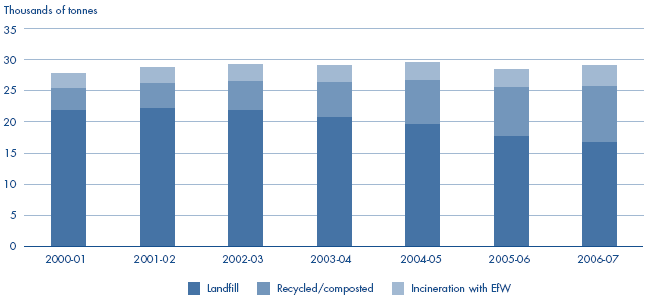
1.3 Local authorities and consumers have responded to the challenges of reducing landfill and waste. Over the last three years recycling has increased and waste growth has slowed from a rate of 3 per cent in 2001-02 to per cent in 2006-07.1 Together these factors have led to a significant decrease in the amount of municipal waste sent to landfill compared with 2001 levels (Figure 3). Waste is also an increasingly important source of renewable energy: in 2006, 82 per cent of all renewable energy in the UK was derived from bio fuels and waste.2 The waste element included both waste combustion (such as incineration) and landfill gas.
|
2 |
EU Landfill directive targets for reducing the amount of BMW sent to landfill in England |
|
|
|
EU Landfill Directive Targets 1 |
|
|
Year |
Target as a proportion (by weight) of BMW produced in 1995 (%) |
Equivalent in millions of tonnes per annum (compared with 15m tonnes in 1995) |
|
2010 |
75 |
11.25 |
|
2013 |
50 |
7.50 |
|
2020 |
35 |
5.25 |
|
Source: Defra |
||
|
NOTE 1 The European union agreed to defer the target dates for the United Kingdom and Spain by four years because they sent more than 80 per cent of their municipal waste to landfill in the baseline year (1995). |
||
|
3 |
The amount and proportion of municipal waste being sent to landfill has reduced in recent years as recycling has increased |
|
Source: National Audit Office analysis of Defra's municipal waste statistics |
|
1.4 The Department cannot mandate local action on waste management. Local authorities have statutory responsibility for waste disposal. It is for local authorities to decide how to manage waste, whether to invest in new infrastructure and how to finance and manage this investment.
1.5 The PFI has been an important means for local authorities to finance and build the facilities required. Central government financial support in the form of an annual grant payment, following the allocation of what is known as a PFI Credit (Figure 4 overleaf), is available to local authorities for projects approved by central government. Local authorities also use other types of procurement, however, including other public private partnerships. These projects do not receive PFI credits. Although PFI contracts account for most of the new waste treatment capacity being brought into operation by 2013 these other procurements account for most of the deals expected to close in 2008-09 and 2009-10.
1.6 To get PFI credits the authorities must have their plans approved first by the Department and then by the cross-department Project Review Group. The Project Review Group is a panel of experts chaired by the Treasury, with permanent representation from the Department for Communities and Local Government and the Public Private Partnerships Programme (4ps). 4ps work in partnership with all local authorities to secure funding and accelerate the development, procurement and implementation of PFI schemes, public private partnerships and other complex projects and programmes. The approval process is set out in detail in Appendix 4.
1.7 At the time of our audit, 18 local authorities had signed PFI contracts with a combined capital value of £1.6 billion. The Department has allocated £750 million in grant through PFI Credits to support these projects throughout their term. Nine more were in procurement and a further 19 were in development. In the Comprehensive Spending Review 2007 the Department received a further provisional allocation of £2 billion for waste projects.
|
4 |
Meeting the cost of local authorities' PFI contracts |
|||||
|
|
|
|
|
|
|
|
|
|
|
|||||
|
|
||||||
|
Local authority PFI support is allocated by central government in the form of PFI Credits for projects which gain central government approval. PFI Credits act as a promise that an annual PFI Grant can be claimed once the project is operational. Requests for additional credits if the cost of the project increases during the procurement are scrutinised by the Department on a case-by-case basis. To date the Department has not provided additional financial support for changes to projects made or proposed after contract signature. Source: National Audit Office |
||||||
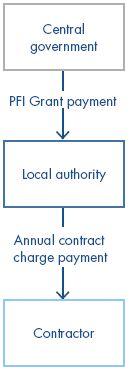
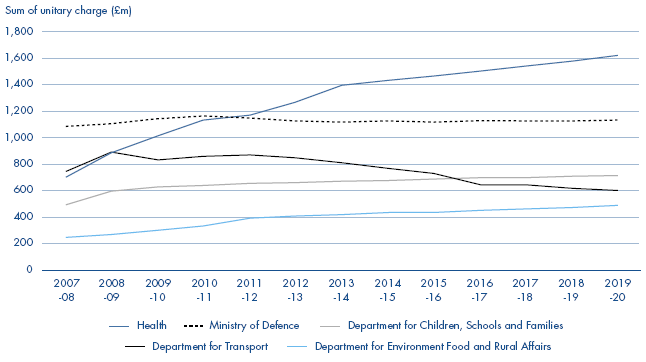
1.8 As a result of this increased investment, the aggregate annual payments are now around £220 million on all PFI waste contracts. The aggregate payments are expected to rise substantially as more projects are approved and come into operation. Figure 5 compares the projected spending on the Department's waste PFI projects to the spending of other departments who are major users of PFI.
1.9 Waste PFI projects can be complex and differ from traditional uses of PFI in several important respects.
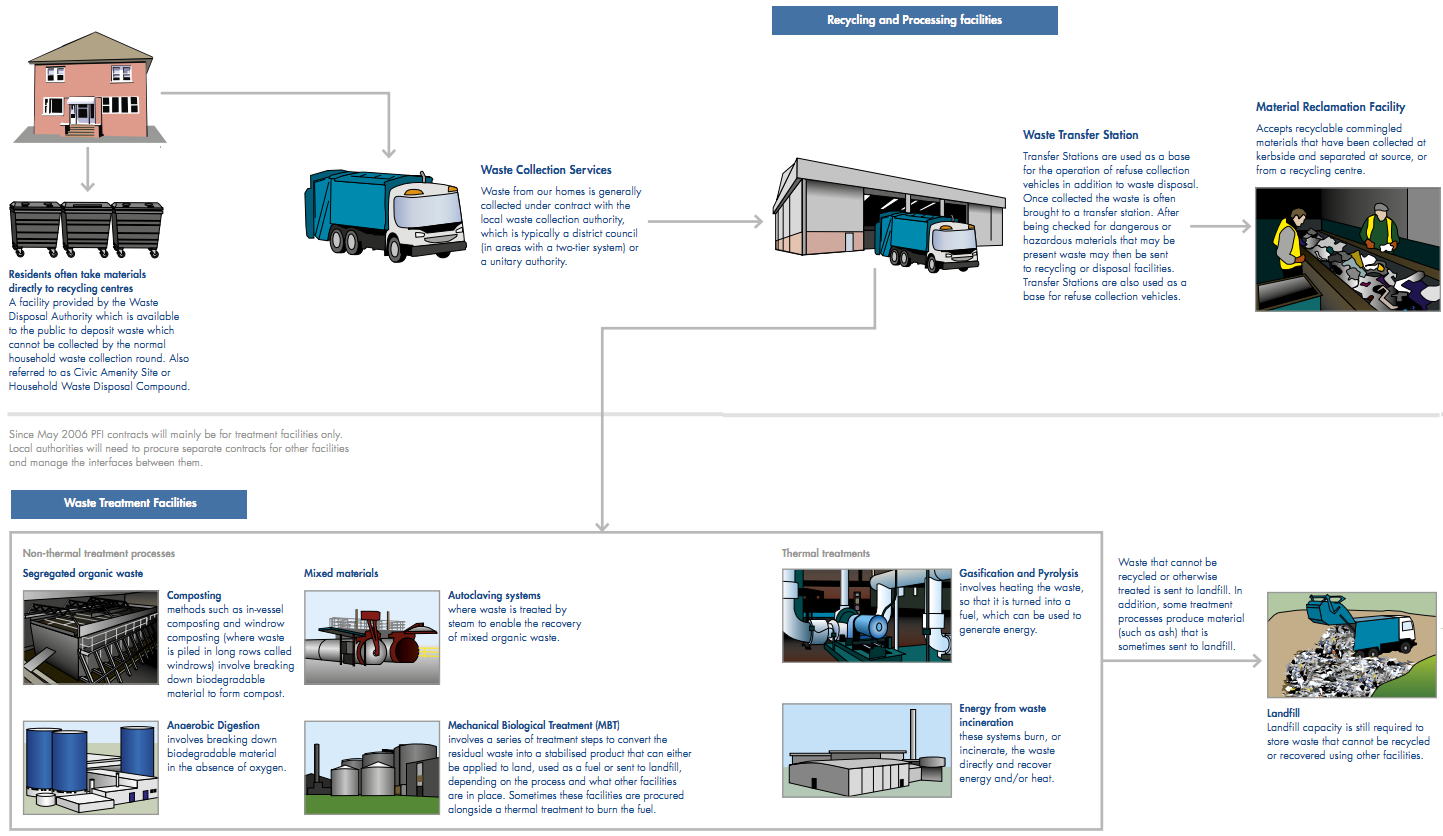
■ Waste management is an industrial process, with several components including collection, recycling and composting and finally treatment of waste (Figure 6 on pages 14 and 15).
■ More risk is carried into the operational phase than a serviced asset such as a school or hospital because of the reliance on technology and the different parts of the waste management process working together.
■ Where local authorities seek PFI credits from the Department, the project requires coordination between central and local government.
■ Some projects serve more than one local authority and therefore require coordination across authority boundaries.
■ Projects have risks which are different from those found in other PFI infrastructure projects, including uncertainty over future waste throughput; planning permission difficulties; the risks of different types of technology; and finding markets to sell products from waste treatment.
■ There are other Government objectives to consider, such as increasing the use of renewable energy and reducing the impact of climate change (Appendix 5).
|
5 |
Comparison of projected spending on waste PFI projects with the PFI portfolios of other departments |
|
|
|
|
NOTES The unitary charge figures for Defra comprise: 1 Unitary charge payments for waste projects by local authorities (98 per cent of total payments to 2020). 2 Three small (non-waste) PFI projects: (2 per cent of the total unitary charge payments to 2020). |
|
|
6 |
An overview of the facilities that may be procured and operated as part of a waste management PFI contract |
|
Integrated waste management contracts may include all these services under one contract, although only a minority include collection. |
|
|
|
|
Source: National Audit Office
____________________________________________________________
1 Source: Defra.
2 Source: BERR (2007) UK Energy in Brief, July 2007.