Part 1 The Home Office will get what it wants from the deal
This part of the report examines whether the Home Office achieved its objectives. It shows that the deal provides a replacement for the Home Office's inadequate existing central London accommodation and that the Home Office expects to secure wider business benefits from its new accommodation although it will not be possible to house all staff. The Home Office considered alternative options to the Marsham Street PFI deal but concluded that they would not offer as good value for money.
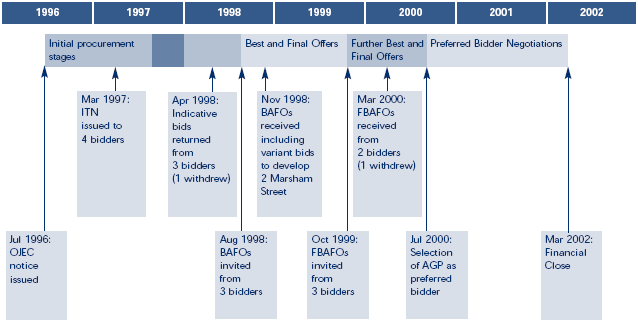
1.1 In 1996, the Home Office launched a review of its accommodation requirements in central London and concluded that there were deficiencies in its existing estate. The history of the procurement exercise that followed is shown in Figure 1. An Invitation to Tender stating the Home Office's accommodation requirements was issued to prospective bidders. In addition to bids to refurbish the existing estate, one bidder offered a developed solution proposing to redevelop the site of the old Department of Environment building at 2 Marsham Street, affording the opportunity to bring the Home Office and Prison Service staff together in a new headquarters building and avoiding the need to decant temporarily from its existing building while it was refurbished. The Home Office liked the strategic solution offered but the bid was not sufficiently developed so a further round of bidding was necessary. This solution, however, meant that the Home Office would have to surrender the lease of Queen Anne's Gate at a price equating to a net present cost of £91 million unless another government department took over the tenancy. In June 2003, the Department for Constitutional Affairs committed to take over the Queen Anne s Gate lease, exercising an option to extend the lease in accordance with a Memorandum of Understanding with the Home Office, thus saving the Home Office the cost of its surrender. (See Part 3)
1 |
| History of the Home Office Central London Accommodation Project |
|
| |
| The project was suspended between August and December 1997 following the General Election and in light of a parallel decision to suspend the procurement of refurbished headquarters accommodation forc the Treasury | |
| Source: National Audit Office analysis | |
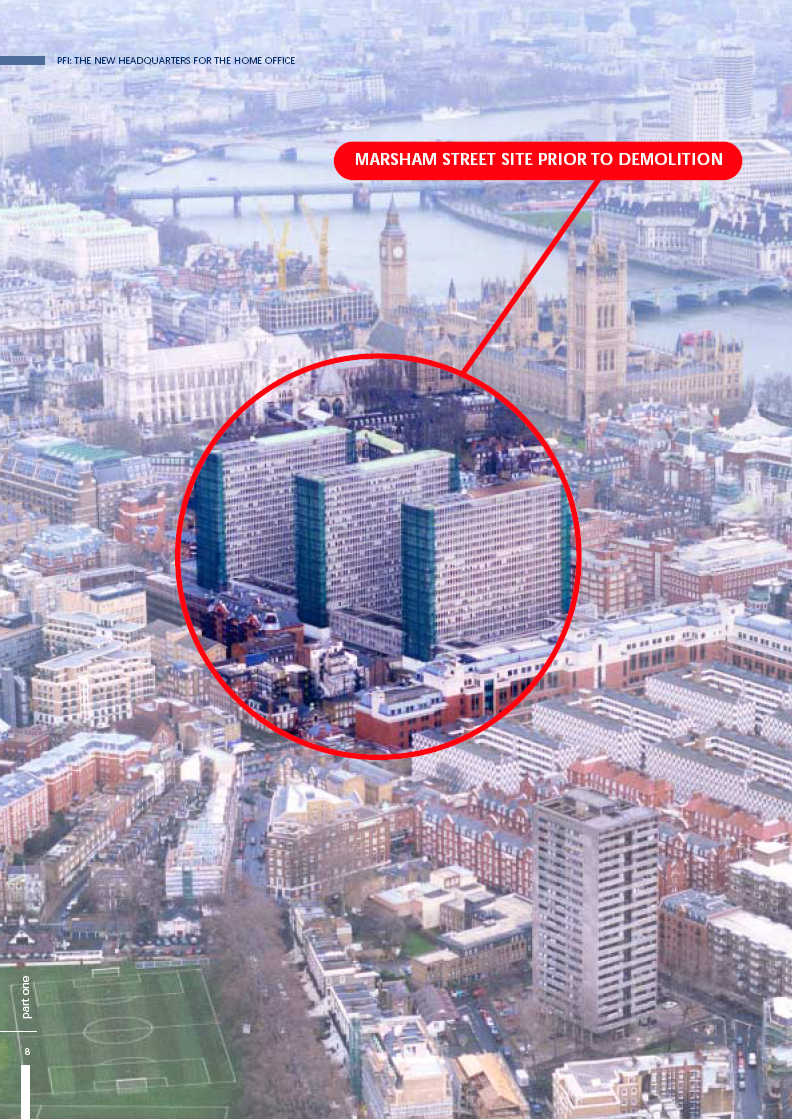
1.2 Annes Gate Property plc (AGP) was selected as the preferred bidder in July 2000 and the deal was finalised in March 2002. The project involves the demolition, the design and construction of new buildings on the site, the relocation of up to 3,450 Home Office staff and the provision of support services for 26 years. The new building will occupy around two-thirds of the site with the remainder being a separate development of mixed residential and commercial premises to comply with Westminster City Council planning requirements for the area.
1.3 The demolition and construction work will be financed by AGP through the issue of £244 million of long-term debt to investors and £29 million in the form of equity. When the Home Office moves into its new building it will begin paying a monthly charge for the building and associated services amounting to £311 million (net present cost) over the life of the project. At the end of the project agreement in 2031, the Home Office will have a choice between either walking away from the deal or purchasing the building.
1.4 Demolition of the existing buildings on Marsham Street began in 2002 and the Home Office is expected to move to the new building in 2005.
2 |
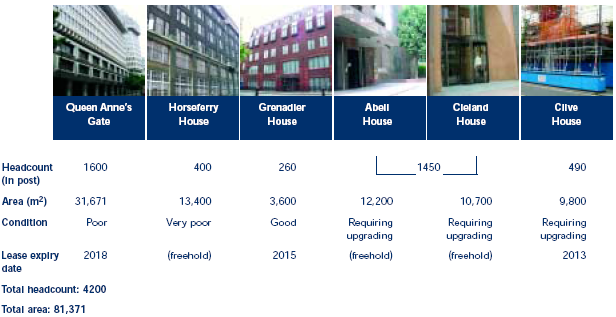
| The Home Office's Existing Estate as at financial close (March 2002) |
|
| |
| NOTE Since March 2002 both the staff numbers and the estate have changed. Clive House has been acquired by the Department for Constitutional Affairs and is currently being refurbished. The Home Office has acquired Allington Towers from the Treasury (accommodating 375 staff) and Ashley House from the Office of Government Commerce (accommodating 130 Home Office staff). See Figure 4 for total current staff numbers. | |
| Source: Home Office | |