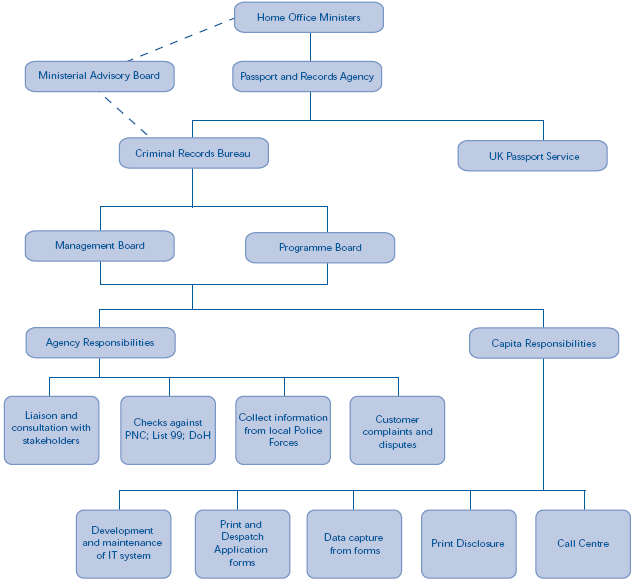
Structure of the Bureau
1.4 The Bureau provides a One Stop Shop, from which individuals can, by sending in an application, request a Disclosure which details a person's criminal history, if any. The Bureau is a complex structure with the process of producing a Disclosure split between Capita and the Agency, with the involvement of Registered Bodies and local police forces.
2 |
| Timetable of events |
|
| 1996 | White Paper On the Record announces establishment of Criminal Records Bureau |
|
| 1997 | Police Act passed. Part V provided the regulatory framework for the Bureau |
|
| 1998 | Home Office announces creation of the Bureau |
|
| Early 1999 | Implementation team formed in the UK Passport Agency to set up the Bureau |
|
| June 1999 | Advertisement for Public Private Partnership placed in the Official Journal of the European Communities |
|
| February 2000 | 3 Bidders short listed to produce a Technical Design Study, with contribution towards costs of £100,000 reimbursed |
|
| June 2000 | Best and final offers received against final contract requirements |
|
| August 2000 | Contract awarded to Capita |
|
| February 2001 | Home Office announce Disclosures will be free to volunteers |
|
| April 2001 | Fees for all types of Disclosure set at £12 |
|
| Spring 2001 | Registered Bodies seminars and registration underway Service agreements signed with local police forces and the Police National Computer |
|
| Summer 2001 | Go Live delayed from August 2001 to March 2002 Customers demand a Paper Forms Route and this is added Enhanced Model Office/Pilot testing added |
|
| November 2001 | System tested |
|
| February 2002 | Model Office and Pilot completed |
|
| March 2002 | Live operations launched |
|
| May 2002 | Backlogs develop |
|
| May - September 2002 | Action by the Agency and Capita to improve business processes and reduce backlogs |
|
| August 2002 | DfES requires people working in schools to be vetted by CRB before taking up posts |
|
| September 2002 | Independent Review team appointed by the Home Secretary |
|
| November 2002 | The Bureau was processing more applications than new ones received, but still a significant backlog of aged applications, with delays occurring in local police force checks |
|
| January 2003 | Millionth Disclosure issued |
|
| February 2003 | Independent Review Team Recommendations announced |
|
| June 2003 | Revised service standards published in Business Plan 03/04 and fee increases announced. Service standards for turnaround time of applications being achieved and aged applications backlog eradicated. Two millionth Disclosure issued |
|
| September 2003 | The Bureau was established as a separate Agency |
1.5 The Chief Executive of the Passport and Records Agency was, until 31st August 2003, accountable to the Home Secretary for the development, running, management, and performance of the Bureau. Three boards monitored the development and implementation of the Bureau (Figure 3): a Ministerial Advisory Board advised Ministers on the Bureau's plan and performance; a Programme Board managed the development and implementation of the Bureau, and was made up of senior managers of the Agency, Capita and the Association of Chief Police Officers; and a Management Board made up of senior managers from the Agency and non executive directors, was added in 2001 to focus on preparing for operations and on personnel and financial issues. Capita was a member of the Management Board (except for Agency internal matters). A Partnership Executive was also convened between the Agency and Capita, as an expression of the intention to work as a Partnership to develop the Bureau, although this was later discontinued. From September 2003, the Bureau has been established as a separate Agency under the Home Office, with a newly appointed Chief Executive.
3 |
| Organisational Structure of the Criminal Records Bureau during development and implementation |
|
|
|
|
|
|
|
| NOTE PNC = Police National Computer; List 99 & DoH List: Lists of individuals deemed unsuitable to work with children. Source: National Audit Office analysis |