Most project managers were satisfied with the design and construction
2.26 Good quality design is important to achieving high quality public buildings. Design development costs are likely to be small in relation to the whole life operating costs of a building project but the design process can have a large impact on the total project costs. PFI incentivises the consortium to invest in good quality design and construction as this can reduce whole life costs. Departments are placing more weight on the aesthetic aspect of design, while realising there is often a trade-off between this aspect and construction costs. The Treasury places importance on good design in public buildings and commissioned a review by the Commission for Architecture and the Built Environment (CABE) and the Office of Government Commerce. This review resulted in a report published in October 2002 'Improving Standards of Design in the Procurement of Public Buildings'. The report includes recommendations to assist the development of good design in public buildings.
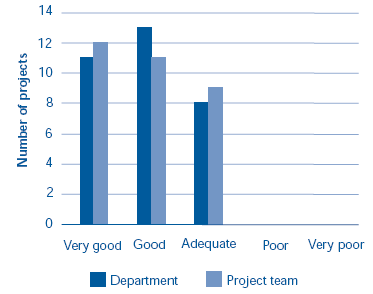
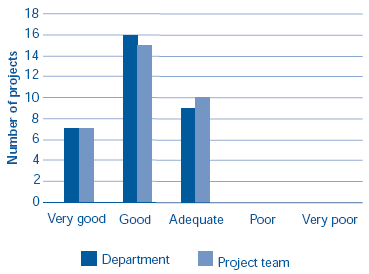
2.27 We asked the PFI project managers we surveyed to report the assessment by the project team and the department of both the design and build quality in their projects (Figure 7 and Figure 8).
2.28 In over half the projects, the department and project managers rated design and build quality as good or very good. An example is described in Figure 9. In our census, the project director for the building development at South Buckinghamshire NHS Trust stated that the project team rated the design quality as adequate with some design features considered poor by the individual hospital departments. This was because there had been certain design issues which have been unpopular with patients and visitors (see case study, Figure 10). Therefore the design could not be considered adequate in all respects. But overall the Trust is in general very satisfied with the new developments and the majority of views of the staff and patients using the wards and departments were positive.
2.29 Feedback from users can be a valuable indicator of whether a built asset is satisfactory. Only four projects we surveyed, however, had undertaken a detailed user satisfaction survey, which were generally favourable. Of the rest just over half told us they had some means of obtaining user feedback, ranging from letters from users to anecdotal comments.
| 7 | Rating of design quality | |
| The Figure shows that all respondents rated the design and construction quality adequate or better. | ||
|
| ||
| NOTE The project team at South Buckinghamshire hospital rated the design quality as adequate with some design features considered poor by the individual hospital departments Source: National Audit Office |
| 8 | Rating of build quality | |
| The Figure shows that all respondents considered the build quality to be adequate or better. | ||
|
| ||
| Source: National Audit Office |
| 9 | Case Study | |
| Good design and construction Prison Service: HMP Altcourse (Fazakerley) The construction company, Tarmac (now Carillion) introduced new design and construction features into the procurement of prisons which enabled the prison to open five months ahead of schedule. The innovation (in the UK) was in pre-casting off-site modular houseblocks, which could then be transported by lorry and quickly assembled on site to provide the basic structure. The Prison Service considers that the houseblocks are well-lit, spacious and provide good sight lines. The resultant synergy between the design and operations at the prison is demonstrated by the level of staff deployment that takes advantage of the sight lines. The achievements made at this procurement set the standard for bidders at subsequent privately financed prison competitions. |
| 10 | Case Study | |
| Hospital department concerns over design and construction Department of Health: South Buckinghamshire Hospital The Trust stated that the South Buckinghamshire developments are aesthetically very pleasing, but some of the architectural design features have brought with them certain tensions in the day-to-day operation. One of the features was to provide a non-institutional ambience, without traditional long hospital corridors, by use of combining general and departmental circulation spaces. The desegregation of general and ward areas has not been popular with people walking through departments to get to their destination. This has led to concerns from staff to restrict access through departments to improve security. Some doors have been locked with restricted access. This has led to patient and staff traffic being diverted. Both sites are built on a slope and have an unusual design feature that each floor can be accessed at ground level at particular points along the slope. There is very good disabled accessibility. There are more entrances than would usually be the case, with the resultant concerns over security and restricting access at nights and weekends. Also availability of adjacent parking has been an issue. Some visitors have commented that they find access confusing and achieving clear signage is complex, with no obvious main entrance to which visitors are guided clearly. These operational issues have become evident since bringing both new buildings into use. |
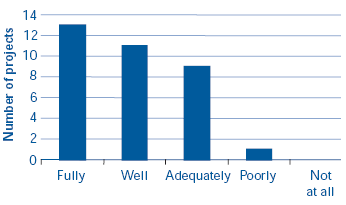
2.30 The majority of those surveyed expressed satisfaction with the performance of the building. Thirty three of the 37 projects were reported as performing adequately or better (Figure 11).19
| 11 | Extent to which the asset is performing to contract specifications | |
|
| ||
| Source: National Audit Office |
_____________________________________________________________________________________
19 Three did not respond to this question. Only one was reported to be performing poorly.