NATS had faced problems in financing and implementing its investment programme
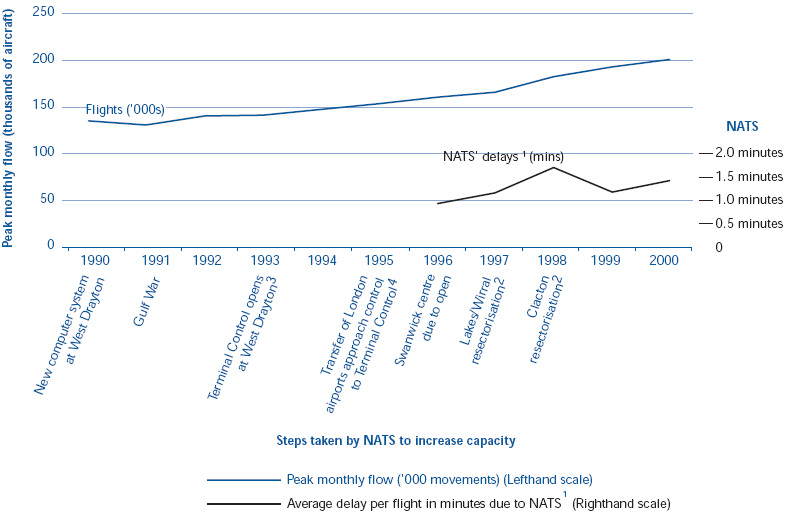
1.2 NATS holds a monopoly of all air traffic control for aircraft flying over the United Kingdom and, with its Irish counterpart, the North East Atlantic. It also provides air traffic control at most of the large airports around the country. Its costs are met by charges to customers, mainly scheduled and charter airlines and business aviation. A summary of its operations is at Appendix 2. Annual growth in air traffic of seven to eight per cent resulted in long delays for passengers at UK airports in the late 1980s. In the early 1990s, the Government approved a number of major capital projects to enable NATS to raise capacity to cope with further predicted annual increases of some five per cent. These capacity increases and the slackening of civil traffic growth in the early 1990s due to the Gulf War and economic factors helped NATS keep flight delays steady (Figure 1 on page 12) whilst maintaining high standards of safety. Delays in United Kingdom airspace due to air traffic control are broadly similar to those in France and Germany. (Figure 2 on page 13)
1.3 There has never been a fatal incident in UK airspace that was attributable to NATS (and only four in Europe in the last 25 years attributable to air traffic control), and trends in incidents have been positive, (Figure 3 on page 14). The lack of standard performance criteria and differences in airspace make international comparisons of air traffic control safety difficult if not impossible. However more crude data, such as the number ofaccidents involving write-offs of aircraft, suggests that the UK's overall levels of air safety are comparable with Western European and North American standards.
1.4 Though NATS' customers and the Department told us that they respected the Company's operational performance, they had concerns over the level of its charges to users, amongst the highest in Europe (Figure 2), and the management of its investment programme. NATS' biggest-ever investment project, the new en route air traffic control centre at Swanwick in Hampshire, was originally due to open in late 1996, but eventually opened only in January 2002, some £150 million over the £475m budget. A review commissioned by the Department identified problems in project strategy, organisational interfaces, and cultural barriers within NATS, such as:
■ poor internal reporting and inhibition of open debate;
■ barriers between the project team, senior management and operational functions, leading to difficulties in managing user involvement; and
■ lack of senior management large-scale project management experience.
1.5 An additional problem was limited access to the capital that NATS considered necessary to fund its investment programme. NATS' normal annual operating surpluses of some £50 million in the 1990s enabled it to fund some of its investment internally. But it had to compete with the rest of the public sector for borrowing to fund the rest. In addition the Government questioned whether the private sector might manage the risks of major investment projects better. Accordingly in 1993, the Government announced that the New Scottish Centre to be built at Prestwick would be designed, built, maintained and funded via the Private Finance Initiative (PFI) and operated by NATS. But NATS had reservations about losing control of major technical assets, contending that systems needed to be continually updated, and that if NATS did not own the assets its ability to carry out upgrades would be limited. Commercial negotiations with PFI providers proceeded slowly and were eventually overtaken and superseded by the PPP.
1 |
| Key trends in UK airspace since 1990: flights and delays |
|
| To meet growth in the number of flights, NATS has taken steps to increase capacity and so limit increases in delays.
NOTES 1. These data are not available on a consistent basis before 1996. 2. Resectorisation: Increasing the number of sectors in UK airspace by splitting the existing ones, giving the controller fewer aircraft to handle. 3. Terminal Control: The operations room controlling traffic over London and South East England under 24,500 feet. 4. Airport approach control: Control of aircraft from when they come onto the landing glide path (about 10-15 miles out) until shortly before landing. Source: Data from NATS, the Department and Eurocontrol |