The process for selecting a partner was well planned
1.11 The Department appointed CSFB as lead financial advisers in September 1998 to advise on:
■ the feasibility and structure of a PPP, and the preconditions to a deal that bidders would need to see resolved;
■ the sale strategy, for example the merits of a trade sale versus a flotation; and
■ the optimum timetable.
CSFB also tested the market's appetite for NATS as a business proposition, and assisted the Department and NATS in preparing the company to meet potential bidders.
5 |
| The Government's objectives for the Public Private Partnership |
|
| For maintaining and enhancing standards of safety and security ■ To enhance aviation safety in the UK by separating regulation from service provision; ■ To maintain NATS' effective contribution to national security through effective civil/military joint working arrangements; ■ To maintain effective accountability to Government as shareholder, to the CAA as regulator and to the wider public interest. For developing NATS' business ■ To ensure that NATS has access to the necessary project and complementary commercial management expertise to provide for its long-term development as a safe and efficient air traffic service provider; ■ To ensure the strategic partner takes responsibility for managing NATS' strategy, investment programme and new business development; ■ To provide NATS with the commercial freedom to develop its business, within the necessary framework of incentives, regulations and other disciplines; ■ To introduce new incentive and performance based regulation to replace the existing "cost-plus" charging regime, to encourage timely and appropriate investment and ensure value for money for NATS' customers; To provide value for money for the taxpayer ■ To ensure NATS has access to adequate capital without adding to pressure on public sector borrowing; ■ To ensure long-term value for money for the taxpayer and generate sales proceeds to help fund other transport programmes.1 NOTE 1. The Department for Transport had expected sale receipts of £500 million and this was included in their Public Expenditure provision. Without these receipts transport spending may have reduced. Source: Department of Transport, Local Government and the Regions |
6 |
| The PPP Structure |
|
|
|
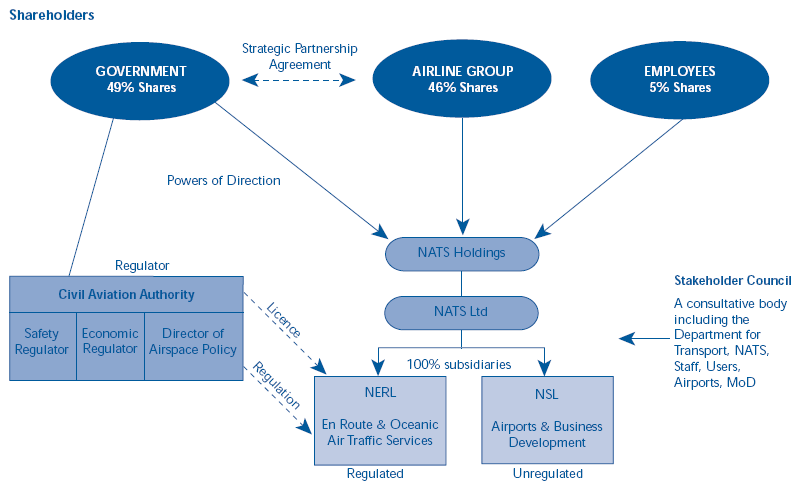
7 |
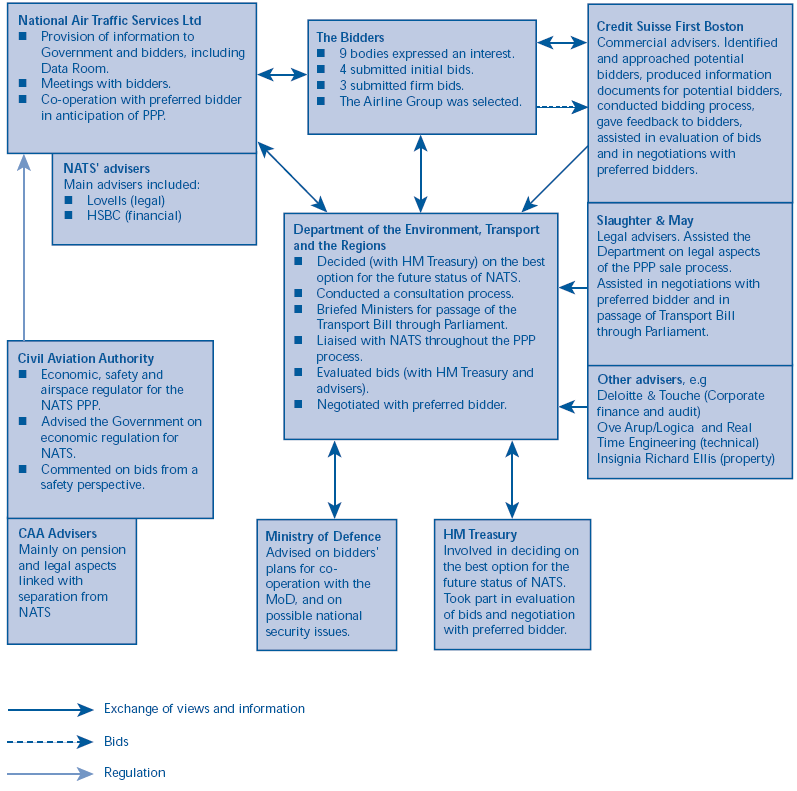
| Kay players involved in the design and implementation of the NATS Public Private Partnership |
|
| Many public and private bodies were involved in the process.
Source: National Audit Office |
1.12 The key events in the process of selecting the strategic partner, compared to the original timetable, are highlighted in Figure 8 on page 20. The timetable was largely met except in the later stages when there was an extra round of bidding, and when closure of the deal with the Airline Group took longer than expected (discussed in paragraphs 1.19 and 1.21). The three shortlisted bidders found the timetable of the final stages very demanding. The Department told us that, once legislation was enacted in November 2000, they saw benefits in progressing quickly and ending the uncertainty over the PPP.