NATS' business plan provides a basis for acceptable performance, subject to future technological developments
3.9 NATS introduced its first post-PPP Business Plan in December 2001. The Plan was heavily influenced by the downturn in air traffic following the events of September 11th 2001, and the finances to support implementation of the Plan have still to be put in place. Nevertheless, the Plan has been better received than most previous NATS' Business Plans, not least because there has been extensive consultation with shareholders, users and NATS' regulators during its drafting. A new Stakeholder Council, set up as part of the PPP, has been an additional forum through which NATS' customers have expressed their views. The Stakeholder Council is chaired by a government-appointed Partnership Director and the NATS Board is required to formally consider its representations. As well as NATS, the Stakeholder Council meetings are attended by representatives of the Government (the Department and Ministry of Defence), the Airline Group, airlines, airports and other users of NATS' services, environmental interests and NATS staff representatives.
3.10 We have examined how NATS' business plan addresses the main risks to the achievement of the Partnership's objectives for developing the business. We consider the key risks are:
■ that the plan might not provide for sufficient additional air traffic control capacity;
■ that sufficient controllers or systems may not be available; and
■ that management capability in NATS may not be enhanced to meet the challenge.
These risks are described in paragraphs 3.11 to 3.17 below.
3.11 The plan covers the ten years to March 2011. During this time, NATS expect the annual number of flights it handles to increase from just over 2 million to around 2.8 million, but the Company has planned to provide sufficient capacity to meet their high growth forecast, which predicts around 3.1 million flights per year by 2010, (Figure 19). This is prudent because projects to increase air traffic control capacity typically take several years to bring into operation, and under-capacity tends to have disproportionate effects on delays. Figure 16 (on page 32) shows that, as airspace capacity is approached, the level of delays rises exponentially. Greater air traffic control capacity will reduce delays, and will also have environmental benefits because aircraft will burn less fuel and cause less noise pollution. The Civil Aviation Authority told us that in their view the projections for growth used in the business plan were sensible.
19 |
| The growth in capacity proposed in NATS' 2002 business plan |
|
| NATS' business plan proposes increases in capacity to deal with a high rate of traffic growth in the skies above Southern England.
NOTES 1. For example, providing more controllers per sector. 2. Capacity gains from splitting the airspace into smaller sectors. 3. New computer tools to carry out some of the functions currently done by controllers. Source: NATS |
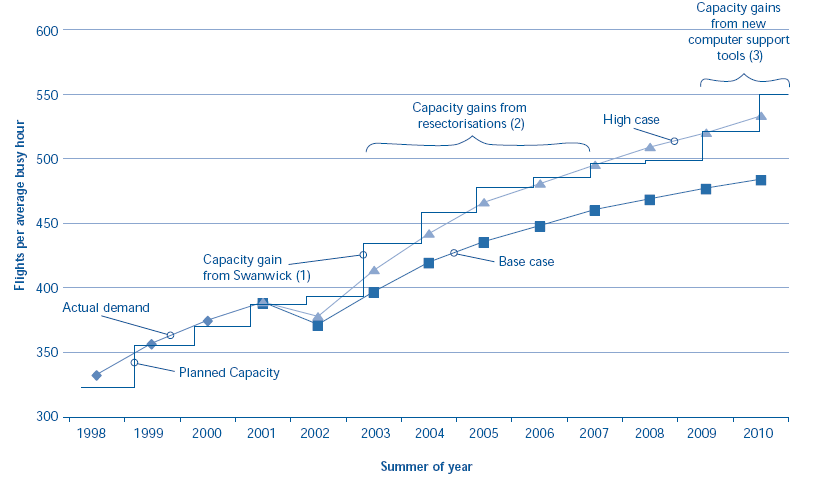
3.12 For most of the Plan period, up to 2008, NATS will improve capacity in the same way as it did in the 1980s and 1990s; by labour intensive methods. These involve splitting its airspace into smaller sectors, and changing the way in which controllers work (such as by having two controllers per sector instead of one). These methods will require more controllers than NATS currently has, and the Company has embarked on a demanding programme of recruitment. The annual intake of trainee controllers at NATS' training college will only be increased from 120 to 130, but NATS hopes to achieve significantly higher pass rates by more selective recruitment and effective training, and shorten the period of "on-the-job" training. Increasing the complement is a particular challenge because, due to recruitment patterns in the 1970s and 1980s, many controllers are due to retire in the next few years. NATS plans to increase the number of en route controllers from 1421 in 2001 to 1617 in 2011. It is too early to say whether these measures will be sufficient to deliver the planned increases in capacity over the period of the Plan, but controller shortage is a problem across much of Europe. The new control centre at Swanwick provides space to accommodate the increased controller numbers required for airspace over England and Wales.
3.13 Beyond a certain point, splitting up airspace into increasingly smaller sectors will cease to be effective, because aircraft need to be formally handed on from one sector to the next, and with smaller sectors these handovers will take up more and more of controllers' time. Therefore from around 2009, NATS aims to introduce new technology to increase controller efficiency. These tools will automate some of the controllers' functions, and also warn of potential collisions far in advance of the aircraft coming near to each other. However such tools are not currently available, and it is not yet clear when they will be developed and what level of capacity or efficiency gains they will bring.
3.14 Like other shortlisted bidders for the NATS PPP, the Airline Group proposed moving away from NATS' previous usual strategy of commissioning custom-built systems for its major projects such as Swanwick. The Business Plan intends to reduce the risks and costs of system procurement by modifying existing "off-the-shelf" systems to meet NATS' particular needs. NATS plans to buy such systems jointly with air traffic control authorities of neighbouring states, who supported the Airline Group's bid. In May 2002, NATS and the Irish Aviation Authority announced that they had agreed to investigate potential areas of co-operation including airspace management, systems investment and support services. For example, the two authorities could combine their staff training programmes, and manage parts of each other's airspace. The other air traffic authorities which supported the Airline Group bid, and with which NATS would be most likely to co-operate, are those of Germany, Holland, Belgium and Iceland. Such moves are likely to be encouraged by the European Union's Single Sky initiative, which aims to restructure and simplify air traffic control in Europe, and may lead to fewer air traffic control providers. Forming alliances in the same way as airlines have done may improve the position of entities like NATS if and when such restructuring takes place.
3.15 The main immediate effect of September 11th on the NATS Business Plan was to postpone the opening of the New Scottish Centre at Prestwick, probably until 2009. The target opening date for this centre when the PPP was signed was 2007, but in fact the existing Scottish centre at Prestwick does not have the same capacity constraints as existed at Swanwick's predecessor at West Drayton. The safety regulator believes that a delay to 2009 is feasible, although NATS will have to monitor and update the existing centre's hardware and support systems, some elements of which will be 30-40 years old by then. Another relatively aged NATS asset is the flight data processing system at West Drayton, which processes information on flights in UK airspace, and on which the new centre at Swanwick is dependent. The system was installed in 1975, and although the hardware has been replaced on a number of occasions (most recently in 2001), the software is written in a language no longer in general use, except in the equivalent system in the United States. The system has a good reliability record (99.96 per cent in 2001) but has had three serious failures since 2000, including two so far in 2002, severely affecting operations at Swanwick. The current NATS Business Plan envisages replacement of the flight data processing system in stages from 2007, but still expects it to support some operations at Swanwick until 2011. This timetable is under review in the light of the recent incidents.