Appendix 2 National Air Traffic Services Ltd
Before the disposal of a 51 per cent stake through the Public Private Partnership in July 2001, National Air Traffic Services Ltd (NATS) was a wholly-owned subsidiary company of the CAA. NATS provides air traffic control services in UK airspace, and jointly with Ireland in the Oceanic Control Area over the North-Eastern Atlantic Ocean. In the year 2000, NATS handled more than two million flights carrying around 200 million passengers.
Control of aircraft in UK airspace flying between airports, or en route to overseas destinations, is known as en route air traffic control, and this is NATS' major activity, accounting for around 82 per cent of its revenue (around £486 million in 2000/01). Charges for en route services are collected on behalf of NATS by a division of the European organisation for the safety of air navigation, Eurocontrol.
En route control of aircraft flying along the major airways over most of England and Wales is carried out at NATS' new London Area Control Centre at Swanwick in Hampshire, which opened in January 2002. Control of the complex and congested lower airspace over London and the surrounding areas is still carried out from the London Terminal Control Centre at West Drayton, near Heathrow. Two centres at Prestwick in Ayrshire control the airspace over Scotland and Northern Ireland and also (in conjunction with the Irish Aviation Authority) provide a service to aircraft over the north east Atlantic. There is also a small en route centre at Manchester which covers north west England. NATS has developed a two-centre strategy to rationalise these facilities, involving the transfer of the West Drayton functions to Swanwick, and the construction of the New Scottish Centre at Prestwick, that will replace the existing facilities at the existing Prestwick site and take over the functions of the Manchester centre.
NATS' second major source of income (around 13 per cent of turnover, or £81 million in 2000/01) is through control of aircraft arriving at and departing from UK airports. NATS provides air traffic services at 14 major airports, including the major UK operations at Heathrow, Gatwick and Stansted. At airports, NATS recovers its costs either directly from aircraft operators or through charges paid by the airport company. Provision for airport air traffic control is a competitive market. Some airports provide their own ATC service, while others use private companies such as Serco.
NATS also receives revenue for services provided to the MOD, for providing services to helicopters operating in the North Sea, and for various training, engineering support and consultancy contracts in the UK and overseas. One of the key features of UK air traffic control is the way in which NATS and MoD controllers currently work together aided by collocation. NATS is formally responsible for en route air traffic control throughout UK airspace, and controls the designated air routes, other busy areas such as the terminal control areas in South East England and Central Scotland, and advisory routes. NATS also provides services to aircraft in certain areas outside controlled airspace. However, the services to aircraft outside controlled airspace are shared with Ministry of Defence controllers who, using NATS equipment, control military and some civilian traffic. They also make use of NATS equipment for defence purposes (e.g tracking intruders).
NATS' main centres of operations
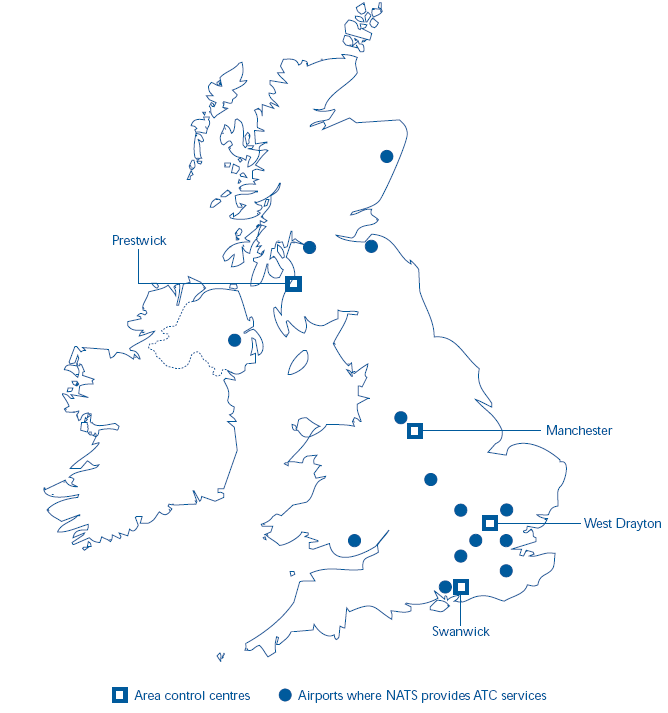
West Drayton. Area control facilities managing traffic in the southern half of the UK, were replaced by the new centre at Swanwick, outside Southampton in January 2002. The London Terminal Control Centre remains at West Drayton, as does the Military Area Services Operations Room, pending relocation to Swanwick. Both are relatively modern facilities completed in the early 1990s. Manchester - a small area control centre, likely to be subsumed by the New Scottish Centre within the next 10 years. Prestwick Centre, managing traffic in the northern part of the UK, and the North-East Atlantic (jointly with Ireland) to be replaced by a New Scottish Centre at the same location, probably by 2009.