Housing Strategy
1.1 The previous Government's July 2007 Green Paper, Homes for the future: more affordable, more sustainable outlined two key housing delivery targets:
• Increase housing supply to 240,000 new homes per year by 2016, including 45,000 new social homes per year by 2010-11.
• Ensure 95 per cent of social housing in England reaches the Decent Homes standard by 2010. The standard aims to make homes warm, weather-tight and with reasonably modern facilities.
1.2 Under the previous Government, spending on social housing was due to increase to £10 billion a year by 2010-11. In March 2009, the Department for Communities and Local Government (the Department1) projected growth in demand for new homes of at least 275,000 a year compared to extra supply of less than 100,000.2 On current projections (November 2009) 305,000 properties will not reach the Decent Homes standard by 2010, although work on the properties will be partially completed, underway or planned.3
1.3 A range of organisations is responsible for improving existing social housing and delivering new homes (Figure 2 overleaf). The Homes and Communities Agency (the Agency) was created in December 2008 to take over responsibility for housing delivery from the Department, the Housing Corporation and English Partnerships.
|
Figure 2
|
|
Source: The Department for Communities and Local Government and the National Audit Office |
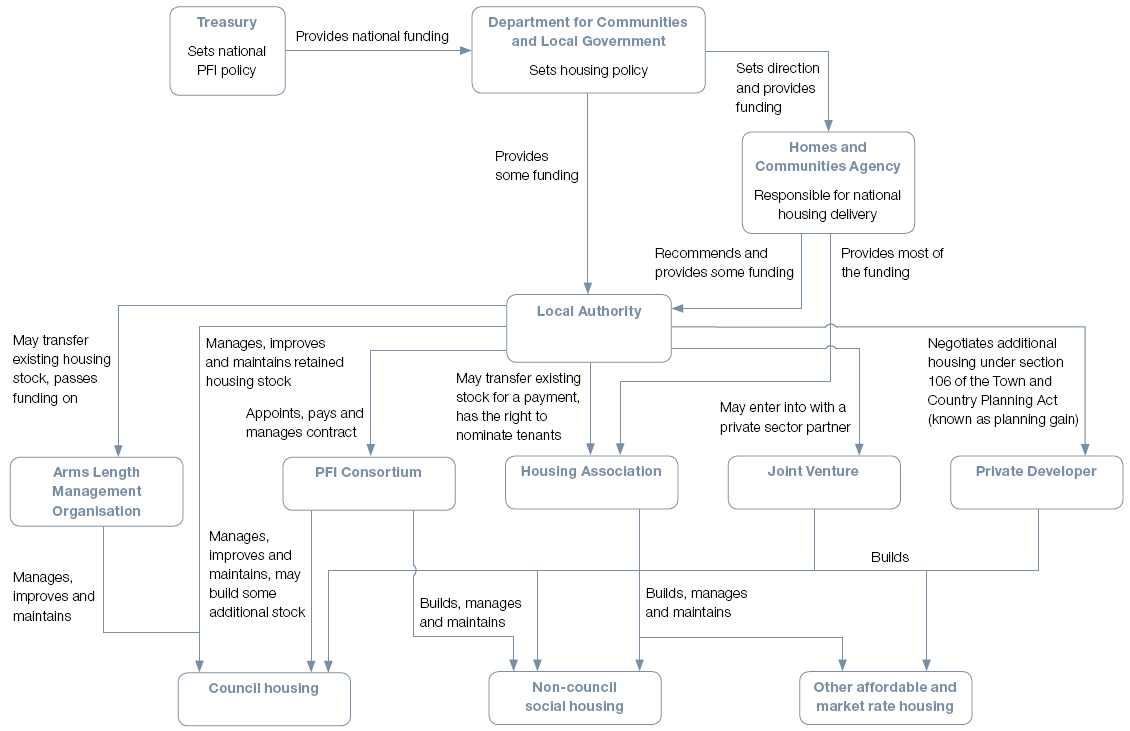
1.4 To ensure existing council stock reaches the Decent Homes standard, many local authorities have funded improvements themselves. Where additional funding is needed there are three investment options, although not all options will suit the particular circumstances and needs of individual local authorities:
• Stock may be transferred to housing associations for a payment equivalent to the value of the stock. Housing associations fund refurbishment through private borrowing and their own resources. Where stock has a negative value this has only been possible where there has been gap-funding.
• Some local authorities have established companies, known as Arms Length Management Organisations, to manage and improve their stock with funding provided by the Department. This is generally not an option where high levels of investment are required.
• The Private Finance Initiative (PFI), where the local authority enters into a contract with a private sector partner, is aimed at areas of higher investment need.
1.5 The funding regime for local authorities has discouraged them from directly building new social housing. Typically this is provided by housing associations using government grants. Local authorities can also ensure that developers provide new social housing through the planning system4 or enter into joint venture vehicles with private sector partners. Proposals were announced in July 2009 to reform the council housing financing regime which could provide local authorities with greater flexibility to maintain existing stock and invest in new housing directly.5
______________________________________________________________________________________
1 We use this to refer to the present Department and its predecessor departments which had responsibility for the PFI housing programme.
2 Mind the Gap – housing supply in a cold climate, David Pretty and Paul Hackett for the Smith Institute, the Town and Country Planning Association and PwC, September 2009.
3 The Decent Homes Programme, National Audit Office HC 212 2009-10, 21 January 2010.
4 Section 106 of the Town and County Planning Act 1990 allows local authorities to enter into planning agreements with developers. As part of these agreements developers are often obliged to deliver an agreed percentage of social housing.
5 Reform of council house finance consultation, Communities and Local Government, July 2009.