A strategic review of the project scope may have generated further savings
1.6 The Department carried out a strategy study in 1992 to consider all their communications requirements until 2010. This study considered the implementation of a single fixed telecommunications system as the keystone of the Department's future communications strategy and the savings which this would produce would be an important factor in enabling their other plans for improving communications to be achieved. This strategy was confirmed by the Department's Defence Costs Study 16, which was an element of the Front Line First initiative of 1994.
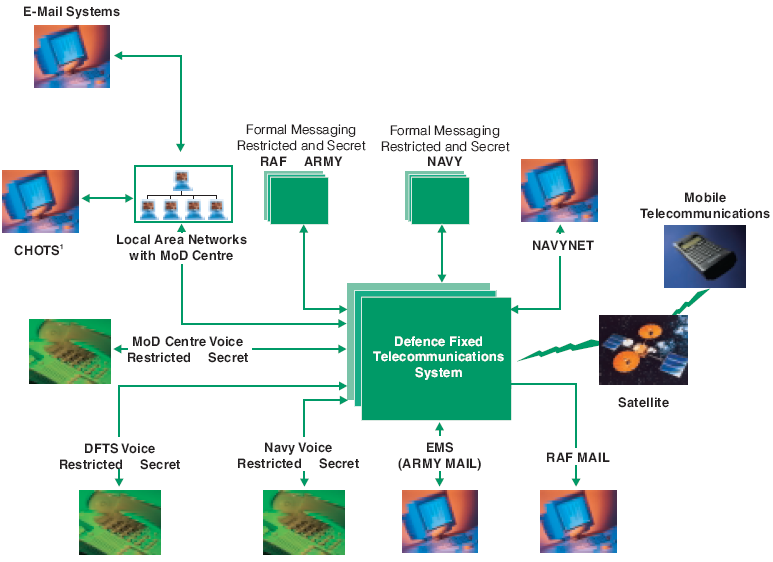
1.7 There are interrelationships between the Department's various communications systems and the Defence Fixed Telecommunications System network, which transports the voice or data (Figure 4, next page). In addition, the rapid changes in communications technology require purchasers to reassess quickly and frequently the most effective mix of systems and forms of service delivery that will meet their needs. Although the Department's studies considered a wide range of communications services, the Department did not assess the potential advantages and disadvantages of alternative scopes for the project to procure a new fixed telecommunications system. We would have expected the Department to have carried out a strategic review of the likely benefits and disbenefits of both expanding the project to include more than just fixed telecommunications (in order to take advantage of volume savings), or reducing the scope to generate competition between suppliers for a number of smaller projects.
|
|
Figure 4 | How the Defence Fixed Telecommunications System connects to other Ministry of Defence telecommunications networks |
Many of the Ministry's other telecommunications networks are connected to the Defence Fixed Telecommunications System
| |
Note:1. Corporate Headquarters Office Technology System (see Glossary) Source: Taylor Barton Taylor consulatants | |
1.8 Our consultants, Mason Communications and Taylor Barton Taylor, consider that the inclusion of other forms of telecommunications in the project would have led to further savings. These savings would have arisen through:
■ better pricing arrangements to reflect the greater volume of services being supplied by the contractor. The Department were able to negotiate volume discounts for three of the services in the contract (paragraphs 3.27 and 3.28);
■ more efficient purchasing and maintenance of hardware; and
■ a simplified system of support services.
In addition, like many telecommunications users, the Department are monitoring the growth in the use of mobile telecommunications and are considering the impact this may have on their fixed telecommunications requirements. The Department did not, however, address this issue in the specific planning for this project.
1.9 The Department told us they may try to bring other areas of their fixed telecommunications within the contract as their other telecommunications contracts become due for renewal. For example, they are currently negotiating terms to bring the telecommunications component of their Corporate Headquarters Office Technology System (CHOTS) within the system (see Glossary). This system links the whole of the Department and provides transmissions up to secret security level. Including this system should allow the Department to negotiate price reductions for similar services that are already within the contract, due to the increased volume of transmissions.
1.10 Following the end of the Cold War and the Government's recent Strategic Defence Review, the Department decided that the BOXER and UNITER systems (see Glossary), which provide telecommunications resistant to nuclear attack, need no longer remain in public ownership. The Department are investigating the possibility of a public-private partnership to own and operate BOXER, and are considering changes in the scale and provision of UNITER. These plans may result in reduced payments under the contract but there are likely to be cessation charges payable to BT, which provides support services for them under this contract so the impact on value for money of including these two systems is unclear at present.
1.11 These developments demonstrate that the Department's various communications needs in a rapidly changing sector require careful management. For this reason we consider the Department should have carried out a strategic review to determine the most appropriate project scope.