Executive summary
1 The Joint Services Command and Staff College (the College) was established in January 1997 and initially operated in temporary facilities at Bracknell. In August 2000 the College opened in new purpose-built facilities at Shrivenham (Figure 1 opposite). The College trains 2,000 people a year with a staff of 160. Its forecast expenditure in 2001-02 is £35 million1. From April 2002 the College is to become part of the Defence Academy of the United Kingdom, along with the Royal Military College of Science at Shrivenham and the Royal College of Defence Studies in London.
2 The Ministry of Defence (the Department) identified the need for a joint command and staff college in its 1994 Defence Cost Studies. Command and staff training had to keep pace with the fact that there were more joint operations and with initiatives such as the formation of the Permanent Joint Headquarters and the Joint Rapid Reaction Force. During the Defence Costs Studies the Department also considered that a joint college would generate savings from rationalisation of the existing Service colleges - the Royal Navy at Greenwich, the Army at Camberley and the Royal Air Force at Bracknell. Following more detailed work the Department concluded that a joint college would be broadly cost-neutral.
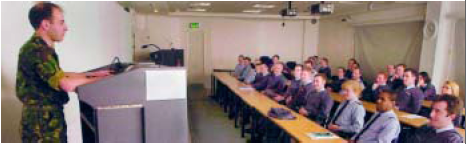
3 The Department originally intended to pursue a conventionally funded public sector solution to provide a new college but this proved costly and it was questionable whether the large initial capital outlay involved was affordable. The Department therefore explored a Private Finance Initiative (PFI) project for the construction of a new college, associated married quarters and single accommodation, and the provision of facilities management services and academic teaching - the Department continues to provide directing staff and military lecturers. In June 1998 the Department awarded a 30-year contract to Defence Management (Watchfield) Limited (Defence Management), a special purpose company wholly owned by Laing Investments and Serco Investments. Figure 2 provides a brief chronology of the steps leading to the establishment of the new College at Shrivenham.
4 This report examines whether the Department managed the establishment of the College effectively - whether the College has succeeded in delivering joint training and whether the use of the PFI has been value for money. The methodology we adopted is set out in Appendix 1.
2 |
| Chronology of events | |
|
| Date | Event |
|
| July 1994 | Decision to form the Joint Services Command and Staff College |
|
| September 1995 | Decision to explore the use of the PFI to provide the College's permanent facilities |
|
| August 1996 | Invitation of preliminary PFI proposals |
|
| January 1997 | Establishment of the College |
|
| February 1997 | Selection of Defence Management as preferred PFI bidder |
|
| September 1997 | Start of the first joint Advanced course in temporary facilities at Bracknell |
|
| June 1998 | Signature of PFI contract |
|
| August 2000 | Completion of the new facilities at Shrivenham and admission of the first students |
|
| September 2000 | College fully established at Shrivenham; interim facilities close |
__________________________________________________________________
1 This excludes VAT and is net of forecast receipts of £3 million.