The Department concentrated on the joint Advanced course
1.5 The Department set realistic objectives for the level of jointery for the courses at the new college. In practice the training previously provided for each of the three separate Services had been very different from each other. While the Services each saw the need for joint training and were committed to it, the courses at their own colleges had been tailored to meet their own approaches, needs and traditions. Against this background the design of joint training was a considerable challenge.
1.6 Given the need to take all three Services along with it, the Department adopted an incremental approach to delivering joint training. It considered that there would be significant benefits from concentrating on the mid-career 12-month Advanced course, the College's "intellectual engine room". This course would form the bulk of the College's training and was designed to prepare students for the next ten years of their careers. The students would go on to occupy senior and higher command and staff posts within the three Services, the Department, and Joint Commands.
1.7 For the Junior courses, the Department considered that a joint academic content was not appropriate as the purpose of these courses was to equip junior officers to fulfil single Service roles. The Department also considered it important to maintain a single Service ethos among officers at these junior levels.
1.8 The Higher command and staff course was essentially an Army course that had been partly opened up to officers of the other Services before the joint college concept was planned. The course was therefore brought under the auspices of the College and the population made increasingly joint.
3 |
| Officer training |
|
| There is a hierarchy of training for officers as their career progresses.
|
|
| NOTE 1. Ranks given are those for the Army. Source: National Audit Office |
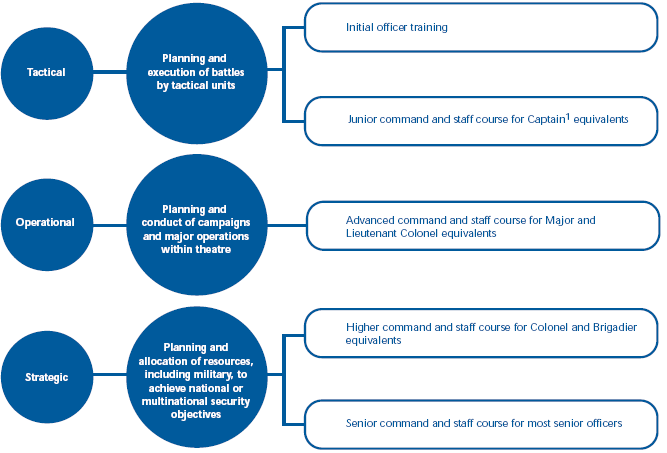
1.9 The College began operating in January 1997 with the first Advanced course starting in September 1997 as planned. The training courses offered by the College on its opening reflected the level of jointery that was considered appropriate (Figure 4). The establishment of the College and delivery of the first Advanced course by the planned dates was a significant achievement given the scope for disagreement about the design of the course. Strong leadership and effective management were crucial to this.