The College seeks feedback from its customers
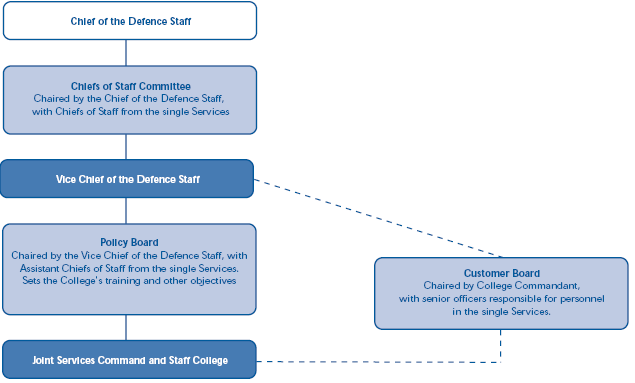
1.31 In addition to its formal evaluation of training, the College gathers feedback from its formal governance structure (Figure 6). The College considers that this structure, combined with the evaluation feedback, ensures that all its key customers within the Department have the opportunity to comment on the appropriateness and quality of the training. The College is concerned, however, that the Customer Board currently does not include all the College's stakeholders. It therefore informally seeks feedback on its training from all stakeholders who visit the College to deliver lectures to the students. The College also recognises that the formation of the Defence Academy will provide it with an opportunity to address its concerns over stakeholder representation on its governance structure.
1.32 There are also other, more peripheral stakeholders who are not represented in the College's governance structure and whose training is not formally evaluated by the College. Around a fifth of students on the Advanced course are students from overseas armed forces. Their training is part of defence diplomacy and foreign policy cultivating links with those countries. Overseas demand for these places is high, reflecting the College's international standing.
5 |
| The College's evaluation of training | ||||
|
|
|
|
| ||
The College evaluates its training in line with good practice. Feedback on the training has generally been positive. | ||||||
Aspect of evaluation | Evaluation method | Evaluation results | ||||
Student satisfaction | Satisfaction with the three courses is extensively monitored, primarily using questionnaires filled in by the students during the courses. | Feedback has been generally positive. On the Advanced course, for example, less than 10 per cent each year say that the course has not met its objectives at least satisfactorily. Student satisfaction with the course is gradually increasing year on year. | ||||
Validation of student's learning | The College does grade its students at the end of its main course, the Advanced course, based on their performance and work during the course. Assessment of the education received by the Advanced course students is also provided externally for those who chose to sit an MA as part of their course. | The trend is for an improvement in the grades for students' performance. Up to 55 per cent of students choose to take this each year and the pass rate is over 80 per cent. | ||||
Impact on the student's performance | For all courses questionnaires are used to gather the views of the graduates and their line managers (both military officers and civil servants) on the relevant course and on the performance and ability of the graduates. The questionnaires are sent out between 6 and 18 months after the course's end, the timescale varying with the course. | Feedback in November 1999 from the graduates of the first Advanced course in 1997-98 was that the course had been useful and its benefits were growing over time. Their line managers stated that it was too early to make a worthwhile assessment of the graduates against their peers who had not been on the course. However they considered that the graduates were at least of an equivalent ability and had a better understanding of the joint environment. | ||||
Long-term impact on the organisation's performance | The College currently does not evaluate this, although it plans to do so for the Advanced course. Firstly, it intends to monitor the performance of a sample of graduates from each course by sending these graduates and their line managers a questionnaire every two years for a ten year period after the end of their course. Secondly it intends to identify certain key marker posts and monitor the performance of the graduates holding these posts at that time, as revealed by each subsequent round of questionnaires. This will allow it over time to identify any improvement or otherwise in the quality of the different graduates holding that post. | None to date. | ||||
|
|
| ||||
Source: National Audit Office | ||||||
6 |
| The College's governance structure |
|
|
|
|
| Source: The College |
1.33 As a result of the Defence Training Review, the College is to become part of the Defence Academy of the United Kingdom from April 2002. The Academy will aim to be a national and international centre of excellence, providing military and civilian personnel with high quality education, primarily at postgraduate level, and carrying out academic research, in fields related to defence. The Royal Military College of Science at Shrivenham and the Royal College of Defence Studies in London will also be included in the Defence Academy. These organisations are to be brought together under a single management and budgetary structure. The College intends to ensure that its customers are effectively represented on the new governance structure for the Academy.