Overall conclusions
4 We have identified three main reasons behind this failure: the sheer number and scale of risks and lack of a single sponsor; the way in which the Campus partners organised and carried through the scheme, including the failure to secure adequate land for the scheme; and the lack of active strategic support for the Campus vision.
5 The cancellation of the scheme represents poor value for money for the patients, visitors and staff who have been left with hospital premises that are long overdue for renewal and specialist clinical services which have failed to meet the recognised need for reconfiguration.
6 While it was necessary to spend money attempting to develop a robust business case for the proposed health campus, taxpayers have nevertheless lost out as the almost £15 million spent came to nothing. In addition, in recent years, building costs have risen sharply. The failure to deliver to the original timetable means that any new schemes will be more expensive for the taxpayer than they need have been. However, to date no additional costs have been incurred as the scheme did not proceed.
7 An important opportunity to put the scheme on a sounder footing was missed in late 2002/early 2003. An assessment in December 2002 by external construction consultants, commissioned by the Campus partners, provided evidence, for the first time, that the estimated capital construction costs had more than doubled since the OBC. In November 2002 Westminster City Council advised that the scheme could not fit on the land available.
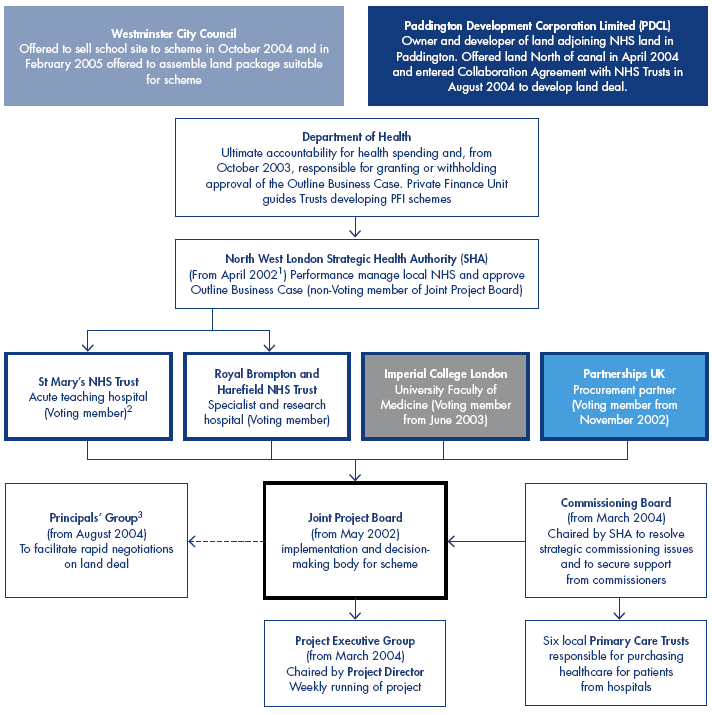
1 | The principal organisations involved in the Paddington Health Campus scheme (2002-2005) |
Source: National Audit Office | |
NOTES | |
1 The project was initially sponsored by the West London Partnership Forum. The Forum oversaw the scheme through its Paddington Basin Project Board from April 2000 to March 2002. 2 The other non-voting members of the Joint Project Board were the North West London Strategic Health Authority and the Kensington and Chelsea, Westminster and Brent Primary Care Trusts. 3 The Principals' Group comprised the Chairs, Chief Executives, Finance Directors and nominated Non-Executive Directors of the two NHS Trusts, the Project Director, the Paddington Health Campus land negotiator, the Chief Executive and Chair of the North West London Strategic Health Authority, and representatives from Imperial College London, the Department of Health (until January 2005) and Partnerships UK. It was chaired by the Strategic Health Authority. It was not a formal part of the Campus accountability framework but met every week. | |
8 While the Campus partners were rightly committed to overcoming obstacles, we believe the failure to have a critical challenge led to wasted and misdirected effort and expense. The Strategic Health Authority should have either required that the Campus partners draw up a new OBC in early 2003 or cancelled the Campus scheme. Cancelling the scheme at that point would have freed resources and organisations to develop other schemes. Developing a new OBC would, we believe, have led sooner to the robust assessment of whether the partners could afford to build the scheme and address the:
■ more than doubling of the forecast capital cost;
■ absence of adequate land, in the light of planning constraints; and
■ lack of available funds to build the scheme.
9 A further two years were spent exploring a variety of alternative schemes. In 2003 the Campus partners, strongly encouraged by the Strategic Health Authority, developed Outline and Full Business Cases to acquire The Point building beside St Mary's hospital in 2003. From Summer 2004 onwards the Campus partners developed a new OBC for the whole scheme, at the request of the Chief Secretary to the Treasury. In the event, in May 2005 the Campus partners could not agree a revised OBC.