The Campus partners were unable to secure adequate land for the scheme
3.2 The NHS did not own enough land to make the Campus work within Westminster City Council's planning policy. It therefore needed additional land. Much of 2003 was spent exploring the possibility of acquiring additional space beside the Campus site - The Point building. This was an office building on the other side of the Paddington Basin from the St Mary's site. With the strong encouragement of the Strategic Health Authority, which also took an active role in securing Primary Care Trust agreement to the affordability of this option, the Campus partners prepared a Full Business Case for the procurement of The Point. This was approved by the Strategic Health Authority on 4th November 2003 which then submitted it to the Department for approval (Map C in centre page map section, page 28).
3.3 A month earlier, the Chief Secretary to the Treasury wrote to the Department expressing concern about the scheme's escalating costs and setting out that before he could consider approving any expenditure on the Point he required:
■ a new OBC for the Campus scheme; and
■ an independent review of the process that led to that situation.
3.4 Once the Joint Project Board was orally briefed on the interim findings of the independent review in February 2004, it stopped work on developing the scheme as the review highlighted fundamental weaknesses (Map D in centre page map section, page 28). The Department authorised work on a new OBC, as requested by the Chief Secretary, in July 2004, following a submission from the Campus partners in April 2004.
3.5 In April 2004, Paddington Development Corporation Limited (PDCL), the developer of the Paddington Basin site, approached the Campus partners with a proposal that the Campus use land to the north of the Paddington Basin (Map E in centre page map section, page 28 ). The Campus partners immediately referred the offer to the Department who approved testing its feasibility.
3.6 In October 2004 Westminster City Council's Leader and chair of its planning committee met with the Campus partners and informed them that the then current proposal with hospitals on both sides of the Paddington Basin could not be recommended for planning permission. The Campus partners recognised that this would mean they could not build the Campus as they did not have sufficient land available to meet the Council's concerns. They therefore decided to exit the scheme, anticipating that it would take four weeks to make the arrangements before making a public announcement.
3.7 Three days after this decision, Westminster City Council re-iterated that it would support use of part of the North Westminster Community School site, due to become free in 2006, to accommodate all clinical activity at the hospitals on the north of the Basin. The Campus partners, with Departmental consent, immediately decided to explore the Council's offer. This would have freed the main St Mary's site as well as the Brompton and Harefield sites for disposal, more than funding the costs of acquiring the land on the north of the Basin, albeit with a delay before disposal receipts could be received.
3.8 In December 2004 the Campus partners thought they had found a solution which involved the purchase of land from PDCL and Westminster City Council. However the Department considered that the proposed land deal was unacceptable because it meant the land purchase would appear on its balance sheet, and so would count against its annual spending limit for capital projects, which it could not accommodate. The Department also considered the £62.5 million premium over open market value that would be paid to PDCL excessive, although the District Valuer confirmed that, in his view, the land transaction represented fair value. The Department made clear in January 2005 that it would reject the December 2004 OBC on the above grounds.
3.9 The Campus partners therefore decided in January 2005 that, in the light of the Department's reaction to the 2004 OBC, they had no option but to exit the scheme.
3.10 Westminster City Council did not want to see the scheme fail because of a lack of land as, in planning policy terms, it had made clear since 1987 that it viewed the retention and improvement of St Mary's hospital as a strategic priority for the Council. Therefore, in February 2005, with the agreement of the Department, and the support of the Campus partners, but without any written brief, the Council commenced negotiations with PDCL on behalf of the Campus partners (Map F in centre page map section, page 28). The Campus partners were not present at these discussions although the Department held a number of bilateral meetings with the Council over this period. On this basis the Campus partners decided to draw up an Addendum to the 2004 OBC. This would concentrate on the financial implications of the potential new land deal.
3.11 The Department stipulated four conditions for the land deal for the Campus scheme. These were that:
■ The agreement on land for the Campus scheme had to be with Westminster City Council only, not PDCL, as the Department did not believe PDCL should receive anything more than fair open market value for their land.
■ PDCL was not to be involved in the disposal of surplus sites.
■ No overage was to be paid to parties other than Westminster City Council.
■ No premium over open market value should be paid by the NHS on land it acquired.
3.12 The PDCL negotiator made it clear that he would not recommend any proposal to his shareholders unless it had been agreed by the Department first and represented at least as good value to PDCL as the proposed December 2004 deal. This made the approval of the Addendum to the OBC difficult: there could be no Addendum without a land deal and no land deal without support for the Addendum. This conundrum would later prove to be insurmountable.
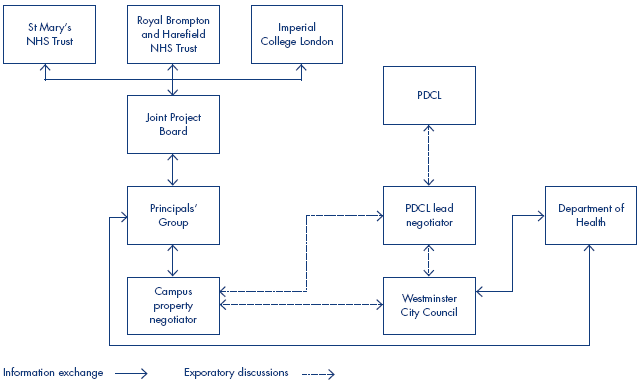
3.13 On 2 March 2005, PDCL formally renounced any further involvement with the Campus partners as it believed the Department did not support the scheme and that the scheme would therefore ultimately fail. PDCL publicly announced it had appointed architects to develop the site. This is not to say nothing was going on. With the support of the Principals' Group and the Joint Project Board, the Campus partners' property negotiator - an independent property consultant - continued to have exploratory discussions with Westminster City Council and the principal PDCL negotiator on what sort of deal might be available (Figure 5).
3.14 Both the Campus partners' property negotiator and PDCL's negotiator were effectively operating informally in exploring with each other the shape and nature of a successful land deal. The Campus partners' property negotiator was authorised to deal with Westminster City Council, but had no brief to discuss with PDCL, and the PDCL negotiator was not, at this time, operating on behalf of PDCL, so did not speak for PDCL. All parties have told us that this did not amount to negotiation. The Department was kept aware of developments by the Council and the Campus partners, even though at this time the Department was no longer invited to the Principals' Group.
3.15 In the proposed May 2005 land transaction PDCL would be involved in the disposal of surplus sites and would receive overage at a lower level than in the December 2004 deal. In addition PDCL would be paid £19 million for the work required to secure planning permission for the surplus sites plus indemnity for abortive costs it would incur in seeking planning consents to develop its site before the Campus partners would agree the land deal.
5 | Relationships between parties on the proposed land deal, March - May 2005 |
Source: National Audit Office | |
3.16 The May 2005 Addendum to the OBC was predicated upon the NHS Trusts accepting contractual obligations if the Department approved the OBC. Because of the complex relationships described in paragraphs 3.13 and 3.14 above, the Royal Brompton and Harefield NHS Trust was not confident that PDCL was serious about selling the land to Westminster City Council or that a genuine proposal existed which had the support of PDCL, Westminster City Council and, particularly, the Department. It was concerned that the Department would not support the proposed land deal as the conditions set out in paragraph 3.11 above had not been satisfied, although the Department had explained that its conditions were not immutable.
3.17 In May 2005 Westminster City Council wrote to the Department to set out
■ how it saw the current position on the proposed land transaction;
■ that it required commercial close on the option to buy the North Westminster Community School site by September 2005; and
■ that it sought a decision from the Department on whether it found Westminster's proposals acceptable by the end of June 2005.
3.18 In its letter, Westminster City Council stated that it believed:
"this overall proposal is fair to both parties and provides an appropriate and justifiable framework for agreement between the public sector partners and a private developer. The most recent offer represents the most favourable basis on which we believe PDCL's participation can be secured. It is either this deal or no deal."
3.19 St Mary's NHS Trust has told us that it was the contents of this letter that formed the basis of its Board's support for the Addendum to the OBC. Conversely, the Royal Brompton and Harefield NHS Trust noted from the same letter that the PDCL Board was "unenthusiastic" and that past experience suggested further discussions between the Trusts and PDCL "may be pointless". Coupled with PDCL's public withdrawal from involvement with the scheme (paragraph 3.13 above), the Royal Brompton and Harefield NHS Trust was left in the position of lacking confidence about the certainty of a suitable land deal and its acceptability.
3.20 Unlike the Board of St Mary's NHS Trust, the Royal Brompton and Harefield NHS Trust Board at this stage declined the offer of another presentation on the proposed land deal from the Campus partners' land negotiator. It believed it had a full understanding of the land deal through previous discussions and presentations. On 25 May 2005 its Board declined to support the proposed Addendum, in part because of the above concerns.