APPENDIX FOUR The opportunity cost of delay in taking forward the Campus scheme
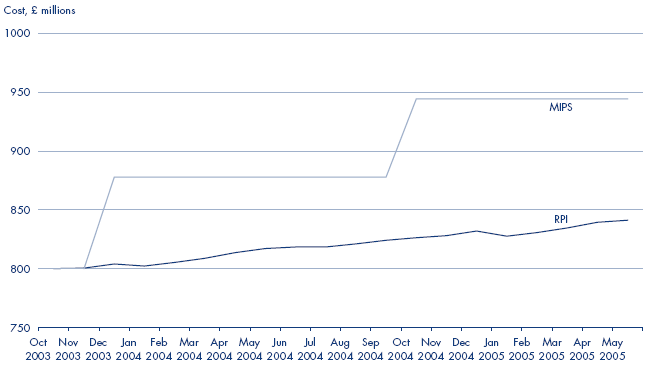
1 The opportunity cost of the failed project is likely to be greater than the simple £14.9 million direct cost of the project itself. Delay is expensive when building cost inflation is running ahead of general inflation in the economy. While it is difficult to be precise about the costs of delay on a scheme which was never static, for illustration, had the project eventually gone ahead in May 2005, in substantially the same form it had reached by October 2003, then that 17 month delay would have added approximately £103 million to the cost of construction (construction tender prices exceeding general inflation by some 13 per cent during the period) (Figure 12). The cost of borrowing has the capacity to offset the impact of capital cost increases, if rates fall, or indeed add to the cost, if rates rise, although the degree of offset /cost would not be known until financial close.
2 This amount is illustrative and is not a cash cost, as the eventual project configuration by May 2005 differed from that in October 2003, partly to accommodate affordability concerns. However, it does demonstrate quite clearly how quickly costs would have risen in this case, at that time. This underlines the importance of factoring likely cost increases into decisions on whether to proceed with a project when there have been material changes to the key factors that determined its original viability.
12 | Construction Costs Inflation between October 2003 and May 2005 |
Source: Office of National Statistics, Paddington Health Campus documentation | |
NOTE RPI is the all-items Retail Price Index and MIPS is the Median Index of Public Sector Building Tender Prices published by NHS Estates based on information compiled by the Department of Trade and Industry. | |