Operational risks are borne by the supplier
2.17 The FCO's unitary payment to Arteos every month for the provision of accommodation and services will commence once handover has been completed. The payment comprises:
■ an availability element related to availability of each room in the Embassy; and
■ a service element relating to the provision of secondary and tertiary services.
2.18 If service faults occur which are serious enough to affect availability of the building, Arteos will forfeit the whole or part of the unitary payment for that period. The contract also stipulates that if 75 per cent or more of the building is unavailable for a month no payment is due, which should encourage the supplier to ensure the Embassy is kept open.
2.19 The Embassy is notionally divided into sections for the purpose of defining the criticality of areas of the building, with key areas such as the Ambassador's suite being the most critical. This weighting is then used in determining the unavailability of the building and therefore the level of deductions from the availability payment which should be incurred. This should ensure key parts of the Embassy form the supplier's highest priority for maintenance.
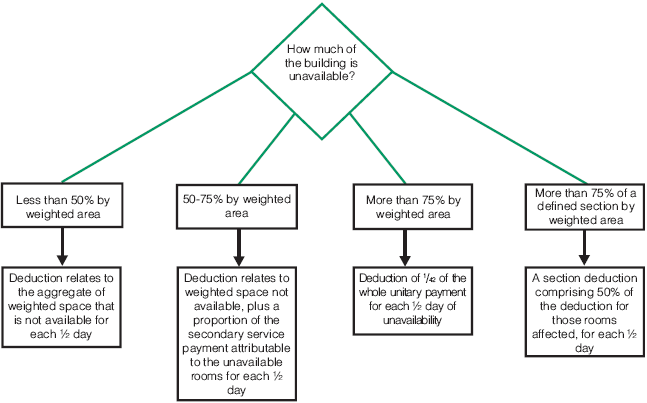
2.20 The payments regime is designed to incentivise the operator to remedy any defects which occur to avoid paying financial penalties. The mechanism for reducing the monthly unitary payment when parts of the building become unavailable is shown in Figure 11.
Figure 11 |
|
Availability deduction regime | |
The amount of the deduction depends on the floorspace unavailable and how critical it is to the FCO | |
| |
Source: The FCO | |
2.21 If, during the period that a room is unavailable, the FCO uses it for any reason, the deductions cease for the period of such reoccupation. The FCO cannot claim unavailability for a room and make deductions while, at the same time, using that room and possibly hindering the supplier in his attempts to remedy the problem. The FCO has access to such an "unavailable room" in order to retrieve material such as equipment or papers.
2.22 The FCO has achieved a reasonable position in concluding this agreement in the context of a building with offices. Under the contract the supplier may suffer a deduction from the service payment because a room has a defect even though the FCO continues to occupy it. As is recommended by Treasury guidance, the supplier should only receive a full unitary charge to the extent that the service is available to the required standard. Deductions should either be made from the performance payment (the approach taken by the FCO) or from the availability charge.
2.23 The FCO's payments system which relates to the operator's standards of performance incentivises the operator to remedy poor performance. Figure 12 explains the mechanism for reducing the service-related element of the unitary payment when failures in service occur. Arteos can avoid payment reductions even if it provides poor service for one month if it is able to remedy the problem so that there is a good service provided for the following three months.
2.24 The FCO has ensured that it will only pay for consumption of utilities up to the levels agreed with Arteos regardless of actual consumption, although the FCO will bear the risk of utility prices increasing, or achieve savings if utility prices fall.