1 Risks to the Ministry of Defence
1. The Defence Evaluation and Research Agency (DERA) had the role of supporting effective procurement of military equipment by providing the Ministry of Defence (the Department) with independent advice and carrying out research to support the development of advanced technology. It also managed the testing and evaluation of military equipment.2 The decision to part privatise DERA was taken in 1998 as a means of addressing the impact that declining defence research budgets would have on the business. Over the period 1992 to 1998 the budget for defence research had fallen by 40% in real terms.3
2. QinetiQ was created by dividing DERA into two organisations in 2001. The most sensitive aspects of DERA's work were kept in the public sector by transferring them to the Defence Science and Technology Laboratory. The remainder of DERA, including the responsibility for delivering test and evaluation services, was transferred to a Government owned private company, QinetiQ, and privatised in two stages: the sale of a minority stake to a strategic partner in 2002 and the flotation of the business on the London Stock Exchange in 2006.
3. The privatisation has been successful in protecting the viability of the business.4 Since the privatisation, QinetiQ has found new sources of revenue to balance the fall in the defence research budget, which between 2001 and 2005 fell by 10% in real terms.5 Revenue has grown by 48% between 2003 and 2007, as shown in Figure 1, and operating profit has increased by 197% over the same period. The business has expanded its presence in the US defence market by acquiring a number of US companies,6 and in the six months to September 2007 it derived over 40% of its revenue from the US.
4. Significant risks to value for money remain over the long term.7 One of the Department's objectives in part privatising DERA was to deliver reduced contract prices, enhanced flexibility and improved services. It is not yet clear whether these aspirations have been achieved. There is a particular risk associated with the price of the 25 year Long Term Partnering Agreement, which is renegotiated every five years to agree a minimum step down in price. No other suppliers are able to deliver the services under the contract and the Department will need to develop robust benchmarks to ensure it realises the envisaged costs savings.8
Figure 1: Growth in QinetiQ's revenue
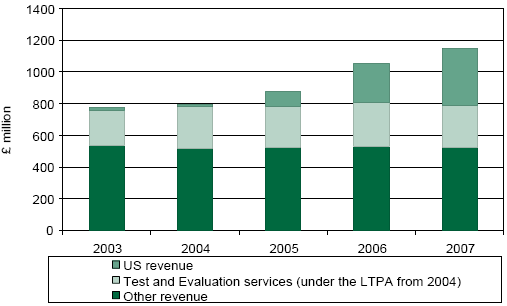
Source: QinetiQ Annual Report and Accounts 2003-07 and IPO Prospectus
5. QinetiQ is still responsible for the provision of independent advice to the Department on the effective procurement of equipment. As QinetiQ is increasingly a supplier to the Department, conflicts of interest may arise when QinetiQ is required to give independent advice on equipment that it is also supplying. In creating QinetiQ the Department established the Compliance Regime whereby QinetiQ is required to inform the Department of any potential conflicts of interest and, where necessary, to establish a firewall between the teams that are providing independent advice and those that are directly supplying the Department.9
6. At present there are restrictions in place that prevent QinetiQ from engaging in defence manufacturing work. These restrictions will be lifted from April 2008, potentially increasing the number and severity of any conflicts of interest and the number of firewalls in operation.10 The Department is confident that the Compliance Regime is working effectively but has acknowledged that it will require careful monitoring.11 It asked its Internal Auditors to audit the effectiveness of the Compliance Regime process and its application in September 2006.
__________________________________________________________________________
3 House of Commons Defence Select Committee, Sixth Report, Session 1997-98, The Defence Evaluation and Research Agency, HC 621, 6 July 1998
5 Using Retail Prices Index
7 Q 43