The fallback was not complete at contract award
2.38 In deciding to continue with a single bidder, PITO planned to develop a credible fallback option. The view was that if O2 saw that a fallback was available to the forces, it would be less likely to exploit its single bidder position. The fallback that PITO envisaged was one in which the police forces, either individually or collectively, as small regional groups, procured their own digital radio systems. The overriding concern that PITO and the Home Office had about this option was that the police forces would procure systems that would not be compatible with radio systems operating in neighbouring forces. The goal of obtaining a national service would be lost. PITO, however, was convinced that O2 and its partners, having spent £20 million in bidding for the deal, also wanted to avoid losing the opportunity of building and operating a national network.
2.39 PITO started preparing a fallback in June 1997 but had to halt work in August because of a lack of resources. Work did not restart until late 1998, after the Association of Chief Police Officers expressed its concern to the Home Office about the lack of a fallback in the event that forces decided not to accept Airwave. As a result, the Home Office made extra resources available and, by the end of December 1998, a fallback strategy had been produced. The strategy set out the issues that would need to be considered if forces
13 |
|
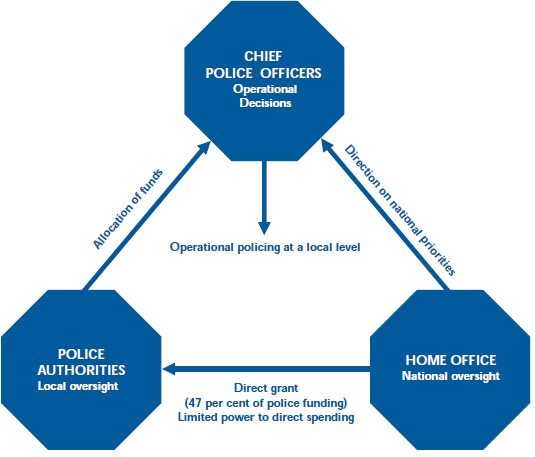
Central funding of the police and powers of direction |
Source: NAO |
conducted their own procurements, and recommended that an implementation package should be developed by July 1999. However, this work was not taken further because resources were again not available. PITO told us that it would immediately have resurrected the fallback option if Airwave had failed, because it would have been the only realistic option for police forces.