Implementation across all police forces will be phased
3.4 There are 52 police forces involved in Airwave (8 in Scotland, 43 in England and Wales plus the British Transport Police). The English and Welsh forces are split into four cohorts rolling out over a four-year period as shown in Figure 15. Scotland will join in 2005. Priority has been given to those forces which have the greatest need for Airwave, while forces that have purchased newer radio systems are in the later cohorts.
3.5 Within each police force there is a phased approach to migration to the new service, police divisions or areas will take up the service one at a time. This enables the force to conduct testing, complete training and identify deficiencies in service, coverage etc. Phased migration also avoids an all or nothing move and the risk of initial problems affecting the whole of the policing function in a force area.
3.6 Lessons learnt from the pilot and the earlier cohorts will be disseminated in order to make migration of later forces smoother. Scripts have been developed for the pilot, which test all of the functions and simulate heavy or complicated patterns of usage. These will be made available for forces to use as part of their own acceptance testing. Other technical solutions and fixes for any problems with interfaces between the infrastructure and the handsets or control room systems will also be shared, although some of these will only be useful if later forces are using handsets produced by the same manufacturer as those used in the pilot. PITO told us that gaining a greater understanding of how this type of technology affects user requirements has been important and will be particularly valuable learning points for forces later in the roll-out.
15 |
| Order of roll-out of Airwave |
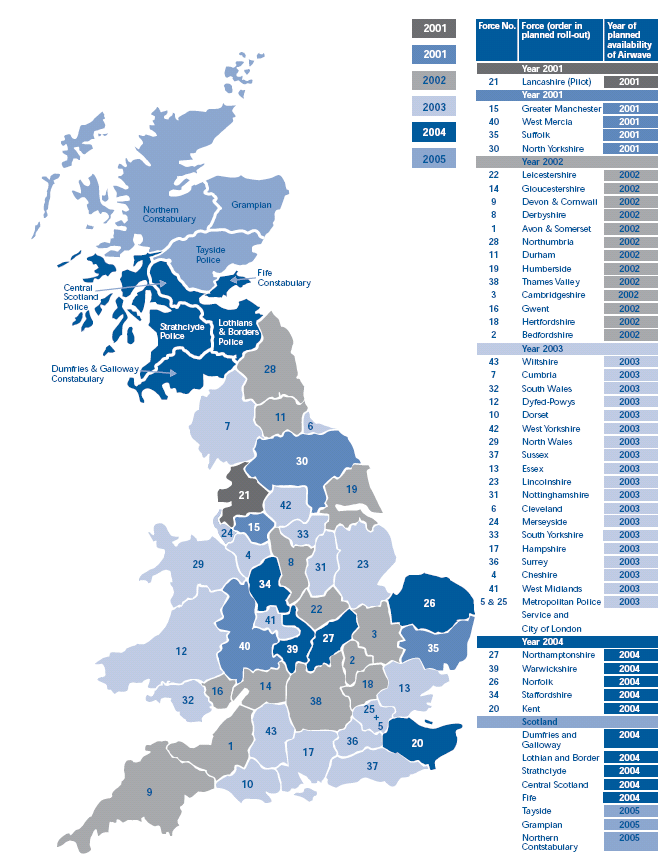
Source: O2 |