SUMMARY

1 In 2003, the Department for Children, Schools and Families (the Department) announced the Building Schools for the Future Programme (BSF), which aims to renew all 3,500 English secondary schools over the 15-year period 2005-2020, subject to future public spending decisions. It plans to entirely rebuild half the school estate, structurally remodel 35 per cent, and refurbish the rest. Refurbishment includes providing new ICT to recently built schools. Local Authorities are responsible for commissioning and maintaining the schools. The Department created Partnerships for Schools (PfS) to manage the programme centrally.
2 The Department sees BSF as important to improving educational attainment and the life chances available to children, by providing educational, recreational and social environments that support modern teaching and learning methods. It wants buildings to be shared and used by local communities, and to be flexible in responding to developing needs. It also wants BSF to support local reorganisation of secondary schools to reflect demographic needs and a greater diversity of provision, including Academies and specialist schools.
3 BSF also aims to achieve improvements in the way school buildings are delivered through:
i targeting funding to groups of schools to allow Local Authorities to plan strategically for the provision of school places and other facilities, and for the delivery of children's services, on an area wide basis;
ii long-term partnering efficiencies between the public and private sectors, usually through the establishment of local joint ventures called Local Education Partnerships (LEPs), which have exclusive rights for 10 years to deliver new and refurbished school facilities and related services; and
iii central programme management, coordination and support for local strategic decision making and school building and refurbishment projects.
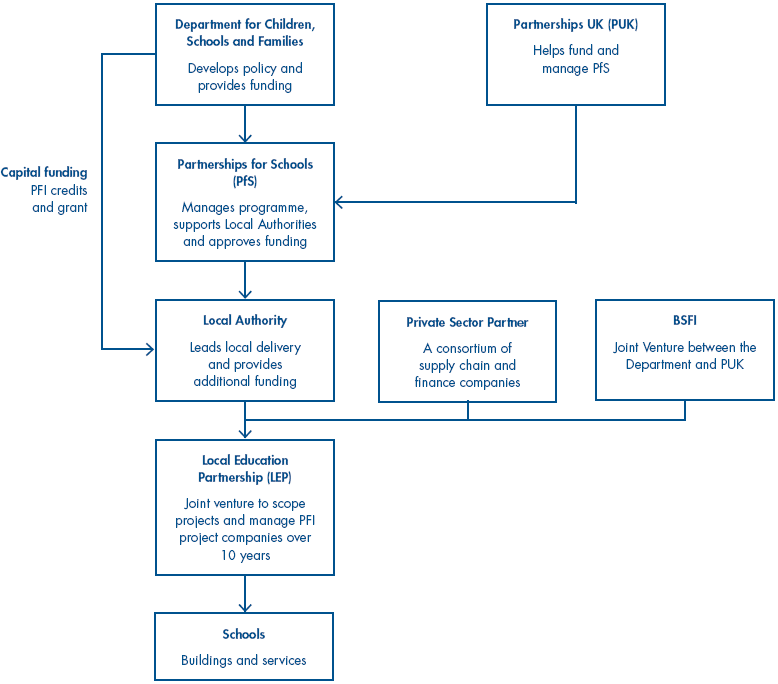
Figure 1 sets out the roles of the main parties. Figure 6 (page 16) shows the funding, contractual and investment flows.
1 | BSF: Roles of the main parties |
Source: National Audit Office analysis | |
4 The Department decided to use private finance in a number of different ways to help deliver BSF:
i By encouraging Local Authorities to use the private finance initiative (PFI) to procure new school buildings with the aim of providing better project management and maintenance. PFI is expected to account for 41 per cent of BSF by capital value up to 2011 (£4.5 billion allocated up to 2011). The rest (mostly to remodel and refurbish schools) is funded conventionally, mainly through capital grant from the Department (£5.8 billion allocated up to 2011).
ii In the funding and management of PfS - which is carried out jointly by Partnerships UK (PUK) and the Department.
iii In the LEP partnering arrangements, which bring together private sector contractors, lenders, the Local Authority, and Building Schools for the Future Investments (BSFI).
iv BSFI is itself a joint venture between the Department and PUK. It invests in the share capital of LEP joint ventures and in PFI projects to allow national influence over the quality of local project delivery.
5 The Department provided £3.6 billion of capital funding up to March 2008 (£2.3 billion under signed PFI contracts and £1.3 billion under conventional funding). It has allocated another £7.5 billion up to March 2011, and plans to provide further funding after that. BSF accounted for 22 per cent of England's expenditure on school buildings in 2007-08. BSF has not been included in the Government's acceleration of education capital funding to act as a fiscal stimulus.
6 Approximately 75 per cent of Local Authorities that had signed contracts before December 2008 have developed BSF projects under PFI arrangements. Over the course of 2008, difficulties in the banking sector reduced the amount of money available for banks to lend and it became difficult for Local Authorities to find lenders of senior debt for PFI deals. Kent County Council agreed a BSF PFI deal in October 2008 and between then and the start of February 2009 everyone that signed BSF contracts used conventional funding. The Department, PUK and PfS believe at present that BSF remains one of the more attractive markets for bidders, but the extent to which financing difficulties will have an impact on the programme as a whole is as yet unclear. The Treasury, Department and PfS are seeking new sources of private finance, including the European Investment Bank.
7 This report focuses on the progress of the programme up to December 2008; on the delivery arrangements used by Local Authorities, including their local resources and capacity, the planning process and the benefits and costs of a LEP; and on the delivery arrangements used by the Department, PfS and PUK, including the management of the programme by PfS and the funding arrangements for PfS and BSFI.