Previous related reports
1.21 Our previous reports on other building programmes in the education sector (Figure 8 on page 18) have found that projects have tended to be of a high quality. There have often been, however, poor central support and programme management, leading to cost overruns and poor prioritisation of projects.
1.22 There have been a number of reports on BSF from other bodies (Figure 8). The Department has commissioned PwC to undertake annual evaluations of the effect of renewing BSF schools, the first of which established a baseline. Some have focused on how to speed up the process. The Education and Skills Select Committee reported on the effectiveness of the planning and procurement processes, concluding that it was more important that BSF took the time to plan properly and get things right than to deliver quickly (Figure 8).
6 | Principal BSF funding, contractual and investment flows |
Source: National Audit Office analysis | |
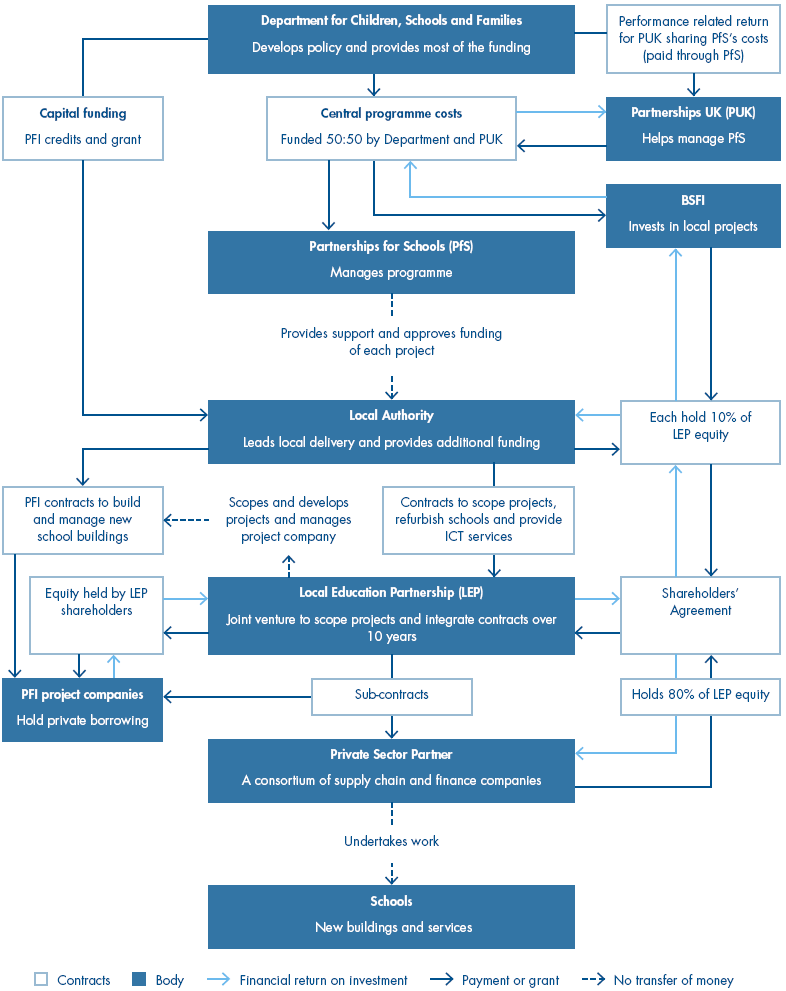
6 | Principal BSF funding, contractual and investment flows continued | |
|
|
|
Roles and responsibilities within the BSF Programme National delivery bodies |
| |
Department for children, Schools and families (the Department) | Responsible for all children, primary and secondary school and family policy. Provides capital funding for each project after approving all business cases. | |
Partnerships for Schools (PfS) | A Non-Departmental Public Body founded by the Department in March 2004 to act as the BSF delivery agency and manage the programme. Acts as the main gateway between Local Authorities and the programme. | |
A joint venture between the Treasury, Scottish Ministers and the Private Sector, which works exclusively for the public sector and has helped the Department establish the programme. It is classified as a private sector company. Jointly funds PfS and BSFI, receiving performance payments for funding PfS from the Department and investment returns from BSFI. | ||
Building Schools for the Future Investments (BSFI) | A limited liability partnership between the Department and PUK to provide influence in the management of LEPs. BSFI invests as a minority shareholder in LEPs alongside each Local Authority and their private sector partner, and appoints a Director to each LEP's Board. | |
Local delivery bodies |
| |
Local Authority | Principal client for all building, ICT and facilities maintenance contracts. It provides revenue funding for each project and tops-up capital funding. Develops local strategies for how to use investment before procuring a LEP. A Local Authority invests as a minority shareholder in LEPs alongside BSFI and the private sector partner. It also manages the LEP. | |
Schools | Provide funding towards ICT and maintenance budgets and helps the Local Authority procure the LEP. Plan the use of new buildings and work with the private sector partner and its supply chain to manage rebuilding work. | |
A public private partnership between a Local Authority, BSFI and a private sector partner to construct and maintain local infrastructure. Sub-contracts work (normally to the private sector partner) and manages its supply chain. Develops plans for each phase of building. | ||
Usually a consortium of private sector contractors who enter into negotiations with the Local Authority to provide services to construct and maintain infrastructure and ICT. | ||
Supply chain | Designs and builds new schools and refurbishments and provides ICT and facilities maintenance services. | |
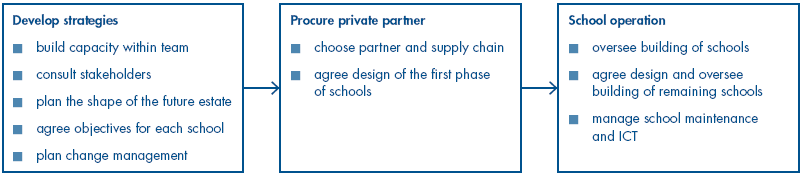
7 | Overview of three stages undertaken by a Local Authority |
Source: National Audit Office process mapping | |
8 | Previous reports |
|
| ||
Education and Skills Committee |
| |
"Sustainable Schools: Are we building schools for the future?" HC 140-I 2006-07. | The Select committee undertook a major review of the BSF programme focusing on its planning and procurement, the focus on educational transformation, and sustainability. It concluded "Delay in the programme is a less significant risk to its success than inadequate preliminary thinking and clarity at a local level about what is required" and therefore that BSF should "take the time to get it right". | |
PriceWaterhousecoopers (PwC) |
| |
"Evaluation of Building Schools for the Future - 1st Annual Report", December 2007 | The Department commissioned PwC to undertake annual evaluations of the BSF programme. PwC have concentrated on surveying schools and monitoring the effect of BSF on educational transformation. Their first report found: (i) the existing school estate is increasingly unsuitable for modern teaching and learning; (ii) existing literature tentatively indicates that improved (new or refurbished) buildings contribute to pupil performance; (iii) teachers had high expectations of BSF and most believed it supports educational transformation; (iv) early and deep consultation is needed at all levels; and (v) there was scope to improve communication (particularly between Local Authorities and schools) and reduce the complexity of management. | |
"Building Schools for the Future procurement review", May 2008 | PfS commissioned PwC to review the procurement process. PwC suggested ways of shortening the process to cut the cost to bidders by £250 million over the whole programme. | |
Confederation of British industry |
| |
"More than bricks and mortar", July 2008 | This report represents the interests of the private sector and the voluntary/not-for-profit sector in the BSF programme. It concluded that "(i) putting education first; (ii) decisive leadership from DCSF; (iii) a long-term commitment to the BSF programme; and (iv) improvements to the procurement process", were essential to making BSF a success. | |
Previous reports on related subjects |
| |
National Audit Office |
| |
This report focused on the Department's programme to improve education in deprived areas by setting up a new type of school. We found that most Academy buildings were of good quality, but had also suffered cost overruns from unforeseen costs and poor project management. Responsibility for managing the construction of Academy buildings has since been transferred to PfS. | ||
"Renewing the physical infrastructure of English further education colleges", July 2008, HC 924 2007-08 | This report examined the Learning and Skills council's (LSC) programme to renew Further Education (FE) colleges. We found that the FE sector is making good progress in rationalising its estate and most projects were producing high quality buildings with limited cost overruns. We also found that the LSC's programme management had improved over time, but that there was scope for improving some aspects including prioritisation of projects, the quality of management information and client support for colleges. | |
Audit Scotland |
| |
"Improving the school estate", March 2008 | Audit Scotland reviewed the Scottish programme of primary and secondary school renovation. Scotland used funding arrangements up to 2007 (when it stopped using PFI) that were similar to those used in England prior to the introduction of BSF. It found these had allowed the Scottish Executive to achieve its aims; but at current rates of progress it would take 20 years to remove all schools from a poor or bad condition; and its programme does not have a clear strategy with meaningful information on what needs to be done or understanding of how much it would cost to renew all the schools that require rebuilding or refurbishment. | |
Source: National Audit Office literature review | ||