Over time, PFI deals need to be changed to meet inevitable changes in public services
1.1 Under the Private Finance Initiative (PFI), the public sector enters into a long-term contractual arrangement with private sector companies to design, build, finance and operate an asset such as a hospital or school. The companies involved establish a separate company, usually known as a Special Purpose Vehicle (SPV). The project agreement is between the public sector authority and the SPV, while the relationships between each of the constituent companies and the SPV are governed by separate contracts (Figure 1 overleaf). Although it is the provider of facilities management (the FM provider) which will implement most changes, especially the small ones, the SPV will normally manage the process, including any competitive tendering for new work, and provide the interface with the public sector. Under conventional outsourcing, the public sector would usually have a number of shorter-term contracts directly with separate suppliers.
1.2 The duration of a PFI contract should reflect the optimal period over which the procuring authority wishes its services to be provided, after taking account of the anticipated level of changes in service requirements. Contracts for PFI projects with major capital assets usually last for 25 to 30 years. Under the terms of the contract, the SPV is paid by the public sector authority once assets are operational (usually in the form of a monthly "unitary charge") and may face payment deductions if availability or performance fall below agreed standards. Such a structure aims to incentivise delivery of quality services and the ongoing maintenance of the assets involved.
1.3 In 2006, 435 PFI deals had been signed in England of which 390 were operational2 and unitary charges for operational projects amounted to nearly £5 billion. The annual figure is projected to rise to a peak of approximately £6.2 billion in 2017-18, before declining as earlier PFI projects come to a close. The operational deals encompass a wide variety of services, including serviced accommodation such as schools and hospitals, defence equipment and training, light rail, street lighting and waste management. Around three out of four operational deals are managed at a local level (for instance, by an NHS Trust or Local Authority) rather than as a programme of projects coordinated by a central team, such as the PFI prisons programme overseen by the Ministry of Justice.
1.4 The long-term contractual approach inherent in PFI contracts provides two key advantages over conventional procurement:
a transparency of pricing in that the public sector knows in advance how much it will be paying and the contract is for the provision of services on a whole-life basis. This removes the possibility of replacement costs arising unexpectedly in any one year or being delayed in the event of budgetary constraints; and
b a planned and consistent approach to maintenance as the SPV is under an obligation to maintain the asset in good condition until the end of the contract period and, if maintenance is not undertaken, it risks being penalised for not meeting agreed availability and performance standards.
1 | In a PFI deal, the public sector authority's primary relationship is with the SPV |
| |
Source: National Audit Office | |
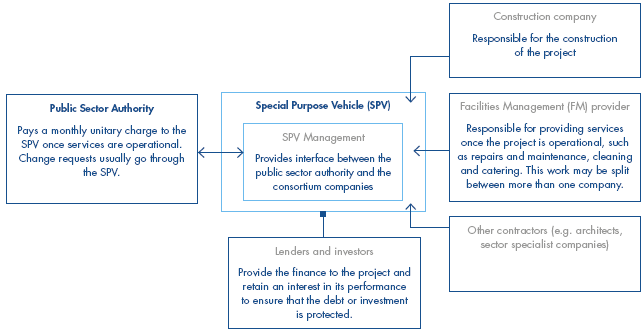
1.5 Long-term contracts, whether procured under the PFI or conventionally, may not be value for money if they cannot be changed in the face of changing public sector requirements. For instance, if there is a lack of demand for a new school, or a major piece of defence equipment becomes prematurely outdated, it is likely that the public sector will not achieve value for money from these assets, irrespective of the procurement route. Under PFI, almost any requested change, even as small as a new electrical socket, has to be processed through the SPV as it manages the asset during the contractual period and bears the risk of failing to meet service obligations. Often lacking the option of going to a different supplier, even for major changes, there is a risk that the public sector will have reduced leverage in negotiation and that the SPV or FM provider may not be incentivised to keep down the cost of changes or to process them quickly.
1.6 It is important that PFI deals can cope with at least a moderate level of change, not least because this is inevitable over a 25 to 30 year contract period. Changes may arise as policy in a sector evolves or in response to new local needs. Figure 2 illustrates the types of changes that have occurred in different sectors.