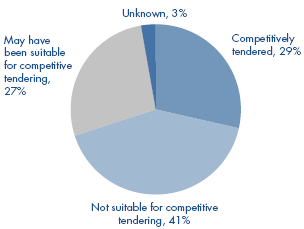
Larger changes are not always subject to a competitive process, putting value for money at risk
2.3 In 2003, the Committee of Public Accounts recommended that Departments should insist on competitions for the provision of additional work after a deal becomes operational.3 Furthermore, they should also take a close interest in these competitions and to make recommendations on firms who should be invited to compete for the additional work. There is a risk that value for money may be compromised if additional work, in particular large changes, is not subject to effective competition.
2.4 In 2006, 70 changes with a cost of £100,000 or higher were made in 43 PFI projects.4 Between them, these changes contributed to 90 per cent of the total spend on PFI changes in England. Appendix 2 sets out the details of each major change and Figure 7 shows that a competitive tendering process was carried out for about 29 per cent of changes, 41 per cent of changes were unsuited to a competitive process and that around 27 per cent of changes (or 47 per cent of the total value of changes in 2006, most of which was accounted for by major changes to three projects5) may have been suitable but were not competed for a range of reasons.
2.5 Changes to staff pay and conditions and software enhancements are inherently not capable of being tendered, while other changes aimed at enhancing soft service provision such as cleaning or portering, can usually be priced using existing costs - for instance, the price of cleaning per square metre. For changes that were not suitable for competitive tendering, public sector authorities typically turned to advisers to benchmark (where possible) and negotiate prices. Where a benchmark could be found, such as with changes that enhanced soft service provision, the final cost was usually similar to, or less than 10 per cent above the benchmark. For other changes, public sector authorities were more dependent on negotiation for lowering costs.
"Our contract says the SPV isn't required to get competitive quotes in the first instance. So what happens is we write them up into a variation, they come back with a price, we go ha ha, right, now go off and get three quotes. We can't instruct them to get three quotes in the first place, which is really, really infuriating. It would just be so much more simple if you could say to them please just get three quotes." NAO focus group attendee |
2.6 The key reason put forward by project managers for not undertaking a competitive tender is the potential impact of the change on the existing project. For works which involve alterations to existing assets rather than the creation of new assets there can be complex interface issues with the ongoing risks and obligations borne by the incumbent private sector contractor, making the option of bringing in a potentially untried third party to do the work less attractive. An example of this is the conversion of a ward in a hospital. Under the PFI contract, the incumbent contractor retains responsibility for ongoing cleaning and maintenance and may face a payment deduction if, for instance, work carried out by a sub-contractor results in adjoining areas of the hospital becoming unavailable. However, competitive tendering has not always been undertaken for changes where it could have been possible in principle. For example, the erection of completely new buildings rather than changes to existing buildings may involve little if any risk to existing services.
7 | High-value changes were not always competitively tendered |
| |
Source: National Audit Office survey 2007 | |