Several methods are used to check the cost of small changes
2.14 For approximately half of small changes public sector contract managers have used a schedule of rates, agreed at the time the contract is signed and uplifted with inflation or agreed on an annual basis, to validate the cost of those changes. In many cases, this is an efficient way of ensuring costs are reasonable but its effectiveness depends on the extent to which the schedule can be validated at the point of creation and reviewed thereafter. Inevitably,
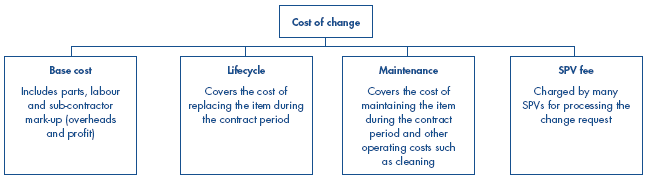
8 | The cost of a change in PFI is made up of several elements |
| |
Source: National Audit Office | |
9 | the cost of comparable jobs carried out in 2006 often varied substantially across and within projects | ||||||
| Number of | mean | Highest | lowest | Lower quartile | Upper quartile | |
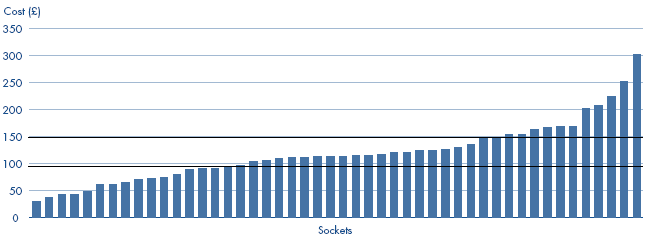
supply and fit an electrical socket | 17 | 118.94 | 302.30 | 30.81 | 86.65 | 147.68 | |
supply and fit a data point | 7 | 246.96 | 398.30 | 95.74 | 183.99 | 297.02 | |
Fit a board (whiteboard, noticeboard etc.) - labour costs only | 6 | 36.60 | 149.71 | nil | 18.72 | 37.72 | |
supply and fit a lock | 9 | 120.41 | 486.54 | 15.09 | 54.08 | 152.26 | |
supply a key | 4 | 18.94 | 47.48 | 4.26 | 8.62 | 24.58 | |
Source: National Audit Office analysis of records of changes made in 2006 | |||||||
Note Following the receipt of additional information from the project, after publication of the report, the £149.71 included the cost of supplying and fitting shelves and the repair and repainting of an area of wall. | |||||||
10 | The cost of installing an electrical socket in 2006 ranged from £31 to £302 in our sample |
| |
Source: National Audit Office analysis of records of changes made in 2006 | |
NOTE The black lines represent the upper and lower quartiles. | |
such schedules can only anticipate the most common jobs, and where change requests are not included in schedules of rates, public sector authorities have had to use other means of checking costs. In these cases, a range of methods have been used including informal means of checking prices, such as drawing on their own experience (or that of a colleague) to gauge how much things 'should cost' or whether a quote looks reasonable.
2.15 Public sector contract managers have told us that there is a trade-off between seeking to challenge the costs of changes and avoiding delay. There is also a small number of projects in which public sector contract managers have not sought to validate the cost of minor changes, either because there are too many of them or because the low value is thought not to justify the time. Overall, it is clear that the amount of time and resources spent checking and challenging the cost of small changes varies significantly from project to project.
"We need to develop some central body of knowledge. It's not necessarily benchmarking in the common sense, but some sort of common understanding of what components make up a variation and what sort of margins are applied. And then you can cross compare to understand it." NAO focus group attendee |