Small changes take longer to process under PFI than in conventionally managed accommodation, but there have been no delays to urgent changes
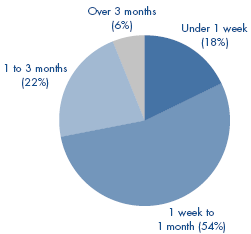
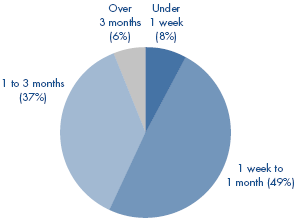
2.26 For most small changes, a price is agreed between the public sector authority and the SPV within a month and changes are then completed within a month (Figure 12). Sixty seven per cent of public sector contract managers who answered our questions said that agreement or completion of changes was a little or much slower than agreed timetables16 and both public and private sector contract managers believe that efficiencies can be made. There are also a small minority of relatively straightforward changes which have seen more significant delays, causing frustration to front-line users.
2.27 Generally, small changes under PFI take longer to process than similar changes for conventionally procured managed accommodation. Fewer than 20 per cent of PFI schools and hospitals agreed or carried out small-value change requests within a week. This timescale would be more common for conventionally outsourced jobs of a similar nature and size although in some instances there may have been good reasons for the extra times taken (such as the need to agree a lifecycle element). For instance, small works changes undertaken by contractors on buildings occupied by HM Revenue & Customs under the STEPS contract17 are nearly always authorised within two to three days and implemented to an agreed programme, or if there is no such programme, then as soon as reasonably practical.
2.28 The types of change requests that have taken longer than expected by authorities have been non-urgent building works. In sectors such as hospitals where there may be a need for urgent changes, PFI contracts usually contain separate provisions for changes that need to be processed as a matter of urgency. Our survey respondents said that contractors had responded to these urgent requests in a timely manner.
2.29 Service improvements are usually easier to negotiate, as the price can be based on existing rates. Where service improvements have been required as a matter of urgency, contractors have been able to respond very quickly (Case example 5).
12 | Time taken to agree and complete small changes in 2006: for most small changes a price is agreed within a month and then completed within a month |
a) Time from change request to price agreement | |
| |
b) Time from price agreement to completion | |
| |
Source: National Audit Office survey 2007 | |
CASE EXAMPLE 5 |
Responding to an infection control crisis at Stoke Mandeville Hospital The PFI contract for Stoke Mandeville Hospital in Buckinghamshire reached financial close in May 2004. under the contract, the contractor had responsibility both for the new building and for the existing estate. Shortly before construction of the new building was completed in 2006, the hospital faced an infection control crisis and decided to respond by increasing the frequency of cleaning and tightening up the isolation regime through changes to the existing PFI contract. Due to the emergency nature of the situation, the contractor agreed to implement the new requirements immediately and then agree a price afterwards. A price was subsequently agreed by applying existing rates for cleaning per square metre, as contained in the PFI deal itself. |