Value for money of changes is often undermined by insufficient resources and poor contract management
3.7 Recent guidance from PUK and the 4ps emphasises that the size of a contract management team for a PFI deal is dependent on the size and complexity of the project, how performance is to be monitored, and how the relationship will be managed. It is therefore difficult to provide generic guidance on the level of resources required. For small projects the contract management function may be performed by a single person, whereas larger projects often require a team of people. The contract manager plays a key role in developing relationships with the service provider and in monitoring performance. As such, the appointment is therefore likely to be full-time.
"It's about having a dedicated, internal team, whose sole responsibility is just to manage, administer, and look after the PFI deal. And not just tag it onto finance." "It's not something you can back into as a part-time job." NAO focus group attendees |
"Early on we had a proper project director, we had commissioning teams, a commissioning nurse - we had a full range of people. And, as soon as the contract was at the operational stage, the director of facilities disappeared, they all disappeared." NAO focus group attendee |
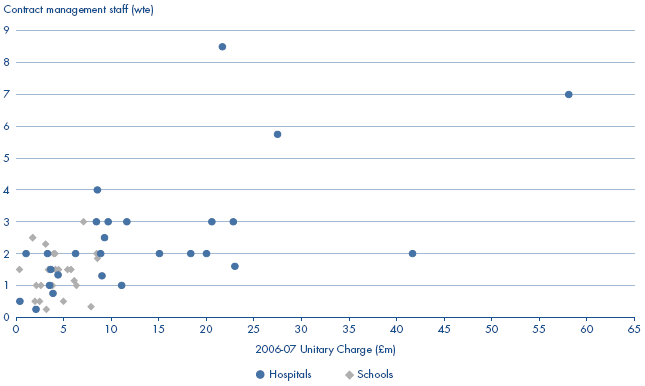
3.8 Although there is an overall correlation between the size of a project and the size of its contract management team, there are large variations in the level of resources devoted to the management of PFI contracts of a similar size.18 Figure 13 demonstrates this for the schools and hospitals sectors. Overall, a third of contract managers at PFI hospitals and one in six contract managers of PFI schools we surveyed described their teams as under-resourced. Over 15 per cent of PFI projects we surveyed were not being managed on a full-time basis, including ten with annual unitary payments of more than £3 million each.
13 | There are large variations in staff resources between individual projects of similar size in both the schools and hospitals sectors |
| |
Source: National Audit Office survey 2007 | |
3.9 A similar point can be made about the relationship between the amount spent specifically on change and the level of staff resources devoted to managing that change. There is a weak correlation between them and less than a quarter of variation in staff resources devoted to change is explained by the amount spent on change.19
3.10 Most public sector authorities have access to relevant skills and substantial experience. However, without proper resources or planning, the change process can be ineffective. In our visits to projects, we have seen examples of poor control of change requests, inadequate job briefs, no checks or challenges over costs and disputes over relatively insignificant matters. In one instance, the contractor was overwhelmed by the volume of change requests coming through, leading to long delays (Case example 9).
"There needs to be resources on both sides to actually deliver what you say, and according to the timescales that you need." "The public sector are naïve about what the commercial relationship is really about. And there needs to be training in contract management as well." NAO focus group attendee |
3.11 A relatively small number of public sector authorities have used available central resources in response to issues with the change process. For instance, since it was set up in April 2006, there have been 30 phone calls to PUK's Operational Task Force dealing with change issues across the whole of PFI.20 Most project managers who answered our questions on seeking guidance when implementing changes had sought advice from internal sources such as other team members or line managers and from external professional advisers. Only a fifth had contacted PUK or 4ps for advice on change (Figure 14). The vast majority of project managers described the advice they received from all sources as helpful or very helpful.
14 | Project managers have sought advice on change from a range of sources | |
Source of advice | Proportion of projects | |
Other team members or line managers | 81% | |
External professional advisers | 69% | |
Other contract management teams | 37% | |
Departmental PFU | 28% | |
PUK or 4ps | 21% | |
Source: National Audit Office survey 2007 | ||
CASE EXAMPLE 9 |
Blackburn hospital The PFI hospital in Blackburn, which became operational in 2005, has experienced a number of problems in relation to the change process. There have been substantial delays in getting changes through and some minor change requests had still not been processed after 15 months. There have been complaints also over the cost of changes with disagreements about both the capital cost and lifecycle elements. A consultant who works at the hospital told us that there was a degree of despondency amongst front-line users who felt that there was little point reporting problems that were occurring. To some extent, the problems have reflected the transitional difficulties commonly faced in PFI or conventionally funded projects when they first become operational. For instance, it can take time for contract management teams and front-line users to become familiar with the contractual mechanisms in place, and any ongoing disputes surrounding minor defects in the completed construction work can distract attention away from new change requests. In the case of Blackburn hospital, these transitional issues were exacerbated by the sheer volume of change requests that were made - some 1,600 in the first 12 months of operation. However, the public and private sector teams have also argued that more can be done on both sides to solve the problems that have occurred. The public sector team has questioned the attitude of the SPV at times, suggesting that it should see making changes as part of its core business, in addition to its maintenance and other performance obligations under the contract. Meanwhile, the SPV has argued that the process would be improved if the public sector team exerts greater control over the flow of change requests, is clearer as to what it wants and has a better understanding of the full cost of changes. Both teams recognised that they were under-resourced and that additional staff could speed up the processing of new change requests. Recent evidence such as the renegotiation of the SPV fee suggests that the relationship between the public and private sectors is improving (see Case Example 4). |