The circumstances leading to the liquidity problems at Northern Rock
1.2 The Northern Rock Building Society, based in Newcastle-upon-Tyne, was formed in 1965. Over the following 30 years, Northern Rock expanded by acquiring smaller building societies and converted to a listed bank in October 1997. By 2007, the company had become the fifth largest provider of residential mortgages in the UK. In the first half of 2007, it wrote residential mortgages totalling £10.7 billion, net of repayments, representing an 18.9 per cent share of UK net mortgage lending. The growth in business was based on highly competitive pricing of Northern Rock's mortgage products, which required a narrow margin between what it paid for funds and what its borrowers paid in interest on their mortgages.
1.3 Banks raise funds to lend to mortgage customers by three principal means:
■ by the use of funds held on behalf of retail and commercial depositors;
■ through short term loans provided by banks and other financial institutions for periods up to one or two years (often called inter-bank lending);
■ by selling existing mortgages to investors (usually through a process known as securitisation - Box 1).
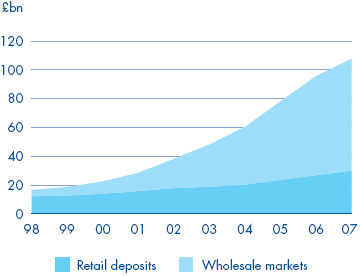
Whereas retail deposits constituted the main source of financing for Northern Rock when it converted from a building society to a bank, it had funded the growth of its mortgage lending mainly through the wholesale markets for inter-bank lending and securitisations.
BOX 1 |
The use of securitisations by Northern Rock to raise funds Securitisation involves the raising of funds by the issue of bonds backed by a bank's assets, usually in the form of outstanding mortgages. Once every three months or so, Northern Rock sold mortgages to special purpose vehicles. Each special purpose vehicle paid for the purchase of the mortgages by the issue of bonds to investors. There were two types of securitisation: Asset Backed Securities - Investors in the bonds are entitled to interest on their investment and to repayment of capital at the end of the term of the bond, for which the mortgage debt retained in the special purpose vehicle was the security. The payments to bondholders are funded by the interest and principal repayments made under the mortgages involved. In March 2001, Northern Rock established a securitisation structure known as "Granite" (see Appendix 4). Covered bonds - Northern Rock also used covered bonds to raise money through securitisation. Covered bonds also involve the transfer of a pool of mortgage loans to a special purpose vehicle, which provides a guarantee of the bonds to investors. In contrast to the Granite structure, however, investors in covered bonds would have a claim against Northern Rock assets, if payments under their bonds were at risk. |
1.4 Northern Rock's balance sheet structure changed significantly between 1998 and June 2007, supported by funding from the wholesale markets (Figure 2). The use of wholesale markets by banks to raise money, including the use of securitisation, was not unusual. Northern Rock, however, made more extensive use of this funding route. Wholesale funding as a percentage of total funding was more than 70 per cent for Northern Rock, compared with an industry average for UK banks of around 50 per cent.
1.5 The raising of funds through regular securitisations and shorter term inter-bank borrowing enabled Northern Rock to expand its business rapidly. As one source of funding was repaid, the company had to identify further sources of funding on a rolling basis. The success of its business model was therefore dependent on:
■ Northern Rock's ability to raise money in the inter-bank and securitisation markets to repay existing short term borrowing and fund additional mortgage lending;
■ its ability to pay a lower rate of interest on the money which it borrowed than the interest it charged to mortgage customers.
2 | Growth in Northern Rock's sources of funding 1998 to June 2007 |
Source: National Audit Office analysis of Northern Rock annual reports and accounts | |
1.6 In the summer of 2007, the world's financial markets entered a period of turbulence triggered by fears of over-exposure to American sub-prime mortgages. Financial institutions and investors started to reduce their purchases of mortgage-backed assets on the wholesale markets. At the same time, banks began to retain cash to meet their own liquidity requirements and to reduce the risk of losses from loan defaults. This combination created a shortage of liquidity that threatened institutions reliant on the wholesale markets to fund their mortgage lending business.
1.7 Northern Rock had planned to securitise around £4 billion of mortgage loans through the Granite structure in the Autumn of 2007. In September, however, deteriorating market conditions caused the proposed underwriter to withdraw and the securitisation did not proceed as planned. Northern Rock was also finding it harder to raise money in the wholesale inter-bank markets. Rollovers of wholesale funding were largely continuing, but at shorter maturities and higher interest rates.
1.8 Northern Rock's difficulties in meeting its funding needs meant that there was a likelihood that it would have to draw on its stock of high quality sterling liquid assets and sell other assets, probably at distressed sale values. In these circumstances, the company's auditors informed the Financial Services Authority on 11 September 2007 that they had reasonable grounds to believe that Northern Rock might cease to be a going concern.