English Partnerships has few contractual levers with which to control the pace of the project
1.4 Figure 4 on page 14 outlines the levers through which various parties and stakeholders can control this complex project. The levers encompass both the legal contracts as well as wider means of influencing the project. EP's leverage over the project and its returns is based on its role in approving business plans, submissions to the Council for the consent to develop land and in scrutinising costs incurred by MDL (the latter function relates to its economic interest in the project under the profit sharing arrangement - see Part 3). Greenwich Borough Council provides the overall planning consent for work to take place.
2 | The main parties to the deal |
| |
Source: National Audit Office analysis | |
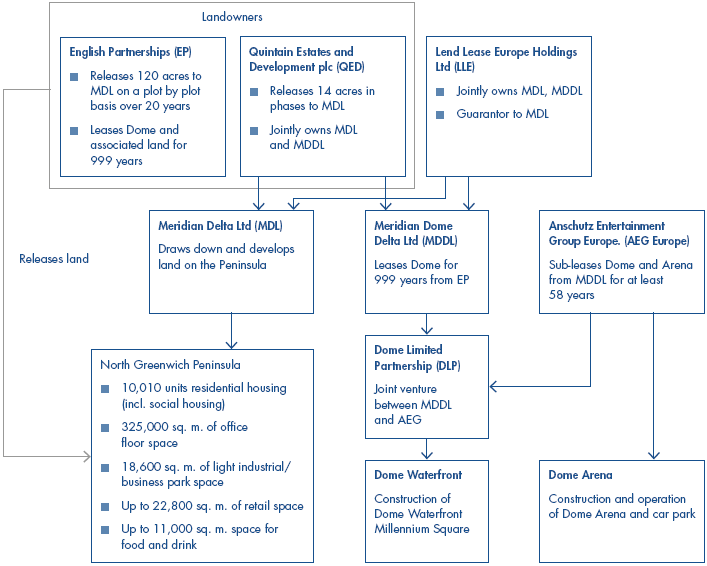
1.5 EP has levers for ensuring that the project meets its objectives in terms of quality and financial returns (Part 3 addresses challenges relating to the latter objective). But as is usual for similar developments none of the public sector parties, including EP, are in a position to place general delivery obligations on house builders to speed up the pace of delivery.4 EP and the Council are able to slow the pace of development down through the approvals and planning process: neither, however, within the terms of the deal can increase the pace. The pace of development is dependent on the objectives of MDL and third party developers, as well as prevailing market conditions. The impact of this is discussed in Parts 2 and 3.
1.6 The Land Disposal Agreement sets out Minimum Development Obligations (MDOs) for the development and marketing of land which have to be met by MDL within a series of five year periods. MDL is required to develop 330,000 square feet and market 670,000 square feet of land over each five year period.5 Failure to comply with the obligations can result in financial sanctions except in circumstances where development would not be economically viable. Such an economic viability test on the imposition of penalties is common in most regeneration contracts.6 These obligations, however, do not serve as milestones to ensure that the pace of development is being kept up because it would take almost 200 years to develop the Greenwich Peninsula, if the developers met their minimum obligations but did no more. The MDOs were put in place to prevent MDL land banking and are not a means of ensuring that the pace of development is being kept up.
1.7 EP also has a role in assisting MDL so that it can fulfil its obligations under the agreement. This can, for example, take the form of acquiring third party interests in the land, entering into planning agreements and in its capacity as landlord, ensuring that the terms of the agreement are met by other influential parties such as London Underground. These various roles depend on EP's ability to create and maintain sustainable relationships with other key parties to achieve its objectives (see paragraph 1.12).
3 | The principal agreements within the deal | ||||||||||
|
|
|
|
|
|
|
|
|
| ||
Agreement | Function | ||||||||||
The Masterplan | MDL's original blueprint for development on the Peninsula designed by Terry Farrell and partners (London based architects and urban designers) to create a high-quality, modern, urban community. | ||||||||||
The MIA controls all of the legal agreements for the project. It also governs the interaction of various parties during the planning process and sets out how the project will deal with the withdrawal or default of a party during the life of a project. | |||||||||||
Governs the implementation of development throughout the Peninsula, other than the Dome Arena and Waterfront, to be led by MDL. contains EP's controls and approvals over the development process, and the right for MDL to draw down plots on a phased basis. The arrangements under the LDA have an expected life of 25 years. | |||||||||||
Incorporates the adjacent land, owned by Quintain, into the development process and sets out the basis for distributions of returns between EP and Quintain. | |||||||||||
Gives AEG an option to develop a hotel on a plot of land outside the Arena and Waterfront. | |||||||||||
The main agreement which regulates the development and use of the Dome, including the construction of the Arena and Dome Waterfront. Contains the provisions for the grant of a 999-year headlease to MDDL and separate sub-leases to AEG covering the Dome and the Waterfront. | |||||||||||
Planning Agreements (sections 106 and 278 agreements) | The planning agreements with the London Borough of Greenwich which triggered the grant of planning consents for the development of land. Section 106 agreements cover community benefits; section 278 agreements cover road links. | ||||||||||
Source: National Audit Office analysis | |||||||||||
4 | The main levers to control the project | |||
|
| Quality of development | Pace of development | Cost/Financial returns |
EP holds monthly Project Control Group meetings which are an overall mechanism for controlling the quality and pace of development and cost/financial returns. The meetings are a forum for undertaking many of the specific actions described below. | ||||
| EP approves MDL's rolling business plan and detailed planning submissions and can refuse to do so on the grounds that these are inconsistent with the Masterplan and design criteria. Monthly design review meetings between EP and MDL. EP uses its influencing skills to push for enhanced quality of the development as appropriate. | EP, via its Project control Group, approves a three year rolling business plan on an annual basis which sets out key deliverables over the period. Within contractual arrangements with third party developers there are time limitations imposed upon planning, start of site and completion. EP relies on its influencing skills where it wants to encourage the pace of development. | EP signs off the financial model. EP signs off all invoices above £25k and a sample of those over £10k. EP checks that tenders have been competitively bid for to ensure that they represent best value for money. | |
A biennial meeting with EP will look at progress in terms of financial returns from the project. | ||||
Greenwich Borough Council (GBC) | GBC provided outline planning consent to the Masterplan for the project which set out the parameters for the project. GBC grants detailed planning consents to develop land based on a range of criteria, including design of buildings. GBC monitors the implementation of the planning consents it has granted. | Once planning consent has been granted, there is a time-lag until the consent is "unconditional" (i.e. when the conditions of planning permission have been satisfied). Following this, a long-stop date (a time by which work must have started on site) may be imposed as a planning condition. GBC does not set a timetable for development once the work is underway. | Establishes the financial contributions made to the project under the section 106 planning agreements. | |
The Housing corporation only provides grants to developments that are consistent with sustainable community principles (good sustainable design, employment creation, mixed-use). | Developers and Registered Social Landlords have one year from confirmation that a social housing grant is available to begin building affordable housing. After this, developers will have to re-apply for the grant. Following the start of works, the corporation does not hold the developers to any timetable. | Provides a social housing grant to subsidise the cost of providing affordable housing. | ||
Statutory Consultees (e.g. Health & Safety Executive, Environment Agency, Transport for London)
| Provide advice to GBC on whether the proposed plans for development comply with relevant legislation, though the final decision is made by GBC. There are also statutory regulatory roles for other stakeholders to undertake on site. | TfL has an influencing role in the pace of delivery over major transport decisions. | TfL can seek significant cost contributions for transport improvements and build-over agreements. | |
Source: National Audit Office analysis | ||||
1.8 In their 2005 report The Regeneration of the Millennium Dome and Associated Land7, the Committee of Public Accounts concluded that monitoring the successful delivery of this regeneration programme will require a long term commitment from EP. In the absence of levers to control the pace of development, EP will need to make use of its partnership working skills to bring due pressure to bear to ensure that the project meets its objectives in a timely manner. EP will also need to continue to develop systematic and effective risk management processes to deal with change as it arises (see paragraph 1.14).
__________________________________________________________________________________________
4 The independent Callcutt Review of housebuilding delivery commissioned by Government (November 2007) makes no recommendations that Government should attempt to do so, but suggests it creates a framework in which the private sector can deliver targets for new housing. The report also suggests that there is no reason why Government should not stipulate faster build out rates for housebuilding providing any loss of value incurred can be justified.
5 Should MDL exceed the quantum of development required to meet the obligations within one five year period, the additional development can be counted under obligations for the next five year period. 330,000 sq. ft is approximately the area of four football pitches.
6 Should these minimum obligations not be met within a five year period, EP may serve notice on MDL requiring the requisite amount of development to be carried out so that the prescribed level is achieved and MDL is required to commence works within a year of this notice. There are, however, restrictions on the use of these sanctions if the development was projected to fail to meet a return threshold for MDL; if there were no realistic prospect of selling residential (or selling and letting commercial) property to meet the minimum land value payments due to EP and other landowners on the Peninsula (e.g. Quintain) and to cover project expenditure; or if there were no implementable planning permissions or other conditions.
7 See report by the Committee of Public Accounts, HC 409 Session 2004-05, 22 September 2005.