An increased rate of delivery by MDL will be needed if English Partnerships is to meet its project level housing targets
2.10 To meet the needs of an increasing and ageing population, the Government has stated that housing delivery is now a key priority and has set a target of building three million new homes by 2020, including more affordable homes to rent and buy.18 The Department and EP will be key agencies in helping the Government achieve this target.
2.11 EP has an annual housing output target, as set out in Figure 7. EP's portfolio of projects, of which the Greenwich Peninsula redevelopment is one, contribute in proportion to their size, a number of housing units towards this corporate target.19 The development of over 1,000 housing units of EP's overall target of just over 23,000 units is due to get underway on the north Greenwich Peninsula within the period 2007 to 2009. This is an indicator of the size and strategic importance of the project.
7 | English Partnerships' corporate output targets | |||||||||||||
|
|
|
|
|
|
|
|
|
| |||||
Output delivery target | EP total | Greenwich Peninsula | ||||||||||||
| 2007-08 | 2008-09 | 2007-08 | 2008-09 | ||||||||||
Housing starts on site1 | 11,043 | 11,993 | 229 | 803 | ||||||||||
Housing completions | 6,721 | 7,398 | 0 | 0 | ||||||||||
Source: EP corporate and regional plans | ||||||||||||||
NOTE | ||||||||||||||
1 Housing starts on site are defined as when the unconditional contract and detailed planning permission are achieved. Physical work on site may not actually start within the timeframes. For both starts on site and completions the 2007-08 EP total is based on a combination of actual and forecast figures. The 2008-09 EP totals are forecasts. | ||||||||||||||
2.12 Further delay to development could mean that the project level targets are not met. At a corporate level, however, EP manages its delivery on a portfolio basis. Therefore, any shortfall in one project could be made up by delivering a surplus in other projects so that the overall target is met. Because of this approach to programme management, any shortfall on the Peninsula is unlikely to lead to EP missing its corporate target.
2.13 Progress on this development also contributes to the Department's targets for housing development within the Thames Gateway. The Thames Gateway Interim Plan targets 100,000 new homes to be built by 2016 within the London portion of the Thames Gateway. This project has the potential to contribute 4,250 of these units.20
2.14 The delayed start to the housing development means that it will be more difficult to meet this target. Given the longer timescale involved in this Plan, there is time to make up for the slow start and MDL plans to accelerate development during the next few years. There is, however, a constraint on the extent to which the project can accelerate development to make up for lost time. Property developers refer to a "market absorption" or "build out" rate as the number of units that can be sold within a given site per year without affecting the price of housing, which is a key driver of profitability for private developers. The highest absorption rate achieved from a single site within London so far is releasing 180 private (i.e. not affordable) dwelling units into the market in a given year.21
2.15 As the first housing units are not expected to be completed until January 2010 the project has a maximum of seven years in which to build the 4,250 housing units to meet the Thames Gateway target. At a constant rate, MDL will have to bring just over 600 units per annum to the market to ensure that EP meets this target, of which it expects 200 to be affordable homes. This rate of building is possible according to MDL because the size of the Peninsula allows for zoning of residential areas into three separate districts and hence for development on more than one front and because the rate can be maintained owing to the mix of affordable and private housing.22 EP also considers that its work to broaden the market audience, for example through the First Time Buyers' Initiative 23 allows for higher absorption rates than is usual.
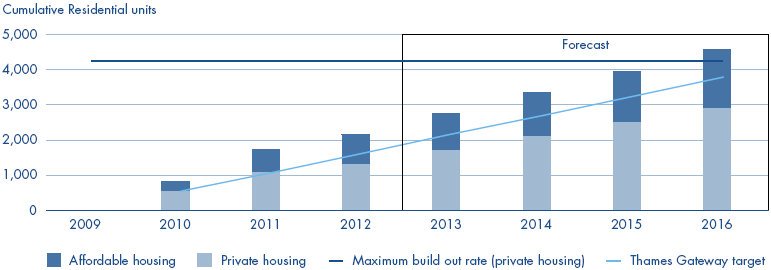
2.16 Figure 8 overleaf shows that this planned acceleration is feasible but that this is an ambitious rate of development which allows little contingency for further delay. It will be dependent on EP, MDL and Greenwich Borough Council being able to manage the planning and execution of several simultaneous developments in order to match the highest rate achieved in London over an extended period of time. This in turn is dependent on market conditions, namely a buoyant housing market, a stable construction industry in the run up to and following the Olympics in 2012 and some insulation from the effects of large and competing residential developments in or around East London.24
2.17 Further delay to the build programme will mean the risk of EP not delivering as expected towards the London Thames Gateway target.25 Furthermore, even if this ambitious build out rate of 600 housing units per year is maintained, the year 2026 is the earliest in which all of the 10,000 residential units will have been released into the market place. This is four years later than was anticipated when the deal was signed.
8 | Only an ambitious rate of build will enable the project to meet its Thames Gateway housing target |
| |
Source: National Audit Office analysis | |
NOTE | |
The data for years 2010-2012 is taken from MDL's forward plans. The data for years 2013-2016 is based on an assumption that MDL maintains an average rate of 600 dwellings per year released into the market place, of which 400 per year will be private and 200 will be affordable housing. The maximum build out rate was calculated based on the assumption that it is possible to separate the north Greenwich Peninsula into three separate areas for development purposes and then to achieve the maximum build out rate yet achieved for a single London site within each area. | |
__________________________________________________________________________________________
18 See the Prime Minister's statement to the House of Commons, 11 July 2007 about the Government's priorities. See also the Housing Green Paper, published on 23 July 2007 which stated the Government's intention to increase the annual rate of house building to 240,000 homes by 2016.
19 Individual projects also feed into regional targets, providing an additional layer of control over EP's outputs. The Greenwich Peninsula project is a part of the London and Thames Gateway region.
20 Thames Gateway Interim Plan, Department for Communities and Local Government, 2006.
21 By Ballymore at their New Providence Wharf development (source: MDL 2006-07 Business Plan). A house builder consulted as part of this study confirmed that this rate was achievable but challenging.
22 Development of private dwellings on three separate sites could achieve an upper limit of 540 private housing units per year. As affordable housing units will account for 200 of the target rate of just over 600 it is only necessary for MDL to build 400 private housing units. This gives them a buffer of 140 private housing units.
23 This initiative is positioned to target key workers and other eligible groups with sufficient income to sustain home ownership, but who are currently prevented from buying a house because of high house prices.
24 Ebbsfleet Valley, Barking Riverside and Stratford City are all large residential-led developments (of over 10,000 residential units) in fairly close proximity to Greenwich which benefit from good transport links. MDL's strategy is to market the Peninsula as a high quality, riverside development in central London - it hopes that this will differentiate the Peninsula from the other East London/Thames Gateway development.
25 Our 2007 report The Thames Gateway: Laying the Foundations concluded that in order to meet the 2016 targets for new homes the build rate would need to now double. If EP is unable to make its due contribution to this 2016 target, this increases the likelihood that the Government is unable to achieve its plans for the Thames Gateway within the timescale originally envisaged.