A number of lessons have been learnt as the PMS has evolved over time although further improvements could be made
1.32 The contract set out principles by which a performance measurement system (PMS) would operate for measuring the delivery of facilities management services. This included the rate at which payments would be reduced for performance scores which were unsatisfactory, the performance indicators and their weighted effect on the payment deductions if not met. However, in seeking not to delay closing the contract, the previous Trust management left the detailed development of performance measures and determining the standards of performance that would result in particular performance scores until after the contract had been let. THC Dartford has told us that the intention was that the work to be completed after contract letting would not change the previously negotiated basis of risk transfer which had informed the terms of THC Dartford's finance and THC Dartford's pricing of the PFI contract. Nevertheless, determining performance measures and how they would interrelate with performance scores after the contract was let means that in practice potentially important issues relating to risk transfer were still being refined after the contract was let.
8 | The contract payment mechanism set out in the original contract |
The monthly performance related payment for portering, internal security and transport
| |
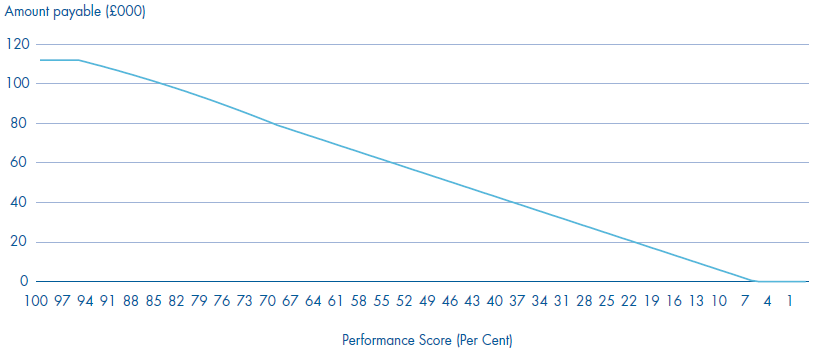
1.33 The Trust and THC Dartford subsequently developed a performance measurement system (PMS) but initially found it to be cumbersome and in any case in need of refinement in the light of experience of using it. The current PMS (Figure 9) has, as a result, evolved over time and in so doing, a number of useful lessons have been identified, which are of wider applicability for those managing PFI hospital contracts on a day to day basis. In addition to the need to agree before letting a contract the detail of how payment deductions will relate to performance deficiencies, other learning points have been:
■ The Trust's experience confirms that events will inevitably occur that were not covered in the contract. The Trust has sometimes been in disagreement with THC Dartford regarding circumstances that have arisen, which were not foreseen, or not explicitly stated, in the contract. For example, there was disagreement over whether the contractor was responsible for de-icing the car park when there was an exceptionally heavy snowfall. In this case, a common sense approach to the problem by all parties prevailed but the Trust has found that resolving contract disputes through the contract process can be time consuming. The Trust and THC Dartford have increasingly developed a reasonable balance between pragmatism and over reliance on seeking contractual solutions.
■ There is a balance to be found between ensuring the PMS provides relevant information without it becoming unmanageable. Initially, the PMS underlaid possible generic deductions (relating to failures to deliver the minimum service standards across the whole hospital), specific deductions (which included tasks specified in the procedures manuals in nominated areas of the hospital) and deductions for non-availability. Both the Trust and Contractor agreed that this initial system was too complex and involved excessive form filling. In recognition of these problems, the Trust combined the generic and specific monitoring forms to produce around ten key indicators for each FM service. These key indicators then had weightings attached and were used as the basis for scoring the FM areas. This more simplified structure sought to achieve easier performance monitoring on a day to day basis.
■ Attempting to replicate the contractor's performance monitoring will cause problems. As with most PFI contracts, the monitoring of the FM services at the Trust is the responsibility of the Contractor. The Trust has itself devoted resources to monitoring the performance of the contract on a day-to-day basis. In the Trust's and THC Dartford's view this has unnecessarily replicated the process and has also created some tensions when monitoring staff at the Trust have taken action in telling the contractor how to rectify a problem. It intends to work with THC Dartford to ensure that all parties play their role fully in the performance management system and further that systems are in place to ensure information is shared and acted on appropriately.
■ A PMS works better if subjectiveness is minimised. Both the Trust and THC Dartford would like to see more objectivity in determining the way performance scores are awarded in the PMS. For example, THC Dartford told us that the PMS needed to be more objective since it was currently unclear as to what standards could be regarded as satisfactory. Whilst some degree of subjectivity is inevitable, subjectiveness in the PMS system can make it harder to agree performance scores and can also lead to problems of consistency if key staff change jobs. The Trust plans to take action on this issue by developing with THC Dartford more objective measures in a number of areas of service delivery.
■ There will be relationship issues in applying a rigorous PMS which co-operation can overcome. The Trust has been developing a partnership relationship with THC Dartford to help realise solutions to identified problems. The adjustment to a more realistic and rigorous assessment of the FM areas meant that, in general, the monthly FM scores fell, although in most cases the performance of the FM services remained satisfactory. Attempting to apply a more rigorous appraisal of FM performance, which relied on subjective assessments, initially created tensions in relationships between the Trust and THC Dartford. These problems are being worked through by the introduction of more objectivity into the PMS and by some restructuring of the responsibilities of staff involved in FM appraisal.
9 | Schematic to show how the performance measurement system works |
| |
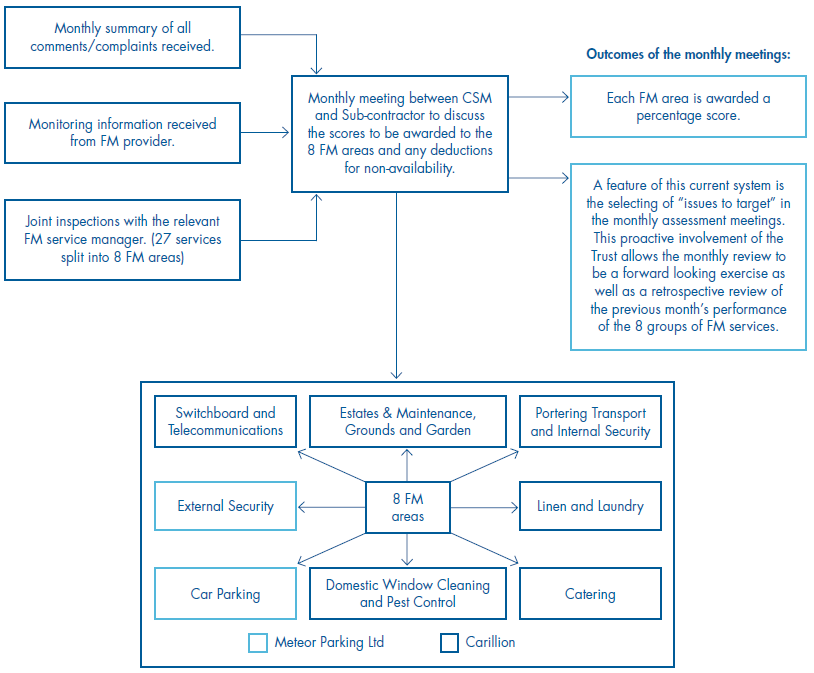
Overall relationships between the Trust and THC Dartford are now good. The steps the Trust and THC Dartford have taken to build a good relationship with THC Dartford include:
■ The Trust and THC Dartford now attend part of each other's Board Meetings.
■ THC Dartford has appointed an experienced non-Executive Chairman who provides a senior point of contact for the Trust with an overview of the whole of THC Dartford's approach to delivering the project.
■ The General Manager of THC Dartford now has his office located within the senior management suite at the Trust.
In building their joint approach to the project, the Trust and THC Dartford have relationships at different levels, ranging from operational day to day interaction about levels of FM performance, to strategic discussions about the development of the hospital. There is always the potential for tension between these different elements but co-operation can overcome them. For example, in the summer of 2003, the senior management of the Trust was in a collaborative relationship with THC Dartford to develop extra facilities on the hospital site, while at the same time, at the operational level, the Trust was awarding performance scores to some FM areas which led to financial deductions. The Trust took account of these different issues in progressing its overall relationship with the THC Dartford.