APPENDIX TWO rail franchising (1996-2004)
1 Since the mid 1990s, the delivery of passenger rail services has been through a number of rail franchises, procured through a competitive tendering exercise, covering the rail network. Each franchise agreement is essentially a contract between the Government and a private train operating company (TOC) for the provision of passenger rail services in a particular geographical area. The first franchises were let in 1996-97 by the Office of Passenger Rail Franchising (OPRAF). The train operators were required to run a minimum level and quality of services - set at the level inherited from British Rail - and the main criteria for awarding franchises was the level of Government subsidy required over the lifetime of the franchise (i.e. the lowest bid won). Most of the 26 initial franchises were for seven to ten years with five being for longer terms of 15 years each.
2 The planned subsidy profile of these first franchises was for Government to pay high subsidies in the early years followed by a reduction in payments towards the end of the franchise, as the private TOCs were expected
3 In February 2001, the Government established the Strategic Rail Authority (SRA) to deliver strategic leadership to the railway industry. The SRA took over OPRAF's franchising responsibilities and published, in November 2002, a Franchising Policy Statement. This revised approach to franchise letting evaluated bids to take account of what was realistically deliverable. The SRA took the view that it should be more prescriptive, specifying service levels and quality standards with the private sector being charged with delivery. This differed from the previous model which sought to create a set of business opportunities, subject to regulation, with obligations not to let services fall below specified base levels.xiv
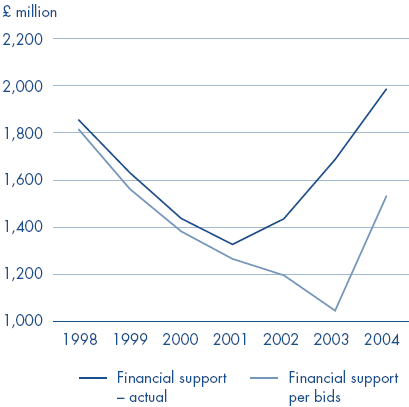
18 | Government subsidy payments to TOCs, 1998-2004 |
Overall subsidy paid to the TOCs | |
| |
Source: SRA, KPMG analysis | |
4 Concerns about spiralling costs in the rail industry and the perceived inability of the SRA to deliver effective outcomes led to a Government review of the structure of the rail industry and publication, in July 2004, of the White Paper, The Future of Rail. This stated that the rail industry's key priorities were to control its costs, live within the public funding available to it and improve its performance, and that Ministers should take charge of setting strategy for the railways. As a consequence, the SRA was abolished and the procuring and monitoring of the delivery of passenger rail services passed to the Department for Transport between July and October 2005.