The contract provides a solution to the accommodation problems
1.10 The Department entered into a contract with the chosen consortium, Newcastle Estate Partnership (NEP), which took effect on 8 January 1998. The contract specifies the Department's properties transferred to NEP, the construction works to be undertaken, the calculation of the payments to be made by the Department, and the estate management services to be provided by NEP over the course of the contract. The documentation is extensive and establishes the action to betaken in a wide range of events or changes, and the Agency told us that it has proved extremely helpful during the implementation of the project.
1.11 In accordance with what is now normal Private Finance Initiative practice, the contract defines objectively when accommodation is "unavailable", due for example to breach of legal or health and safety regulations, ingress of water or to lack of power or lighting. In these circumstances, the Department do not pay for the space if they vacate it. This represents a major improvement in the Department's position compared to that under a standard lease for rented accommodation. In addition, the Agency have negotiated the right to continue to occupy unheated space without making a payment. This reflected their concern that vital social security operations should be maintained wherever possible. The key features of the deal are shown in Figure 2.
| Figure 2 |
|
Key features of the Private |
| |
| The Department transfers to NEP the ownership of the freehold sites, and responsibility for dilapidation liabilities on leased buildings. The Department retain a right to occupy the redeveloped estate for 25 years. NEP will demolish all existing buildings at Longbenton, and design and construct new office buildings there and at a green field site at Waterview Park (which will replace Emerson House on the existing estate) to the south of Newcastle. NEP expect that the total capital cost will be £163 million at 1997 prices. NEP can commercially redevelop surplus land on the Newcastle estate. Some £9.4 million of the proceeds from this redevelopment are guaranteed and will be used to reduce the cost of the Private Finance service to the Department. The Department will also share equally in redevelopment gains if these exceed £9.4 million. NEP will maintain the existing premises transferred to it over a 25-year period starting in January 1998, and the new buildings for 25 years after each is completed. Payment for maintenance services can be reduced by up to 15 per cent in the event of failure to achieve performance targets. The Department will pay only for the space that is available for them to occupy. If an area is deemed to be unavailable for over 24 hours, based on objective tests of heating, lighting and other standards, payment is cancelled. The Department may vacate without charge up to 20 per cent (by value) of the space over the life of the contract. They receive a discount of 20 per cent of the accommodation charge for any area available for surrender which they continue to occupy, or a 40 per cent discount should they relinquish their right to hand back the space. The contract makes provision for the Department's accommodation at the end of the 31-year period. The Department and NEP may enter into a further Private Finance-type arrangement for continued occupation. They may agree a traditional lease at a rent set at 50 per cent of prevailing rents for similar accommodation in Newcastle City Centre (that is a proxy for market rents on the outskirts of the city). Alternatively, the Department are free to seek such accommodation as they may need on the open market. | |
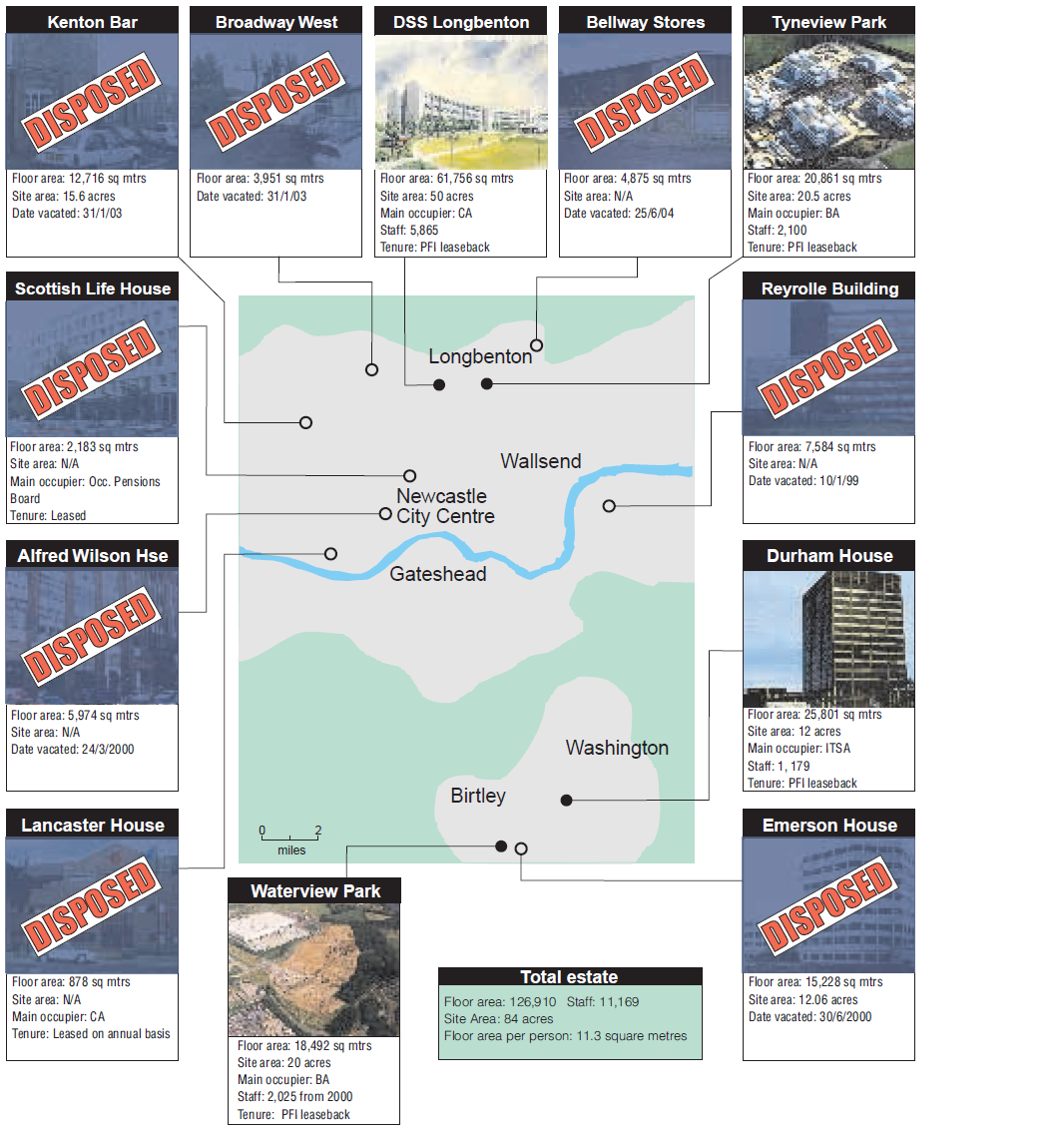
1.12 An illustration of how the Newcastle Estate is to be changed over the redevelopment phase of the project is at Figures 3 and 4. The latest estimate of the number of staff that may need to be accommodated in the redeveloped estate is some 13,200 by 2003/2004. This compares with the revised occupancy levels of 11,466 agreed in April 1998 and the estimate of 10,700 on which the deal was based. At present the current plans can accommodate 11,946 staff. This indicates that the Departments may require further space in the Newcastle area in the future, and the National Insurance Contributions Office are currently conducting for the Departments an evaluation of options for meeting this requirement. These could include retaining existing leased properties, acquiring extra space and making more effective use of the accommodation through improved working practices.
1.13 The Department set six operational objectives for the project. Although the redevelopment of the Estate will not be completed until 2002, it is possible to see now how far the contract addresses these objectives (see Figure 5). The achievement of value for money is examined in Part 3 of this report.
1.14 At the time of writing, the performance of NEP in operating the existing buildings has met contractual targets. On the construction of new buildings, the National Insurance Contributions Office told us that the redevelopment constituted a challenging process which has worked well to date, and that they continue to expect that they and the Department will start occupying the buildings at the originally planned dates.
Figure 3 |
|
The Newcastle estate before development | |
| |
Note: Not shown: Bedewell Store, 2,174 metres. No permanent staff. Sources: National Audit Office | |
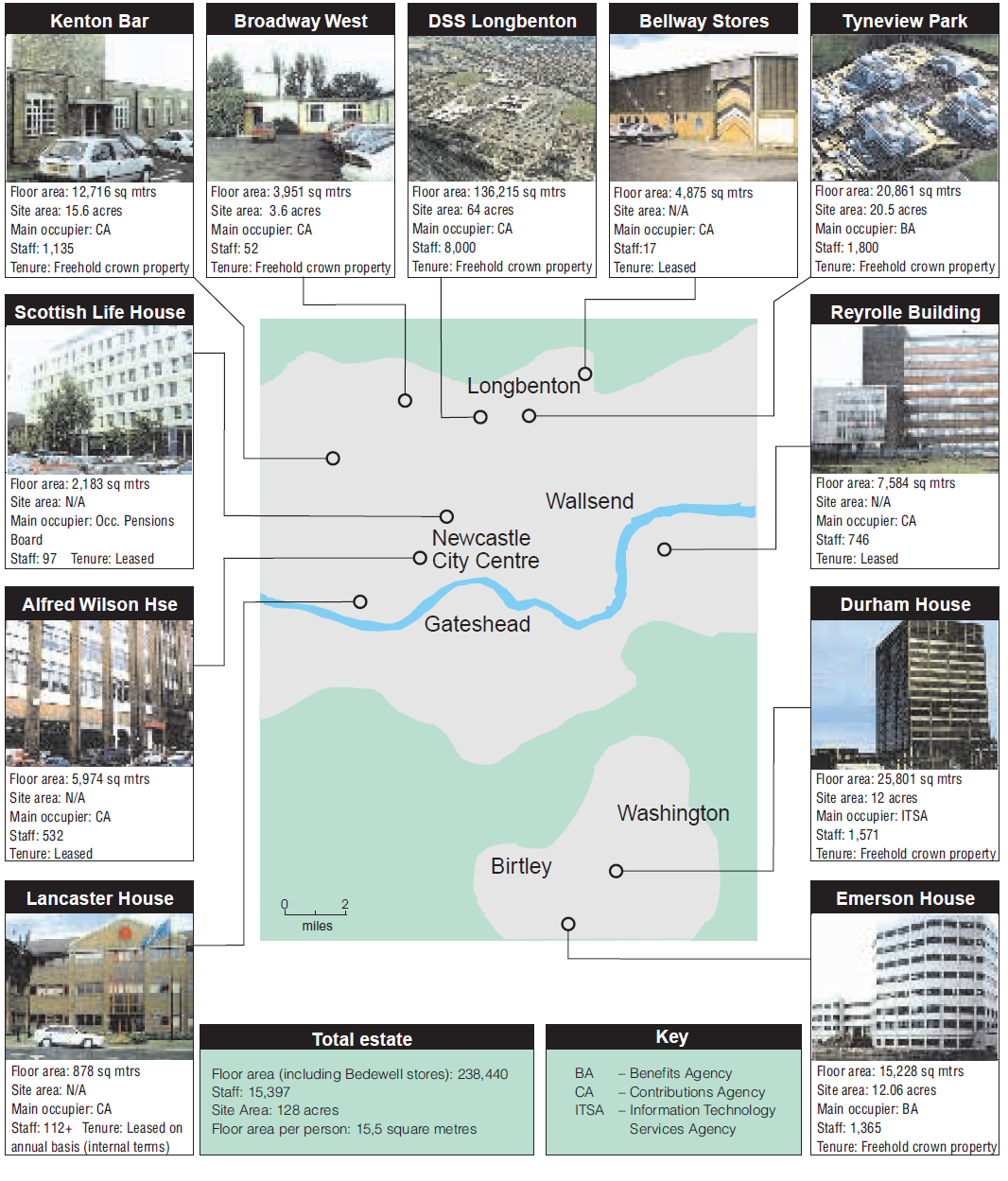
Figure 4 |
|
Newcastle estate, post development as at 1 April 2002 | |
Figures 3 and 4 show that the redevelopment project results in a much smaller, more intensively occupied estate.
| |
Source: National Audit Office | |
| Figure 5 |
| |
The achievement of the Department's operational objectives |
| ||
The Department's operational objectives are likely to be achieved. | |||
| Objective | Prospects for achievement | |
| Provide good quality accommodation in the Newcastle area, which will provide an adequate working environment for staff. | Most users should experience an improvement in their working environment. The achievement of this objective in terms of meeting the needs of users is described more fully in Appendix 2. | |
| Reduce escalating maintenance costs. | Through this redevelopment, the Department will avoid having to undertake an extensive refurbishment and replacement programme at Longbenton, Emerson House, Tyneview Park, Durham House and Bedewell Store. Refurbishment and replacement is now the responsibility of NEP. The Agency estimated that over the next 10 years alone the minimum cost of refurbishment and replacement would be £96 million. | |
| Provide accommodation which is adaptable both in terms of movement between business units and future reductions in staffing. | Unlike the existing blocks at Longbenton, the new accommodation will be predominantly open plan, and more easily subdivided using movable partitions. This could be important with the merger of the Contributions Agency and the Inland Revenue, and provides for further changes in staffing levels. | |
| Reduce the number of sites housing business units. | The number of sites is planned to reduce from 12 to 5, reducing in particular the dispersal of the Benefits Agency and the National Insurance Contributions Office, and enabling common facilities such as staff restaurants and messenger services to be centralised. | |
| Provide accommodation which is IT-friendly and capable of further IT expansion. | NEP will install and maintain IT cabling to the Department's specifications. This cabling will be capable of handling voice and data transmissions. | |
Source: National Audit Office | Harness private sector skills and innovation. | The chosen consortium, Newcastle Estate Partnership, comprises two companies: AMEC Developments Ltd, a subsidiary of an international construction and property development group, and Building and Property Group, a Facilities Management company. The Royal Bank of Scotland funds the consortium, AMEC Developments Ltd and Building and Property Group are equity providers and AMEC plc have provided subordinated loan facilities. | |