But the value and cost of this flexibility are unknown
1.23 The Department considered flexibility as essential in view of their overall business strategy at the time and the Contributions Agency also saw it as inherent to the Private Finance Initiative. The Contributions Agency therefore discussed with each of the three short-listed bidders how much flexibility they and their funders might be prepared to offer. The Agency subsequently instructed each short-listed bidder to build into their priced bids flexibility to surrender 20 per cent of space. They did not seek alternative bids offering no flexibility and therefore they did not know how much their requirement for this flexibility was adding to the cost of the project.
1.24 The Agency considered that they ensured value for money was achieved in obtaining flexibility through the project's competitive procurement process.
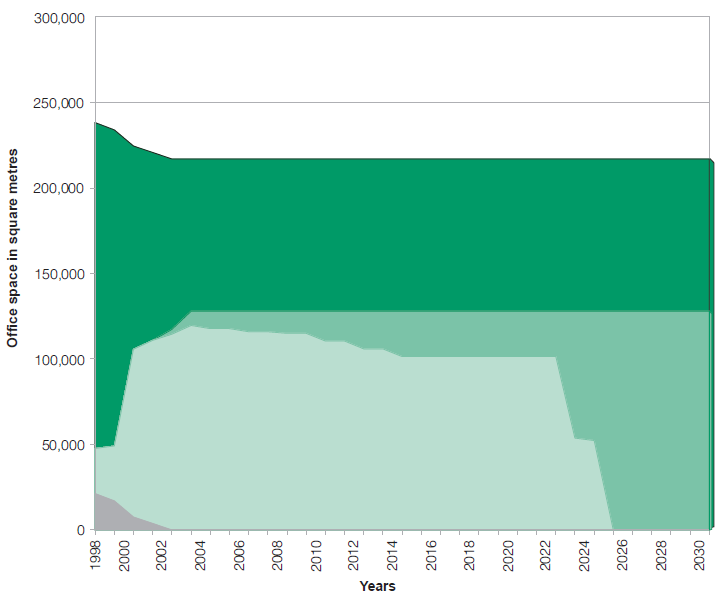
Figure 6 |
|
Comparison of office space under the Private Finance deal and on the existing estate |
The Private Finance deal enables the Department to be housed in a much smaller, tighter estate, but with potentially less ability to dispose of surplus space without charge than they had under the previous, largely freehold, estate. This is because freehold properties can be normally disposed of, while most of the space acquired through the Private Finance deal represents a twenty five year commitment to occupy. However, the Agency told us that, because of the dilapidated state of the site and potentially high demolition costs, it would not have been easy to dispose of the freehold land at Longbenton and some other sites.
| ||||||||
Note: This graph shows the theoretical maximum and minimum commitments to occupy space under the Private Finance deal. There are also a range of intermediate outcomes depending on how business units choose to exercise flexibility. | ||||||||
Source: The National Audit Office |


1.25 To inform their view of how likely the Department was to use the flexibility they had required bidders to offer, the Agency tried to collect staffing projections from all of the occupants of the Newcastle estate. But all found it difficult to forecast realistic requirements over a 25-year period and therefore only five-year forecasts were obtained. The Agency estimated in 1995 that their own staff numbers might fall by 2,000 between 1996 and 1999, noting that even this extent of forward projection was extremely difficult. Forecasting staff numbers beyond then would be more difficult still.
1.26 Feedback from other parts of the Department suggested to them that these other business units felt unable to provide realistic staff projections for the period 2000 to 2025. Therefore, they did not obtain forecasts of what their staffing might be after the completion of the estate redevelopment. They noted that their staffing had reduced by some 20 per cent since the early 1970s and thought that a similar figure would be the best available estimate for the 25 years following the estate redevelopment.
1.27 It is in the interests of the Department to make the most efficient use of space available and to take advantage of the flexibility they have purchased if changes in their business reduce the space they require. They therefore need to ensure that their business units relinquish surplus accommodation whenever possible. The Department already have in place a number of incentives to encourage business units to minimise their requirements for space. In the National Insurance Contributions Office, for example, these incentives include:
a) A business management regime which charges out to business units the cost of support services including floor space;
b) Internal negotiations to reduce the unit costs of their main business activities, such as updating customer records or providing information to customers. These pressures on costs should ensure that accommodation costs are scrutinised;
c) A programme to minimise space requirements through the best use of space and consideration of new working practices;
d) The role of the contract management team to ensure that users consider exercising available flexibility; and
e) A user policy group set up to discuss estate-wide policy issues.