They set up an appropriate project team
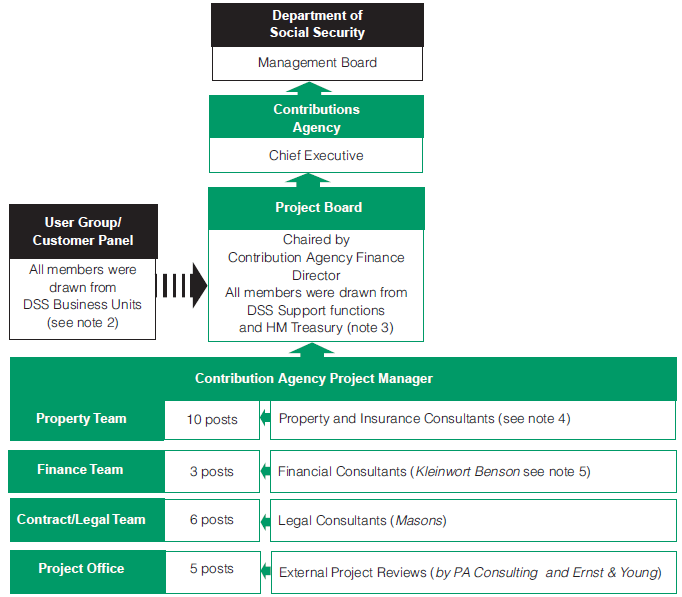
2.3 The Contributions Agency, as the largest occupier of the Longbenton site, had the responsibility for managing and delivering the estate redevelopment project. But all important decisions relating to the project were made by a project board which included representatives from other Agencies using the estate, the Corporate Director of the Department's Estates, the Treasury, and the Private Finance Panel Executive. Other users of the accommodation include the Benefits Agency, the Child Support Agency, and the Information Technology Services Agency, and branches of the Department. The Agency's organisation to manage the project is shown at Figure 7.
2.4 The project board was established in November 1994 to provide overall direction and management of the project. A senior official of the Contributions Agency chaired the project board, members of which had relevant expertise in the management of a Private Finance procurement. A representative of the Private Finance Panel Executive - the body regarded as the source of expert guidance on Private Finance issues - was a member of the project board throughout the procurement. A member of the board chaired a user group, which was established prior to commencement of the procurement. This was later replaced by a separate customer assurance panel, whose chair sat on the project board. These groups provided input to the project board and were advised by the board of the project's progress.
2.5 The project board reported progress to the Chief Executive of the Contributions Agency, who in turn reported to the Management Board of the Department of Social Security. Senior officials and ministers of the Department and the Treasury gave approval to key decisions at appropriate milestones in the life of the procurement, such as the issue of an invitation to potential bidders to express interest, and the signature of the contract.
Figure 7 |
|
Newcastle Estate Project Organisation Chart | |
The figure shows that the project was managed by the Contributions Agency, but with advice and input from representatives of other Department of Social Security Agencies affected by the redevelopment scheme, and HM Treasury. | |
| |
Notes: 1. The chart above reflects the organisation that was in place for most of the duration of the project. When the Project Team was first set up in November 1994 it consisted of only five members. In early 1995 the team was gradually increased up to 25 members. During the preparation of detailed bids, the team reorganised into three separate teams to liase with each of the three short-listed bidders. 2. The Panel acted in a policy and advisory role and where necessary agreed Departmental policy for the estate. 3. Members of the Project Board included: 3 - Contributions Agency (Office Services Director, Project Manager, Finance Director) 2 - Benefits Agency (Corporate Director of DSS Estates, Financial Services Branch) 1 - DSS Procurement 1 - DSS Planning and Finance Division 1 - HM Treasury 1 - Private Finance Panel Executive 1 - Child Support Agency (Finance Director). 4. Property and Insurance support was supplied by Baxter, Clark and Paul, Cundall Johnston & Partners, Graham Mather Associates, Mowlem, Gleeds, Turner & Townsend, Carl Pro Group and Willis Corroon. 5. A contract accountant was also provided by Hays Accountancy and Northern Recruitment Group (NRG). | |
2.6 We asked for comments from some representatives of the business units accommodated on the Newcastle estate on how the project management arrangements worked in practice. These are described at Appendix 2. Some recognised the hard work contributed by the project team, but most felt that communication between the project organisation and accommodation users could have been better. Those representatives we asked were not necessarily involved throughout the whole process but they were nominated by the Agency as the most relevant.
2.7 In November 1994 the project board considered the resourcing of the dedicated project team. They considered that in the absence of earlier similar projects to provide a benchmark any estimate might be only a best guess. But drawing on the Agency's experience in procuring NIRS2, the replacement National Insurance Recording System, through the Private Finance Initiative, they estimated a requirement for seven staff-years of Agency staff at a cost of £167,000, supported by up to £200,000 of consultancy support. By May 1995, when the complexity of the project was better recognised, it was clear that this provision would be inadequate. The project team was increased from 5 to 25 members and a new more senior project manager was appointed.
2.8 The project team staff were employees of the Contributions Agency or seconded to the Agency from other parts of the Department. The team members, including the project manager, had experience in property, finance and contracting and one of the project team members had previous experience of working on a Private Finance project (the National Insurance Recording system). The project team were supported by two lead advisers: Masons, who provided legal advice, and Dresdner Kleinwort Benson, who were the team's financial advisers. To obtain additional assurance, the Project Board commissioned advice at key stages of the process from PA Consulting, the Agency's own internal auditors, and Ernst and Young.
2.9 During the course of the project 14 external firms were appointed to provide the project team with assistance mainly on legal, financial, construction, property and insurance issues. The two external advisers dealing with legal and financial matters accounted for 93 per cent of total consultancy spend. The majority of the remaining seven per cent covered advice on construction issues from five separate firms. With the exception of one small contract for financial accountancy all the appointments were initially let following competitive tendering.
2.10 Six of the eight bidders who responded to our survey (Appendix 5) said that they found the management and decision making structure of the Agency and the Department either unclear or confusing. The other two bidders were not involved in the later stages of the procurement.