Appendix 6 Pricing of public transport services with high capital costs
1. Ordinarily, the social welfare maximising price for a transport service is where price equals marginal cost. At that level, transport services are provided up to the point at which the benefit of providing the last unit of service equals the cost of providing that unit of service.
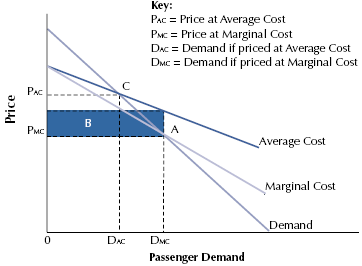
2. However, some public transport schemes - particularly rail schemes - have high initial capital costs and, because of this, marginal cost pricing would lead to the scheme making a financial loss. Figure 43 shows a simplified example where one price is charged for the transport service. The optimal level of service provision is where price equals marginal cost, PMC at point A. However, if the scheme were to be priced at this level, this would result in a financial loss equal to the shaded area B. The Average Cost, which includes the initial fixed costs, is greater than the Marginal Cost of providing the last unit of service, so a financial loss results. The scheme would break even if Average Cost pricing PAC were adopted, point C. But this would mean that DMC - DAC potential rail travellers would be priced off, despite the fact they are willing to pay the additional costs they impose, so this is a less efficient level of service provision. This is the type of situation where the Government may take the welfare decision to pay a grant for the initial fixed costs to allow the operator to price efficiently, or to subsidise the operation of the service in order to prevent the operator making a loss.
43 |
| Pricing a public transport project with declining costs |
|
| Pricing at Marginal Cost, point A leads to financial loss, area B. |
|
|
|
|
| Source: National Audit Office |