The process for commissioning new work
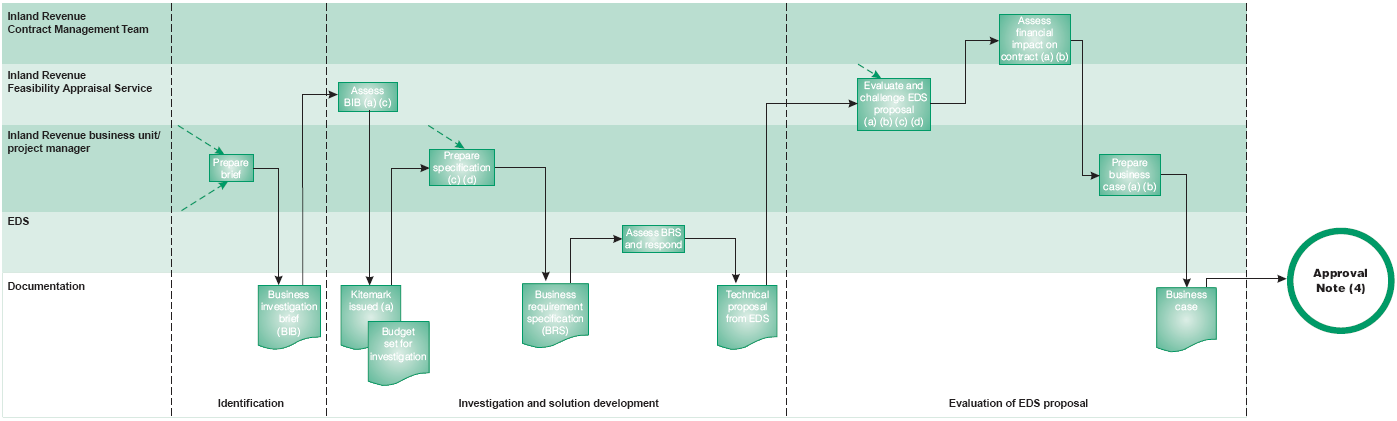
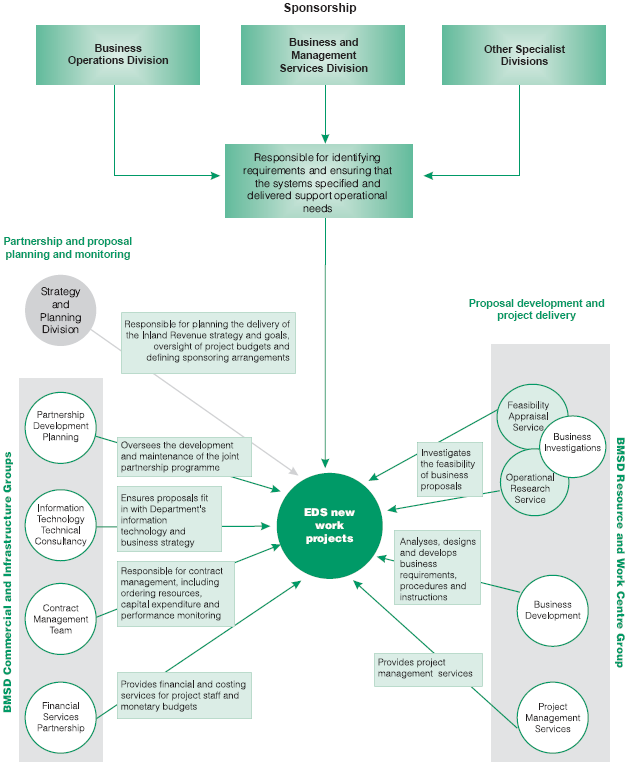
2.5 The Department follows clearly defined procedures in commissioning new work from EDS and a number of individual units within the Department are involved in the process (see Appendix 1). Figure 3 shows the main steps between the identification of a new requirement and approval of the EDS information technology solution and Figure 4 shows the involvement of various Departmental units, the majority of which are located within its Business and Management Services Division.
2.6 There are five main stages in the overall process:
■ identification of the requirement;
■ investigation of the requirement, definition of the information technology element, and development of solutions;
■ evaluation of proposed solutions received from EDS and approval of the project concept and of the funds to proceed;
■ project management of the overall development - with the Department responsible for the coordination of the development and delivery of the whole project and EDS responsible for the management and development of the information technology solution; and
■ project evaluation and handover to live running.
We examined each of the stages of the commissioning process and considered the main risks to value for money. These are set out in Figure 5 on page 17.
|
|
|
|
|
Figure 3 |
The basic process for commissioning new information technology work from EDS |
|
|
Unit with prime responsibility
|
||
|
Notes: |
1. Other Inland Revenue Divisions and parts of Business & Management Services Division have an input into the basic process, as indicated. (a) Strategy and Planning Division (b) Finance Division (c) Information Technology Technical Consultancy (d) Operational Research Service 2. Broken arrows show where the unit of prime responsibility is assisted by other units. 3. Assessment of BIBs, BRSs and EDS proposals may include referral back to the originator for amendment. 4. Approval is carried out at different levels depending on the lifetime value of the project (Figure 9). 5. Following approval, EDS is responsible for developing the information technology system within the total project framework, which is controlled by the Department. On completion, the Department tests and, when acceptable, puts the system into live running. |
|
|
Source: Lorien analysis |
||
|
|
|
|
Figure 4 |
The role of the various Departmental teams involved in commissioning work from EDS |
|
|
|
|
|
|
|
Figure 5 |
Potential risks in commissioning new work from EDS |
|
Stage 1: Identification of the requirement ■ EDS may unduly influence the identification and specification of new requirements and/or the solution Stage 2: Development of solutions ■ Solution may not be in line with the Department's information technology strategy ■ Solution may fail to meet business needs because the requirement was not defined accurately ■ Insufficient time may be allowed for the definition and/or development of the requirement and/or the solution ■ Excessive scope growth of projects, particularly those which use rapid application development (Figure 8) Stage 3: Evaluation and approval of EDS proposals ■ The Department may not evaluate with independence and objectivity ■ The Department may not choose the most critical projects for technical and/or financial assessment of EDS proposals ■ Ineffective evaluation may result in the Department becoming "locked in" to EDS as a provider ■ Approval authorities may have insufficient assurance on the reliability of business cases ■ A shortage of trained and experienced project managers and requirement managers may adversely affect the efficient management of projects ■ Project managers may have insufficient understanding of the contract pricing mechanism ■ Lack of rigour in following post-implementation procedures may prevent adequate assessment of development and live system performance |
|