Project approval
2.45 Every project has to be approved formally before the project manager can order the required EDS resources. The greater the value of a project, the greater the involvement of senior management in the approval process (see Figure 9).
2.46 The Department prepares business cases for submission to the relevant approval authority summarising the key issues for each project. If approval authorities are to make informed decisions, they need assurance that business requirements will have been assessed fully and that optimal technical and economical solutions have been recommended. These factors depend on:
■ the quality of the earlier appraisal and approval processes;
■ the rigour with which the processes have been followed;
■ the skills and expertise of staff involved in the processes.
2.47 The Department has clear procedures for commissioning new work and these are subject to continual refinement. However, Departmental staff involved in commissioning new work acknowledge that the rigour with which the procedures are followed may at times be affected by:
■ insufficient levels of resource or expertise in the Department's assessment units;
■ constraints on development times;
■ the absence of criteria to define when consultation with particular experts is required during the evaluation process.
There is a risk, therefore, that the quality of analysis and assessment supporting business cases may vary both between projects and over time.
Inland Revenue approval authorities for new work |
|
| |
Figure 9 |
| ||
|
| ||
|
| ||
| Notes: | 1. Figure 9 shows the position at 30 September 1999. 2. Project approval boundaries are determined by the total estimated cost of the project. 3. Treasury approval is also required for projects over £100 million. 4. Comprises senior Departmental managers and the EDS Account Director (EDS withdraw during discussions where there would be a conflict of interest). 5. Comprises the Director and other members of the Strategy and Planning Division. 6. Further approvals are required for substantial changes in technical or financial aspects of the project. | |
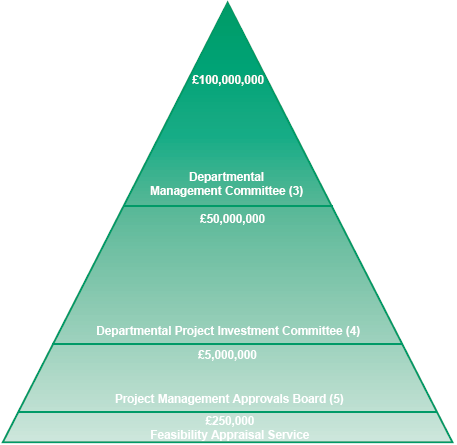
2.48 Management of this risk is particularly important in the case of the Feasibility Appraisal Service which, in addition to evaluating proposals, acts as the approval authority for smaller projects with a lifecycle value up to £250,000. The Department acknowledges this risk but told us that it considered that the financial implications were limited, since projects of this value accounted for less than 5 per cent of total expenditure on new work. It also believed that, in practice, smaller projects were given an appropriate level of review under its evaluation procedures.